
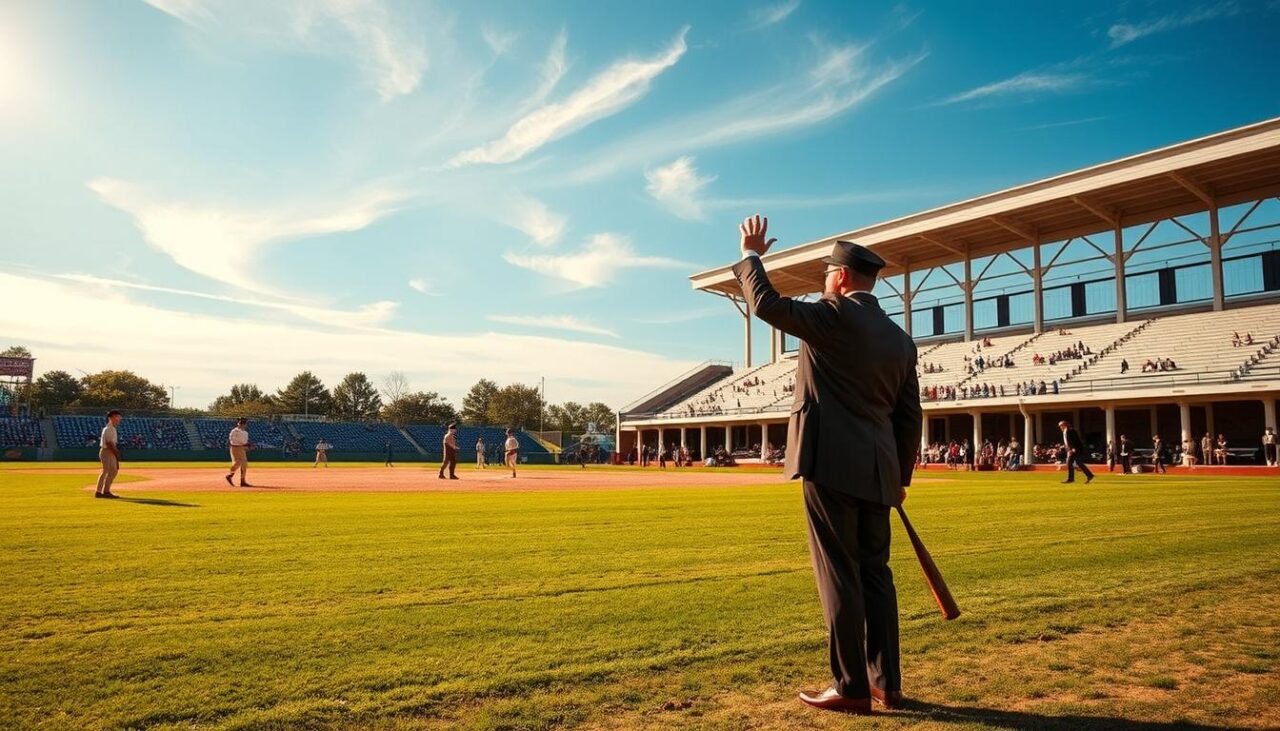
Imagine aristocrats in top hats hitting broomsticks with leather balls. Shopkeepers were arguing if catching a fly in your hat was an out. This was the start of America’s love for baseball, not just a myth.
The Knickerbocker Rules of 1845 helped shape the game. They stopped players from throwing rocks at runners. These rules came from men playing in cow pastures and taverns, arguing over rules with whiskey.
Forget the myth of Doubleday inventing baseball in 1839. The real story is about cricket rebels and early sponsors, like beer companies.
By 1857, games went on until it got dark or the sheep needed to graze. Teams wore heavy wool uniforms and used thin gloves. Yet, they argued over rules we debate today, like fair territory and three-out innings.
Umpires even carried whiskey flasks back then. What started as a gentlemen’s recreation drew 10,000 fans. The Civil War would spread these rules far and wide. But first, let’s see how town ball became America’s first professional sport.
Pre-MLB Bat-and-Ball Games
Imagine a time when baseball had more rules than a Congressional bill – welcome to 18th-century America. Our national pastime started as a mix of English rounders and colonial games. Back then, the strike zone changed as fast as tax laws.
The 1744 smoking clue: A London nursery rhyme mentioned “base-ball” – 70 years before Abner Doubleday’s mythical birth. By 1786, Princeton students were playing instead of attending chapel. They even wrote about “base ball madness” ruining their Latin exams.
Puritanical New England then made America’s first sports rule. In 1791, a Pittsfield, Massachusetts law banned the game near meetinghouse windows. Colonial America feared broken glass more than steroids.
Before the Civil War, three main types of ball games were played:
- Town Ball: 10-14 players, no foul territory, and runners could throw balls at opponents to get outs
- The Massachusetts Game: So tough, it made rugby seem easy, with 100-foot bases and “soaking” runners
- Philadelphia’s Version: Played in cemeteries, using tombstone markers as bases
The Civil War turned into baseball’s accidental marketing campaign. Union soldiers from New York introduced their “New York Game” rules to Southern prisoners. Confederate troops had their own Virginia versions. By 1865, soldiers returning home asked for standardized rules, marking the start of 19th century baseball as we know it.
This messy evolution shows why early 19th century baseball was like making legislative sausage. Regional pride and practicality clashed, making the sport a mix of poetry and backroom deals. The real MVP? Those colonial rebels who turned a children’s game into America’s first cultural export.
19th Century Foundations and Early Leagues
If baseball had a birth certificate, 1857 would be its official issue date. That year, 16 clubs met in New York’s Gothic Hall to standardize the game. The National Association of Base Ball Players (NABBP) convention made baseball a money-making sport quickly.
In the 1860s, clubs turned into money-making ventures. Players started asking for money, not just handshakes and lemonade. By 1869, the Cincinnati Red Stockings became the first rock stars of baseball, touring the country and winning 57 games without losing.
| Pre-1857 Rules | Post-NABBP Standardization | Impact |
|---|---|---|
| Variable innings (first to 21 runs) | Fixed 9-inning games | Created predictable game length |
| No set player positions | 9 defensive positions defined | Specialization begins |
| Rubber-core balls (dead bounce) | Lively cork-center balls | Increased scoring |
| Localized field dimensions | 90-foot base paths mandated | National consistency achieved |
Cap Anson’s .428 batting average was impressive, but he was more known for his negotiation skills. He pioneered modern player leverage, demanding better pay or retirement. His tactics were ahead of their time, similar to today’s MLB free agency.
Three major changes came from this era:
- Professionalization: Players became commodities (average 1869 salary: $1,000 ≈ $22k today)
- Media coverage: Box scores turned athletes into household names
- Rail expansion: Teams could now barnstorm nationally
By 1876, the National League was formed. It wasn’t for love of the game but for profit. This marked the beginning of America’s love for baseball, with high ticket prices and debates over umpire calls.
The Dead Ball Era, Integration, and Negro Leagues
Imagine a baseball field where triples were more common than home runs. Fielders used gloves that looked like oven mitts. This was the Dead Ball Era (1900-1919), a time when baseball was more like a chess game.
White players focused on “scientific baseball,” using bunts and runs. But, a world of talent was growing in secret, hidden by segregation.
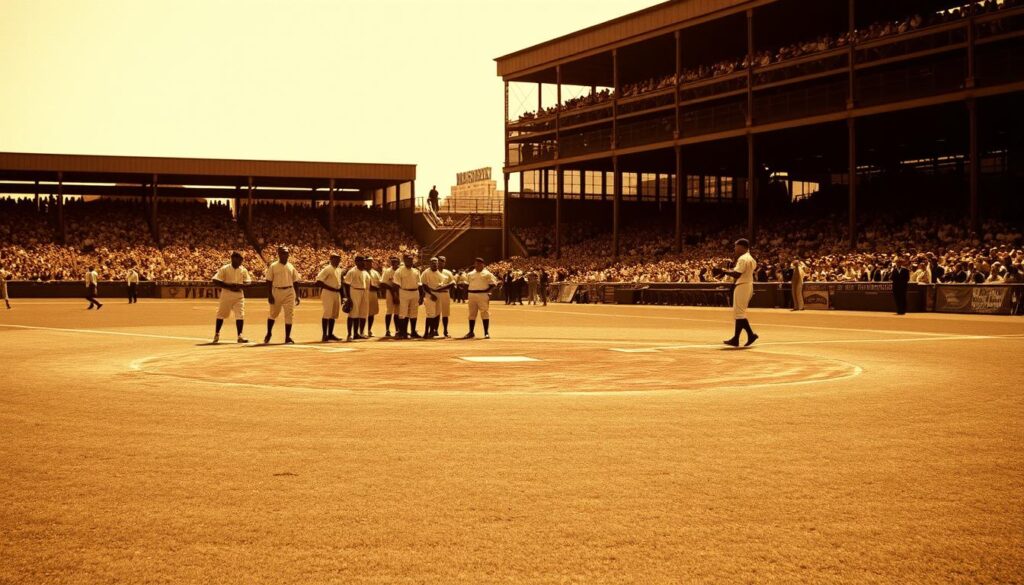
Swingin’ Singles and Segregation
The Walker brothers, Fleetwood and Weldy, were MLB’s first Black players in 1884. But, baseball soon became as segregated as America. By 1900, white teams played “small ball,” while Black teams innovated.
Negro Leagues games were cultural events. They featured:
- Satchel Paige’s hesitation pitch that froze batters
- Josh Gibson’s home runs, called “Black Babe Ruth”
- Doubleheaders that drew 40,000+ fans
The Double Play of Racism and Resilience
Jackie Robinson’s 1947 debut wasn’t baseball’s first attempt at integration. Moses Fleetwood Walker tried 63 years before. But Robinson’s success showed MLB’s hypocrisy.
How could a “national pastime” exclude 13% of the population? The Negro Leagues’ final box scores tell the truth:
- 700+ players never got MLB chances despite better stats
- 30+ Hall of Famers were ignored
- 1948 Cleveland Indians won the World Series with Negro Leagues baseball legends Larry Doby and Satchel Paige
Robinson’s .297 average proved integration worked. But his 197 stolen bases showed its limits. He wasn’t allowed to play the Negro Leagues’ daring style. The real victory was forcing America to see itself in the diamond.
Westward Expansion and Era of Change
Baseball’s move west in the mid-20th century was more than just a change of scenery. It was a big shift in how Americans saw their favorite sport. When Walter O’Malley moved the Dodgers from Brooklyn to Los Angeles in 1958, he changed the game. He showed how sports teams could use new technology and TV to become big cultural forces.
The Giants also moved to San Francisco, making California a key place for baseball. This move was like a new chapter in American history, with team owners as modern-day pioneers. They were exploring new lands, just like the old pioneers did.
- Houston’s Astrodome (1965) introduced air-conditioned baseball – and the horror of orange baseballs lost in white dome ceilings
- Montreal’s Olympic Stadium (1976) proved retractable roofs could break both weather and construction budgets
- Kansas City’s artificial turf (1973) turned outfielders into human cheese graters sliding across plastic grass
Television deals became the new way for teams to make money. Networks paid big to show games across the country. This made teams into national brands quickly. But it also changed the game, making it more about TV than the fans.
This move west caused baseball’s first coast-to-coast identity crisis. Could the sport keep its old charm while reaching for new markets? The answer was a mix of old and new, with Astroturf and bright scoreboards.
The Modern Game: Labor, Free Agency, and Rule Changes
Baseball’s modern era is more than just stolen bases. It’s about stealing leverage. Players now use the diamond as a boardroom, swapping batting gloves for bargaining chips. This has turned baseball into a high-stakes fantasy sport.
When Fastballs Met Picket Signs
Curt Flood’s 1969 lawsuit shook MLB’s business model. His refusal to be traded sparked free agency. But the real drama came in 1994 with the mlb labor strikes. These strikes canceled the World Series, showing even October magic can’t beat billionaire owners and millionaire players fighting over money.
The aftermath brought new rules:
- Salary caps that failed miserably
- Revenue sharing deals that were too good to be true
- TV contracts that turned regional sports networks into cash cows
DHs, Dollars, and Data-Driven Lineups
The designated hitter rule arrived in 1973, sparking outrage. But soon, $9M DHs became valuable assets, aging sluggers who could rake in money while nursing injuries. The 2022 rule changes aimed to speed up the game, fitting it between commercial breaks.
| Year | Game Changer | Financial Impact | Cultural Shift |
|---|---|---|---|
| 1976 | Free Agency Begins | Average salary: $52,300 → $4.4M (2023) | Players become brands |
| 1994 | Season Cancellation | $580M revenue loss | Fans as bargaining chips |
| 2022 | Pitch Clock Debut | 23% faster games = more ad slots | TikTok attention spans win |
Today’s baseball free agency is a $3.8B carnival. Scott Boras plays Santa, while small-market GMs bring coal. The real winner? Your fantasy team’s WAR calculations.
The Analytics Revolution
Baseball’s world changed when Billy Beane’s Oakland A’s showed math could beat money. Gone were the days of “swing hard in case you hit it”. In 2002, the A’s used on-base percentages like a powerful weapon. Ivy League graduates with Python skills became more important than old-school scouts with radar guns.

The Statcast era made baseball games feel like Marvel movies. Exit velocities, spin rates, and catch probabilities flashed on screens like superhero stats. Now, teams draft players based on algorithms that look at launch angles, not just handshakes. But how do we explain a Dominican teenager getting signed with TikTok highlights?
| Old Metric | New Metric | Impact |
|---|---|---|
| Batting Average | Expected Weighted On-Base (xwOBA) | Predicts future performance using exit velocity + launch angle |
| Stolen Bases | Pitch Sequencing Analytics | Robots now call 70% of pitch selections |
| “Clutch Hitter” | Win Probability Added (WPA) | Quantifies drama in decimal points |
MLB’s streaming deals now include real-time data overlays. This makes watching games feel like a special event. Apps track international talent’s biometrics, from Seoul to San Pedro de Macorís.
But analytics can’t capture the magic of a broken-bat blooper or a rain-delay rally. Kirk Gibson’s 1988 home run was unforgettable, even without algorithms. The lesson? Data wins games, but stories sell tickets.
Baseball’s Cultural Role in American Life
Field of Dreams wasn’t just a movie—it was a peek into America’s soul. The sport shows up in books and documentaries, like Doris Kearns Goodwin’s stories and Ken Burns’ PBS series. Baseball is like a mirror, reflecting our politics more than our sports skills.
- 1947: Jackie Robinson integrates MLB seven years before Brown v. Board
- 1998: McGwire/Sosa chase Maris while dot-com bubbles inflate
- 2020: Empty stadiums host pandemic baseball as TikTok virality spikes
The Trump first pitch at the 2019 World Series was like a political show. Fox cameras captured the moment, making it a symbol of all things flashy but shaky. It was a mix of showmanship and questionable moves.
| Era | Cultural Shift | Baseball Mirror | Media Impact |
|---|---|---|---|
| Civil Rights | Desegregation | Robinson’s 1947 debut | Black press coverage surge |
| Reaganomics | Wall Street excess | PED scandals | 24-hour sports radio boom |
| Digital Age | Streaming wars | $12B MLB.tv deals | TikTok highlight culture |
Today’s broadcasts tell a story of their own. Apple TV+ pays $85 million for Friday night games, showing the cost of subscription fatigue. The same tech that changes baseball strategies also decides what replays go viral.
But books keep their magic alive. W.P. Kinsella’s Shoeless Joe sells 100,000 copies a year. The Yankees’ 2001 World Series team had Don DeLillo’s Underworld in their dugout. This novel opened the atomic age with a baseball. What other sport inspires both PhD theses and beer showers in the stands?
As streaming breaks our focus, baseball’s slow pace stands out. It’s not just about surviving, but what new worries it will show us in extra innings.
Literary Classics for the MLB Enthuasiast
Forget box scores – the true magic of baseball lives in the ink-stained pages. Poets in cleats swing for rhetorical fences. Great baseball writing reveals why it matters, turning league milestones into cultural touchstones. Let’s build a bookshelf that swings from oral histories to locker room confessions, with a designated driver for the mythology.
Essential Reading for Timeline Nerds: Lawrence Ritter’s The Glory of Their Times is the gold standard. It lets deadball-era players whisper secrets through time like Babe Ruth tipping fastballs. For modern grit, Jim Bouton’s Ball Four throws brushback pitches at baseball’s sanitized image – a diary so scandalous, it got him blackballed faster than a spitballer in a dry season.
Novelists swing big too. Bernard Malamud’s The Natural turns a slugger’s career into an Arthurian tragedy (spoiler: Excalibur makes a terrible bat). Don DeLillo’s Underworld uses a Bobby Thomson home run ball as the MacGuffin that ties Cold War America together – because nothing says “nuclear anxiety” like a foul ball lost in the bleachers.
| Title | Author | Literary Angle | Historical Period |
|---|---|---|---|
| The Boys of Summer | Roger Kahn | Brooklyn Dodgers nostalgia | Integration Era |
| Shoeless Joe | W.P. Kinsella | Magical realism | Deadball Era mythmaking |
| Moneyball | Michael Lewis | Analytics revolution | Modern MLB economics |
Roger Angell’s essays deserve their own Cooperstown wing. They blend October tension with Woody Allen-esque neurosis. His description of a perfect game? “Nine innings of collective prayer with hot dog breath.” That’s the sweet spot where box scores become psalms.
Pro tip: Skip the baseball metaphors in corporate leadership books. When Malamud wrote “We have two lives – the one we learn with, and the one we live after that,” he wasn’t talking about your LinkedIn profile. These classics remind us that baseball’s real magic happens between the lines – both on the field and on the page.
MLB’s Enduring Popularity and Globalization
Baseball’s secret? Making the world believe it’s America’s favorite sport while growing a global empire. It’s not just about selling caps and jerseys. It’s about creating a whole system where globalization and technology turn local players into global stars.
- 45% of 2023 Opening Day rosters featured international players
- Japan’s $500M annual MLB broadcast rights (up 300% from 2015)
- Shohei Ohtani’s Instagram following (6.7M) is bigger than 12 MLB teams
Ohtani is more than just a two-way player. He’s baseball’s first multinational corporation. His impact is bigger than some Caribbean nations with MLB academies. His splitter is legendary, and his endorsements are breaking records.
The World Baseball Classic is where the magic happens. Here, you see:
- Dominican pitchers facing off against Venezuelan sluggers
- Japanese infielders making double plays with Taiwanese shortstops
- Team USA learning from Puerto Rico’s small-ball tactics
MLB’s growth strategy is like a tech startup’s. They’re not just looking for players. They’re collecting data from all over the world. The latest international signings include a 16-year-old Venezuelan catcher and a Japanese lefty with a viral curveball.
But what really shows globalization? When Little Leagues in Munich talk about infield fly rules and kids in Santo Domingo work on their swing. Baseball is becoming a universal language, with exit velocity and WAR being the common language. The next baseball legend might be practicing in Seoul right now, and MLB’s scouts are ready.
Conclusion
Baseball’s growth is like America’s own story – full of ups and downs. The history of MLB is a tale of highs and lows. Babe Ruth’s record-breaking season and the use of advanced stats today show the game’s evolution.
Big moments in baseball history often came from tough times. The Black Sox scandal led to the commissioner’s office. Jackie Robinson’s first game in 1947 was a turning point against racism. Free agency changed the game, making players into stars.
Today’s MLB is unrecognizable from the past. It has 30 teams, from Toronto to Tampa, with huge values. The Yankees have 27 championships, but the Dodgers’ 2024 win shows money can buy success.
Despite all the changes, baseball remains true to its roots. Managers and players argue, and fans debate the DH. The game’s human touch keeps it alive.
Climate change might change baseball’s future, but it won’t change its spirit. The game has survived many challenges and will likely endure long after we’re gone. Play ball, for sure.