
Imagine a hand-stitched leather ball flying toward a soldier’s bat. The crack of the bat is heard across a Civil War camp. It brings cheers from Union troops, who’d prefer to talk about baseball than war.
Alexander Cartwright introduced the Knickerbocker Rules in 1845. He didn’t just set up the field. He gave us a linguistic framework that changed how we talk. Phrases like “out of left field” and “touching base” became part of our everyday language.
The game spread fast in the 1860s. Soldiers used baseball terms to show unity, even in tough times. It’s amazing how “home plate” could mean both a battlefield spot and the heart of a community.
Baseball became America’s way to understand life. It taught us to keep score, aim high, and sometimes, sneak a peek at second base when no one’s looking.
Why Baseball Resonates
What makes baseball so special in America? It’s not just about peanuts and pennant races. The game is fueled by statistical milestones in baseball that tell stories of our culture. A .406 batting average is more than numbers; it’s a legend written in newspapers.
The Calculus of Nostalgia
History is hidden in numbers. Take the 1918 World Series. It was a time when the Star-Spangled Banner became a pregame tradition during a pandemic. That game wasn’t just about Babe Ruth’s stats; it was a moment of national unity.
Fast-forward to April 15, 1947:
- Jackie Robinson’s debut box score: 0 hits, 1 run
- Stolen base column: Empty
- Cultural impact: Immeasurable
Robinson’s .297 season average was more than a number; it was a social statement. Every stolen base was a form of protest. Even WWII changed how we read the game. Scoring symbols were simplified due to paper shortages, making “K” a symbol of progress.
Box Scores as Cultural Rosetta Stones
Consider the wartime scoring shift:
| Era | Symbol | Meaning |
|---|---|---|
| Pre-WWII | CS | Catcher’s interference |
| 1942-1945 | X | Any defensive miscue |
| Postwar | E# | Position-specific errors |
These symbols tell us more than just the game. They show economic struggles (wartime scarcity) and social changes (postwar specialization). Today, reading baseball box scores is like digging through history. A 1975 World Series scorecard shows stains from manual scorekeeping next to Ford Frick’s asterisk.
Now, Statcast metrics add to America’s love for quantifying achievements. Exit velocity and existential velocity meet in this new chapter. We measure not just home runs, but the distance our legends can travel.
Societal Evolution Through Baseball
Baseball uniforms are more than just clothes. They hold stories of union fights, wartime shortages, and our love for looking good while we sweat. From old woolens to modern synthetics, they show us more than just our sports skills.
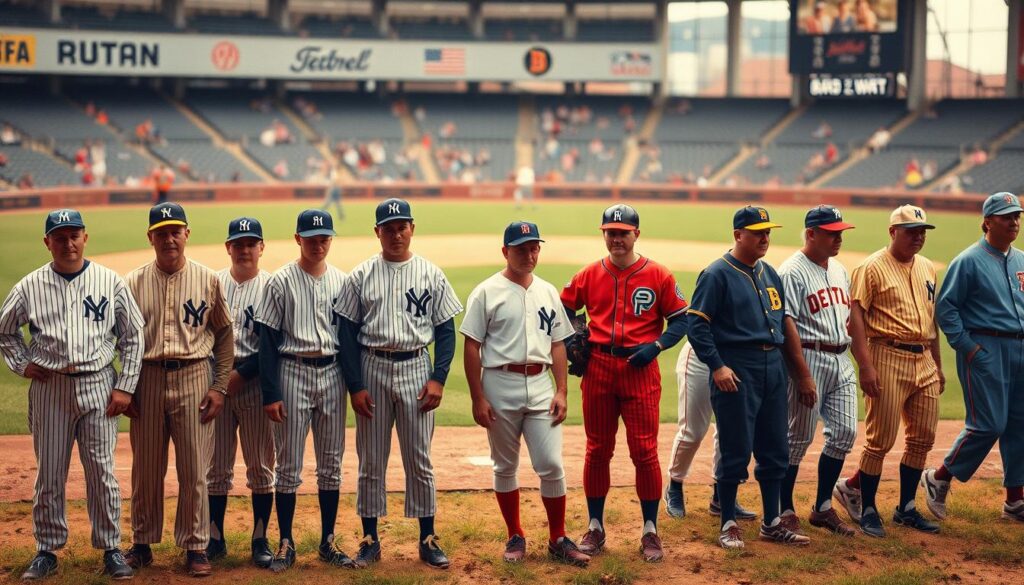
Stitches in Time: Uniforms Tell All
Look at Cy Young’s 1903 uniform and Tatís Jr’s 2023 Nike Vapor Ultralight. One was smelly and worn, the other is high-tech and cool. This change isn’t just about style; it’s about big changes in society.
During WWII, uniforms changed too. With rayon short, teams cut off sleeves. This made players cooler and helped them perform better. It was like the “make-do” spirit of the war time, showing up in everyday life.
| Era | Material | Social Catalyst |
|---|---|---|
| Deadball (1900s) | Wool flannel | Textile union strikes |
| WWII | Cotton blends | Rationing policies |
| Space Age | Polyester | NASA tech spillover |
Today’s uniforms have secret tech. Thanks to science, they keep you dry and cool. Even the colors and designs have a story, like the 1970s rainbow socks that were more than just a fashion statement.
When you see a player adjust their jersey, think about the history behind it. It connects to workers in Pittsburgh and politicians in Washington. Baseball’s uniforms tell a story of labor, science, and style, making it our most interesting history lesson.
Demographic and Generational Change
Baseball’s minor leagues are like a mirror for America. They show where talent meets reality. To see how the sport changes with demographics and new expectations, watch the journey from rookie to pro.
Farm System Allegory: Minors as Melting Pot
Cade Horton, a Cubs prospect, went from surgery to Triple-A stardom. His stats are impressive, but his real story is about more than numbers. It’s about overcoming challenges and growing fast.
Books on player development focus on numbers, but Dusty Baker’s “Kiss the Sky” shows the human side. His stories of the 1970s contrast with today’s high-tech training. Which way is better for the game? The 2023 Diamondbacks’ success with international players offers a clue.
The debate in minors and player advancement is fierce. It’s about data vs. instinct, culture vs. assimilation, and facing first-time slumps.
For a deep understanding of this shift, read these player development books:
- “The Tropic of Baseball” (Dominican Winter League’s hidden curriculum)
- “Swing Kings” (the launch angle revolution’s dark side)
- “The Only Rule Is It Has to Work” (analytics vs. clubhouse chemistry)
Horton’s success shows today’s systems can fix elbows. But can they create the next legendary player? The game’s future is uncertain, with both success and setbacks.
Political and Economic Forces
Baseball’s front offices now look like Wall Street trading floors. The game’s economy runs on algorithms, not sunflower seeds. This creates a paradox: teams win more but lose fan interest.
Moneyball’s Unintended Curveballs
Billy Beane’s 2002 Oakland A’s changed how teams build their rosters. They used Henry Chadwick’s 19th-century innovations. This started as “baseball arithmetic” in 1859 and evolved into WAR calculus for today’s $200M payrolls.
Now, front offices use acronyms like:
- OPS+ (adjusted on-base plus slugging)
- xFIP (expected fielding-independent pitching)
- BABIP (batting average on balls in play)
The 2024 game has 38% more strikeouts and 22% fewer stolen bases than 1985. Here are the numbers:
| Metric | 1985 | 2024 |
|---|---|---|
| Avg Game Time | 2:38 | 3:07 |
| TV Revenue/Team | $14M | $110M |
| Pitches/Game | 267 | 301 |
Analytics led to the Three True Outcomes Era – walk, strikeout, or home run. Networks spend billions on ads during pitching changes. Fans get bored with .220 hitters focusing on launch angles.
Stadiums now have $5M robot cameras to track spin rates. We wonder: When did Moneyball turn into Moneyboredom?
The sabermetrics revolution made teams smarter investors. But it went too far. Now, the most exciting play is often the absence of action.
Famous Writings & Memoirs
Baseball’s greatest stories aren’t found in box scores. They’re in dog-eared paperbacks and spreadsheets. Let’s look at how writers and analysts turned baseball into literature books and baseball analytics books.
Ballparks as Paper: Literature’s Field of Dreams
Thomas W. Higginson’s 1858 essay didn’t just describe baseball. It invented America’s sports writing voice. His words, full of magic, are seen in today’s memoirs. Here’s a list of must-reads:
- Cultural Time Capsules: Doris Kearns Goodwin’s Wait Till Next Year captures 1950s Brooklyn. It turns childhood memories into deep insights into postwar anxiety.
- Statistical Revolution: Ben Lindbergh’s The Only Rule Is It Has to Work mixes Moneyball with Fear and Loathing in Las Vegas. It’s a wild ride of stats and math.
- Underrated Gem: Steve Dunn’s Pug Fireball & Co. brings forgotten ballparks to life. It shows the drama of America’s industrialization through baseball.
| Overrated Classic | Underappreciated Masterpiece | Why Swap? |
|---|---|---|
| The Natural (novel) | Bang the Drum Slowly | Less Arthurian myth, more locker-room grit |
| Mendoza Line memoirs | Rob Manfred’s policy PDFs | Real front-office scheming beats .200 hitters |
Today, literature books about baseball face a challenge. Can they keep up with Statcast and TikTok? The best works, like Lindbergh’s, treat stats like Shakespeare. It’s a mix of Melville and Moneyball, and we love it.
Baseball in Pop Music, Art & Film
Baseball’s rhythm flows through America’s culture, from music to movies. It’s not just about scores; it’s in Springsteen’s songs, Rockwell’s paintings, and Moneyball on screens. This sport is a key to understanding America, loved by artists.
From Sinatra to Statcast: Diamond as Muse
John Fogerty’s “Centerfield” is a timeless song of hope. It’s about second chances, lasting long after trends change. Springsteen’s “Glory Days” also captures the essence of baseball, showing dreams and reality.
Norman Rockwell’s Game Called Because of Rain is more than a rainy day scene. It shows the impact of politics on joy. Today, creators like Ken Burns use baseball to tell epic stories.
| Artist | Work | Surface Theme | Subtext |
|---|---|---|---|
| John Fogerty | “Centerfield” (1985) | Baseball nostalgia | Reagan-era optimism |
| Norman Rockwell | Game Called Because of Rain | Innocent sports scene | Cold War anxieties |
| Aaron Sorkin | Moneyball screenplay | Statistics revolution | Death of romanticism |
Hollywood’s baseball stories show different times. Field of Dreams (1989) spoke to Boomers’ dreams. Moneyball (2011) showed a new era, where truth is questioned.
Statcast’s data inspires digital artists today. It turns home runs into digital art, like Rice’s writing. Baseball is a mirror for society, showing our hopes and fears.
Conclusion
Baseball’s dirt-stained bases mark our social history like time markers. Rob Manfred’s algorithmic strike zones now scan pitches with robot precision. Yet, the 1903 World Series handshake’s spirit remains—a time when agreements mattered more than rules.
Progress? It depends on where you sit in the stands.
Extra Innings: The Unwritten Rules Ahead
Last summer, I caught a foul ball at Wrigley while explaining OPS+ to my niece. That ball became our connection to the game’s past. Baseball in America grows when we share its language, but we must face hard truths.
Women face dugout glass ceilings, like Kim Ng’s short stint as Miami Marlins GM. Minor leaguers sleep on air mattresses while huge contracts distort team finances.
The game’s future needs more than just memories. Imagine bat flips celebrated like Jeter’s jump throws. Picture Venezuelan prospects earning as much as their American peers. Envision front offices where Alyssa Nakken is called “Manager,” not “Coach.”
Baseball’s beauty is in its endless ability to change—if we dare to rewrite its unwritten rules.
Teach someone to read a box score this weekend. Those small numbers tell big stories: sacrifice bunts and stolen dreams, ERA and generational lessons. It’s a key part of American literacy.