
What does it mean to be a celebrant? This isn’t a question for a church, but for the green cathedral of the ballpark. In fiction, a great baseball novel doesn’t just recount a game. It explores the sacred. It finds religion in the ritual—like the seventh-inning stretch and the geometry of the diamond.
This spiritual metaphor is a central theme in literature that treats the sport as a vessel for faith. A celebrant in this secular faith is not a player, but a believer. They venerate the game with reverence, like others might for the divine. The ballpark becomes a house of worship, and the heroes of the game become its secular saints.
This is the central, powerful idea in novels that explore the game’s soul. They ask: what is the symbolism of the game? It’s not just a sport; it’s a mirror for our own devotion, our need for ritual, and our search for meaning. For a deeper look at how this plays out in fiction, explore our take on what makes a great baseball novel.
Plot and character breakdown
In the world of baseball in literature, this novel brings together theology, economics, and early 20th-century America. It’s not just about the game but a story of faith, greed, and business. The plot revolves around three brothers, each representing a different side of a theological debate.
Jake, the devout jeweler, is the main character. He believes in the game’s purity, inspired by Christy Mathewson, a legendary pitcher. His brothers, Eli and Arthur, represent the forces that threaten his faith. Eli is the gambler, and Arthur is the greedy businessman.
The novel is rich in history, mentioning Merkle’s Boner and the 1919 Black Sox scandal. It adds depth and authenticity to the story. Yet, the characters sometimes feel like they represent ideas more than people. Jake is the devout one, Eli is the tempter, and Arthur is the greedy one.
The symbolism is clear but not always subtle. Christy Mathewson is seen as a Christ figure, adding to the novel’s themes. This approach has been praised for its ambition but also criticized for being too obvious.
To understand the conflict, think of the characters as positions in a theological lineup:
| Character | Symbolic Role | Core Conflict | Historical Echo |
|---|---|---|---|
| Jake (The Celebrant) | The Devout Believer | Struggles to maintain faith in the purity of the game against corrupting forces. | Represents the idealistic fan, clinging to the sport’s romantic, pastoral ideal. |
| Eli (The Gambler) | The Serpent / Temptation | Introduces the sin of gambling, threatening the game’s integrity. | Embodies the real-world scandals, like the 1919 Black Sox, that nearly destroyed the sport. |
| Arthur (The Capitalist) | The Corrupting Capitalist | Prioritizes profit and commercial gain over the spirit and tradition of the sport. | Mirrors the early 20th-century commercialization of professional sports. |
| Christy Mathewson (Real Figure) | The Christ Figure | The untouchable, almost divine athletic ideal, representing a lost, pure form of the game. | A real Hall of Fame pitcher, representing the untouchable “golden age” of the sport. |
The novel is a thought-provoking, if sometimes heavy-handed, addition to baseball in literature. It uses the diamond to discuss faith, corruption, and commerce. It shows the long-standing link between baseball and gambling. While the characters may seem like archetypes, they highlight the ongoing battle for the soul of America’s favorite sport.
The fan as believer
Jake’s choice not to meet Christy Mathewson shows a deep truth about fandom. True belief needs distance. He’s not just a fan; he’s a celebrant. In the world of baseball fandom as religion, he’s a devoted follower, worshiping from afar, not up close.
This isn’t just about idolizing heroes. It’s a full-fledged belief system. The signed ball is a relic. Keeping a scorecard is a ritual. The player is seen as a high priest, and the game is a sacred ritual.

This shows the psychology of true believers. It’s a system with its own sacred items and rituals. The sound of the bat is like a prayer call. The seventh-inning stretch is a group hymn.
The baseball fandom as religion is real for die-hard fans. The crowd’s roar is not just noise; it’s a prayer of hope and despair together.
Every fan has their own rituals: pre-game meals, lucky jerseys, and favorite seats. These are not just superstitions; they’re sacred practices. They bring order and meaning. The ballpark is a sacred space, like a modern cathedral, where fans’ faith is tested with each pitch.
Being a fan means believing in something bigger than oneself. It’s seeing grace in a double play and finding community in shared passion. The game is our scripture, players our saints, and the stadium our church.
Stadiums as sacred spaces
Forget about spires and stained glass. The real cathedrals of the 20th century were made of steel and concrete. They had foul poles as spires and a diamond as their sanctuary. In the early 1900s, baseball stadiums became the secular cathedrals for a nation.
The outfield wasn’t just grass; it was hallowed ground, a green cathedral under the sky. The foul lines weren’t just chalk; they were the sacred boundaries of a temple. Every pitch, swing, and crowd roar was part of a ritual. This was a sacred space where the liturgy was a box score and the communion was a shared hot dog.
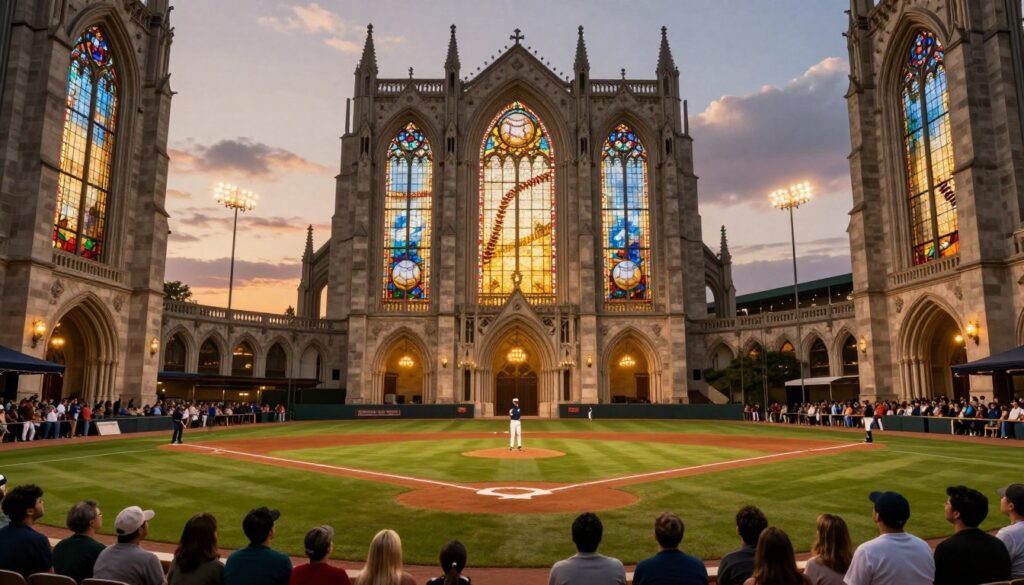
This wasn’t just about sport. In the novel’s era, as cities grew, ballparks became the new civic temples. For immigrants, the ballpark was a place of belonging. The game’s pace provided a new kind of liturgy.
The stadium is more than a venue. It’s the 20th-century cathedral, where faith is in the ritual itself.
And the hot dog and beer? They’re the communion wafer and wine of this faith. It’s the shared, greasy, communal experience that turns a crowd into a congregation. The novel’s backdrop shows this perfectly: in a world of rapid change, these baseball stadiums as cathedrals offered a new kind of sanctuary, a shared, secular religion for the modern age.
Cultural significance in baseball literature
Great baseball literature, like Bernard Malamud’s The Natural and Jim Bouton’s Ball Four, explores the American soul. Baseball and faith are linked, not through religion, but through a shared belief in the game’s power. The stadium, the season’s rituals, and the literature all create a special tradition.
The Celebrant fits into this tradition. It’s a work of “remarkable baseball historical fiction” that understands the baseball and faith bond. It joins works like Shoeless Joe and The Boys of Summer in questioning our national myths. This tradition, from The Glory of Their Times to Don DeLillo’s Underworld, sees the sport as a way to look at American identity and failure.
A small detail, like an audiobook narrator getting a player’s name wrong, shows the imperfection of our myths. It reminds us that our stories are always being retold, sometimes with mistakes. To learn more about baseball’s role in American history, check out this overview. The best baseball writing isn’t just about the game. It’s about the faith we put in our stories about ourselves.