

America loves tall tales, from Paul Bunyan to Pecos Bill. Baseball is no exception. Its long history and stats create a perfect place for baseball magical realism. This mix of the impossible and the real makes the game even more special.
W.P. Kinsella’s The Iowa Baseball Confederacy is a great example. It tells a tall tale of a 40-day game, time travel, and a batting statue. It turns the magic of the sport into a whole world.
These stories aren’t just fantasies. They’re a literary tradition. They’re the tall tales in baseball that show the game’s magic. They make a .400 hitter or a 40-game win streak seem like myths.
In the end, baseball magical realism is about believing in stories. It’s the legend of a game that never ends. It’s the perfect curveball and the tall tales that make the sport a beautiful mystery.
Time distortion and folklore
Baseball, a timeless American sport, has a complex relationship with time. What if the game’s timeline isn’t just a straight line? W. P. Kinsella’s *The Iowa Baseball Confederacy* explores this idea. It uses time travel in baseball to show how myths are created.

In the novel, Gideon Clarke falls into history. He doesn’t just read about the 1908 game; he lives it. This isn’t a simple time machine story. It’s a messy journey from 1978 to 1908, where time is a tangled web.
This twist challenges how we remember history. It asks: is history what we document, or what we choose to remember?
Time as a Fluid Construct in Baseball Lore
Kinsella sees time as a living force. The rainstorm that stalls the game for 40 days is more than a plot device. It shows time itself being paused.
In this timeless state, the game becomes a baseball folklore event. It exists outside of time, creating a new origin myth for the sport.
This fluidity is the novel’s strength. Gideon’s journey is not just from A to B. His 1970s perspective meets the 1908 world, creating a new reality. The “crack in time” he slips through is like folklore, where stories grow.
Folklore and the Fabrication of Memory
Kinsella’s genius lies in his use of time. The novel shows that baseball folklore comes from distortion, not clear facts. The 40-day rain is a narrative device that blurs time.
The game Gideon witnesses is a prime example. Did the pitcher Drifting Away really throw a 168-hour game? The facts don’t matter. Their power lies in their story.
Kinsella shows that memory is a living, contested space. The “truth” of the Iowa Baseball Confederacy isn’t in records but in collective memory. The game’s magic lies in its story, not in official records.
| Concept | Historical/Linear Time | Mythic/Folklore Time (As in the novel) |
|---|---|---|
| Nature of Time | Linear, sequential, and progressive. | Fluid, cyclical, and non-linear. Time can fold, loop, and create “cracks.” |
| Basis of Truth | Verifiable facts, records, statistics. | Narrative truth, emotional resonance, and communal belief. |
| Primary Source | Box scores, newspaper archives, documented history. | Oral tradition, family legend, and “rain-soaked” memories. |
| The 40-Day Rain | An improbable meteorological anomaly. | A mythic, symbolic flood that suspends normal time. |
| Purpose of Story | To record what happened. | To explain who we are and how we remember. |
This manipulation of time serves a higher purpose. It lets Kinsella explore sports history. Is Babe Ruth’s called shot more real because it was photographed? Or is the story’s power what truly lasts?
The novel argues that the most important events are those we keep telling stories about. Gideon’s time travel in baseball is not just a plot. It’s a journey to the heart of a legend, born from mud and rain.
The Iowa Baseball Confederacy suggests baseball’s true history isn’t just in records. It’s in the baseball folklore passed down, the tall tales told in the bleachers, and the collective belief in something magical. The distortion of time is what makes the story and myth possible.
Satire vs. reverence for the game
Baseball writing has always been a mix of the sacred and the profane. It’s a literary double play where the ballpark’s hallowed ground meets the clubhouse’s reality. This tension between satire and reverence defines baseball literature’s soul.
You can’t grasp the game’s literary tradition without seeing this split. It’s like comparing a chapel to a comedy club, both on the same diamond.
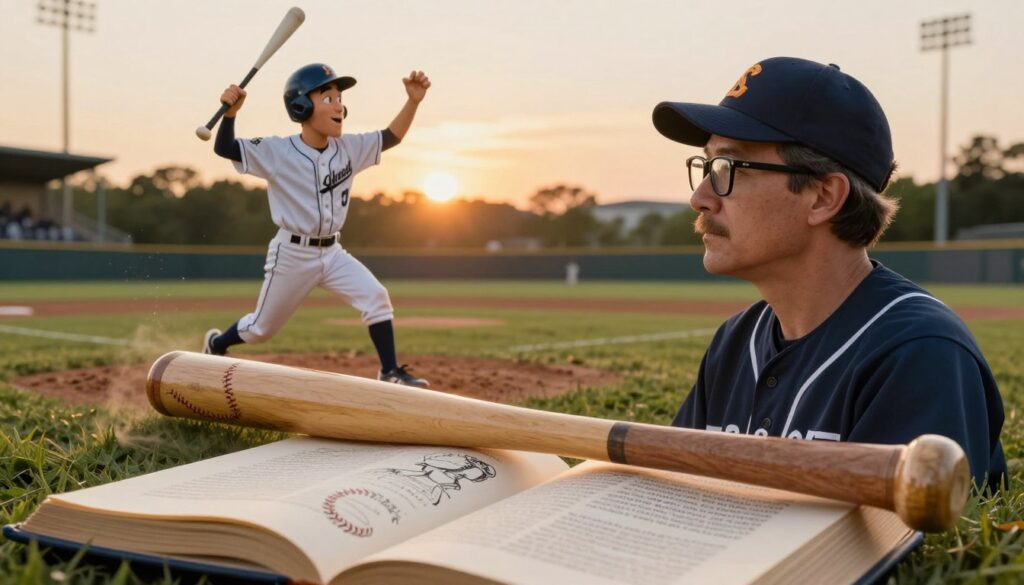
The Duality of Baseball Literature
Baseball literature has a split personality. On one side, there are the sacred texts. These works treat the game with the solemnity of a religious text. Think of Roger Angell’s elegant essays or W.P. Kinsella’s poetic moments.
On the other side, there’s the satirical and subversive literature. It pulls back the curtain, showing the game’s human flaws. This isn’t the game your grandfather knew; it’s the real game.
From “Bullpen Gospels” to “Ball Four”: A Spectrum of Tone
Consider the spectrum. At one end, Jim Bouton’s Ball Four is the book that exposed the game’s underbelly. It was so honest about amphetamines and hypocrisy that it got Bouton blackballed.
At the other end, Lawrence Ritter’s The Glory of Their Times is a work of pure reverence. Ritter captured the oral histories of baseball’s early stars with care. There’s no satire here, just a deep respect for the game.
Most baseball writing falls between Bouton’s muckraking and Ritter’s reverence. Dirk Hayhurst’s “The Bullpen Gospels” is a good example. It’s irreverent yet spiritual, finding the sacred in the profane.
Kinsella’s baseball fiction also occupied this middle ground. He could write about a rain delay with reverence, then turn to satire about a fan’s obsession. His work respects the game’s mythology while laughing at its absurdities.
Small-town baseball mythology
Forget the big stadiums of major league parks. They don’t hold the game’s soul. To find it, you must wander down a two-lane road, past the last stoplight. Here, the outfield fence is just a rumor, and the foul lines are cut by a riding mower.
This is where the real mythology in baseball fiction comes alive. It’s whispered on the wind across the outfield grass. It’s the soul of small towns, where legends and box scores blend into one grand small-town baseball legend.
Forget the Yankees and Dodgers. The most epic games and heroes aren’t in records. They’re in stories told on the general store’s porch, growing taller with each retelling. The town drunk who struck out Babe Ruth, the high school phenom who threw a perfect game in a storm, are these stories’ sacred texts.
The Diamond as the Beating Heart of the Hometown
In baseball fiction, the diamond is more than a playing field. It’s the town’s heart. The backstop is like the community’s front porch. Every game is a town meeting, where heroes emerge from unexpected places.
Think of “Shoeless Joe” or “Big Inning.” The field is a character, a portal to a magical game world. It’s a place where time bends, making 40-day games seem plausible. The field is where the town’s identity is performed and legends are born.
Big Inning: When the Town *Is* the Team
This is where “Big Inning” magic happens. It’s not just a game; it’s a state of being. The pitcher is the town’s honor guardian, the shortstop, its pride defender. The mythology here is about the collective soul of the place, not individual stats.
This mythology contrasts sharply with major league stories. To see the difference, let’s compare the two mythologies:
| Aspect | Small-Town Baseball Mythology | Major League Mythology |
|---|---|---|
| Source of Legend | Oral tradition, local lore, and communal memory. | Statistics, record books, and national media narratives. |
| Heroes | The town drunk who could have gone pro; the high school star who stayed to run the family business. | Hall of Famers, MVPs, and record-setters with verified stats. |
| Sacred Ground | The local diamond, the sandlot, the cow pasture. | Iconic stadiums: Fenway’s Green Monster, Wrigley’s ivy. |
| Central Conflict | Man vs. Time (forgotten glory, fading memories). | Man vs. Man (winning the World Series). |
| Ultimate Goal | To preserve the story, the identity, the soul of the place. | To win the championship, to be the best. |
This table shows the difference between the two mythologies. The major league myth is a national epic, while the small-town myth is a personal, communal story. It’s the soul of the game, found by getting lost on the way to somewhere else.
Why this book divides readers
Some books are just read. But W.P. Kinsella’s The Iowa Baseball Confederacy is different. It’s like a Rorschach test for baseball fans. You don’t just read it; you choose a side.
This book is famous for its baseball book controversy. It asks you to believe that baseball’s myths are as real as the dirt on the field. Some love its dreamlike quality, while others find it hard to follow.
The Magical Realism Divide
Kinsella uses magical realism as the base of his story. It’s not just a hint of the supernatural; it’s the whole story. The 40-day game, strange spectators, and time travel are not just quirks.
For some, this magical realism in sports novels is a brilliant way to show the game’s mythic side. For others, it’s a big departure from what they expect from baseball stories. The book’s magic can either enchant or anger you, depending on your view of its unique storytelling.
The Line Between Enchantment and Frustration
Where does the line between enchantment and frustration lie? Some readers are captivated by the story’s layers, while others get frustrated by its lack of a clear ending. This is what makes the book so divisive.
As one analysis of baseball fiction points out, the best stories work on two levels: the game and cultural insight. Kinsella adds a third: the mythic. The baseball book controversies come from this mix. Is it a deep work of magical realism in sports novels, or just a meandering tale? The answer depends on where you stand on the magical realism divide.