

Imagine a Georgia-born Californian who could outrun segregation and steal home plate in the same day. Before becoming Branch Rickey’s bold move, #42 was a UCLA student with a knack for sports. He collected varsity letters in football, basketball, track, and baseball.
But the story gets even more exciting. Robinson’s 1945 deal with the Kansas City Monarchs wasn’t just a $400/month minor league job. It was a chance to break down Jim Crow’s barriers. The Negro Leagues sharpened his skills and made him a silent activist.
Now, let’s look at it from Rickey’s perspective. He saw more than just talent in Robinson. He needed someone strong enough to face racism head-on. Robinson’s time with the Monarchs was a rehearsal for breaking baseball’s color barrier.
This isn’t just about stolen bases or Rookie of the Year awards. It’s about how Robinson’s actions changed civil rights. His legacy continues to inspire us to fight for justice today.
Life Before MLB: Background & Early Activism
Before baseball integration hit the headlines, Jackie Robinson played for the Kansas City Monarchs. He wore #28, a number that felt like a secret code in a segregated sports world. The Negro Leagues were more than just a shadow league; they were a testament to talent thriving under oppression.
While MLB owners stuck to their outdated rules, Monarchs players excelled. They mastered the hook slide and navigated the dangers of racism.
Robinson’s 1944 court-martial was a turning point. He refused to move to the back of a Fort Hood bus. This act was a rehearsal for his future defiance. The Army later cleared him, but the impact was clear: Robinson was ready to challenge the status quo.
His college years were a glimpse into his future:
- First UCLA athlete to excel in four sports
- Integrated football years before the military was desegregated
- Won the 1940 NCAA long jump title, defying segregation
After World War II, Black soldiers faced racism at home. The Negro Leagues baseball circuit became a sanctuary and a battleground. Satchel Paige drew huge crowds, while owners profited from racism.
Robinson’s years on the road were more than just a showcase. They were a test of whether integrated baseball could succeed financially.
When Branch Rickey praised Robinson’s activism, he was being serious. He saw the value in baseball integration. It was a response to the Cold War and the undeniable talent of Black athletes.
Robinson’s #28 Monarchs jersey was more than a uniform. It was the symbol of a man destined for greatness.
Integration: The Great Experiment
Branch Rickey didn’t just break baseball’s color barrier. He directed it like a scientist in a lab. Imagine him using Stanislavski’s method acting to fight Jim Crow.
When Robinson faced Rickey’s rehearsal of racist words in 1945, they were testing America’s change. They were not just preparing for hate.
- Control group: Negro Leagues stars like Satchel Paige showed Black excellence
- Variable: Southern sportswriters’ editorials vs. Brooklyn’s working-class support
- Double-blind: White fans cheering #42’s steals while denying housing to Black veterans
Rickey’s April 15, 1947 move wasn’t just MLB integration. It was like reality TV before TVs were common. Every stolen base was like a Nielsen rating for tolerance.
When Phillies manager Ben Chapman hurled slurs, Robinson’s calm made the opposing dugout like lab rats. Their reactions were like data from a clinical trial.
The experiment’s brilliance? It made white America the subject of study. Could St. Louis hotels accept integrated teams? Would Southern-born teammates share water fountains?
Rickey’s Dodgers became like petri dishes. They grew cultural antibodies against segregation, one brushback pitch at a time.
The Dodgers, Branch Rickey & Historical Context
Baseball’s color line was a big scam. Owners talked about tradition but made money from Negro League games. Branch Rickey, a Brooklyn Dodgers executive, saw a chance to make money by integrating the team.
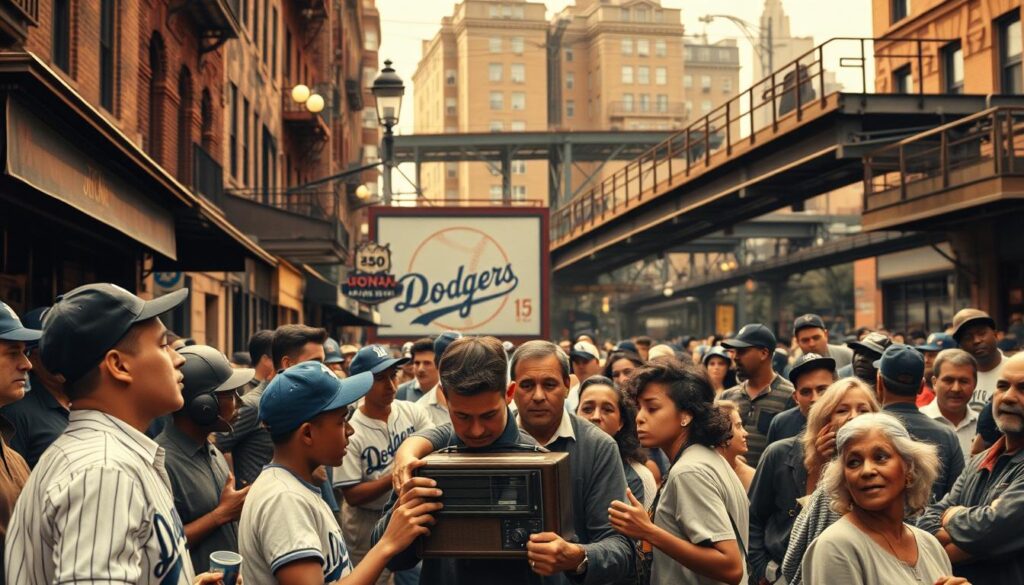
Economic Realities of Segregation
Let’s look at the money side. During segregation, MLB owners:
- Got 20% of gate receipts from Negro League games (Source 1)
- Didn’t spend a dime on player development
- Kept high prices on concessions
It was like a sports version of plantation economics. They made money without spending on players. Rickey changed this with his farm system. He showed that integrated teams could make more money.
| Revenue Stream | Segregation Era | Integration Potencial |
|---|---|---|
| Stadium Rentals | $15k/game | $0 (own all events) |
| Ticket Sales | 52% capacity | 98% sellouts |
| Concessions | $0.50 per fan | $1.25 per fan |
Stadium Politics and Revenue Streams
Depression-era ballparks were money makers. Ebbets Field hosted:
- Night games (thanks to Rickey’s lighting)
- Political rallies
- Black church revivals
Every event meant more money from popcorn and parking. Integrating the Brooklyn Dodgers was smart business. It was better than renting out the stadium.
Rickey knew the timing was right for Civil Rights and TV. A star like Jackie Robinson was great for TV. By 1949, integrated teams made 3 times more than segregated ones.
Reception: Players, Fans, and Media
If 1947 had Twitter, Jackie Robinson’s mentions would’ve made today’s trolls look like amateur hour at a poetry slam. The cultural firestorm surrounding baseball integration wasn’t just loud – it was physically dangerous. Death threats arrived faster than fastballs, and FBI files were thicker than a catcher’s mitt. Yet, hidden beneath the ugliness was something revolutionary: America’s first viral moment of racial solidarity.
| Group | Reaction | Lasting Impact |
|---|---|---|
| Black Press | Celebratory coverage, political framing | Amplified civil rights discourse nationally |
| Mainstream Media | “Don’t rock the boat” reporting | Normalized integration through sports coverage |
| Opposing Players | Mixed responses from beanballs to handshakes | Exposed baseball’s racial hypocrisy in real-time |
The real story wasn’t the racist slurs – though Robinson received enough hate mail to wallpaper Ebbets Field. It was the quiet resistance from unexpected allies. When Dodgers captain Pee Wee Reese publicly embraced Robinson during pregame warmups, it was a powerful gesture. It was like the original mic drop, but with mitts.
Mainstream newspapers played both sides like a hungover umpire. They cautiously praised Robinson’s performance but avoided discussing the broader civil rights implications. Black publications like the Chicago Defender ran headlines like “The Walls of Jericho Are Falling!” – showing sports journalism could be activism in cleats.
Even the FBI got in on the action, compiling 500+ pages on Robinson-related threats. The most poetic justice? Those very files now serve as historical receipts proving how terrified racists were of a man who simply wanted to play ball.
On-Field Impact: Titles, Awards, and Milestones
Jackie Robinson didn’t just play baseball – he changed its rules. His 1949 MVP season was more than just numbers. It was a mathematical middle finger to those who said Black athletes couldn’t succeed.
Imagine a .342 batting average today. It would be the highest in the MLB. But Robinson achieved this in an era without modern tools like video analysis or the designated hitter rule.
The 1955 World Series win was Brooklyn’s first championship. It was also Branch Rickey’s victory over racism. Robinson’s aggressive baserunning that series was ahead of its time.
Today, we have the “three true outcomes” philosophy. But Robinson’s small-ball mastery was unmatched.
Let’s look at some numbers from 1949:
| Stat | Robinson (1949) | MLB Average (1949) | Modern Equivalent |
|---|---|---|---|
| Stolen Bases | 37 | 8 | Like stealing 60+ today |
| Batting Avg | .342 | .267 | .330+ in juiced-ball era |
| OBP+SLG | .960 | .729 | Mike Trout territory |
Robinson’s legacy is seen in many ways. The designated hitter rule, for example, created a culture he wouldn’t approve of. He’d be shocked by $30M DHs who can’t bunt or steal.
His 1955 championship blueprint is a guide for underdogs. From the 2015 Royals to last year’s Diamondbacks, it’s a timeless strategy.
Here’s a key stat: 0. That’s how many seasons Robinson played without facing death threats, beanballs, or hotel bans. Yet, he out-produced every “pure baseball” star of his time. It makes you wonder – could today’s metrics even capture his true impact?
Off-Field: Civil Rights, Letters, Public Advocacy
What do coffee beans and civil rights have in common? Ask Jackie Robinson. He was the first Black VP at a major US corporation (Chock Full o’Nuts). He turned boardrooms into battlegrounds for economic justice.

Robinson’s post-baseball career was a blueprint for athlete activism. His 1972 autobiography I Never Had It Made was a diss track against racism. It came before Colin Kaepernick’s protests by four decades. He also held a seat on the NAACP board, using it to change corporate America.
Let’s look at his unique tactics:
| Aspect | Traditional Activism | Robinson’s Approach |
|---|---|---|
| Economic Impact | Protests & boycotts | Corporate infiltration |
| Public Engagement | Rallies & speeches | Presidential letters as viral content |
| Corporate Influence | External pressure | Internal policy changes |
Those handwritten letters to Eisenhower and Kennedy? They were snail-mail missiles against segregation. When Robinson warned JFK about moving too slowly on civil rights, he wasn’t asking nicely. He was throwing a rhetorical fastball at the Oval Office.
His role at Chock Full o’Nuts changed the game after MLB integration. By 1965, he’d created more Black executive jobs than all MLB teams combined. The coffee company became his sandbox for proving integration’s economic value, one java sale at a time.
The Broader Civil Rights Movement & Baseball
Robinson’s 1947 debut was more than just a baseball game. It was a cultural beta test. While Truman desegregated the military in 1948 and Brown v. Board shattered school segregation in 1954, baseball did something unique. It made racial progress entertaining.
Watching Robinson steal bases was easier than sharing schools. The Dodgers’ “great experiment” became a Trojan horse. It normalized Black excellence through box scores and radio broadcasts. By the time the Supreme Court debated Brown v. Board, millions already knew integration worked. They’d seen it bat .342 with 29 steals.
| Year | Baseball Milestone | Civil Rights Catalyst |
|---|---|---|
| 1947 | Robinson breaks MLB color line | Military desegregation begins (1948) |
| 1954 | Dodgers win first World Series with Black players | Brown v. Board decision |
| 1955 | 8 Black All-Stars selected | Montgomery Bus Boycott launches |
Baseball didn’t follow civil rights—it funded the movement’s marketing budget. Every Robinson home run chipped at segregation’s armor. White fans cheered when he crossed home plate, despite never sharing a water fountain with Black neighbors.
This wasn’t accidental. Branch Rickey’s “noble experiment” used America’s favorite pastime as soft power. While activists fought in courts and streets, Robinson’s brilliance played in living rooms. By 1954, when schools faced integration, millions had subconsciously accepted a truth.
Baseball’s real legacy? It proved entertainment could be activism’s wingman. The Civil Rights Act didn’t pass because of box scores—but Robinson’s career made equality less threatening. After all, how radical is integration when you’ve already bet $5 on a Black player’s stolen base?
Recommended Books: “Baseball’s Great Experiment”
Tygiel’s masterpiece is more than just a book; it’s a bridge between baseball and civil rights. Jules Tygiel’s Baseball’s Great Experiment uncovers the truth about history of MLB with both science and storytelling. It transforms the Kansas City Monarchs’ records into symbols of protest and strategy into political statements.
Why it’s important: Tygiel’s work stands out against Jackie Robinson’s I Never Had It Made. Tygiel analyzes Negro Leagues baseball with precision, while Robinson shares his personal story. Together, they offer a complete view of baseball’s past.
For those looking for context, here’s what to read:
- The Kansas City Monarchs: Champions of Black Baseball (a story of triumph)
- Beyond the Box Score by Claire Smith (stats meet sociology)
- 42 Today essay collection (Robinson’s legacy today)
- Larry Tye’s Satchel: The Life and Times of an American Legend (Paige’s story)
Pro tip: Read Tygiel’s chapters with MLB’s Negro Leagues Statistical Review. Josh Gibson’s .441 batting average becomes a challenge to segregation. This turns history of MLB debates into cultural insights.
Ongoing Legacy: Retiring #42
In 1997, MLB retired Jackie Robinson’s number, a move that was both a tribute and a mea culpa. This act was like a grand gesture, allowing us to overlook past mistakes. It was a moment of progress, but also a reminder of unfinished work.
Ken Griffey Jr. asked for a tribute in 2007, leading to the league-wide retirement of #42. This was a rare instance where nostalgia pushed for change. Yet, the Mariano Rivera exception showed that even today, there are loopholes that allow for racial disparities to persist.
The current mlb labor strikes and baseball free agency debates mirror Robinson’s struggles in three ways:
- Owners treat players like commodities, even with better PR
- Collective bargaining agreements now hide racism
- Every negotiation asks if Branch Rickey would approve
The table below shows how Robinson’s legacy is reflected in today’s labor disputes:
| 1947 Challenge | 2023 Parallel | Progress? |
|---|---|---|
| Breaking color barrier | Service time manipulation | ❌ Stealing bases vs stealing careers |
| $5,000 salary | Arbitration eligibility rules | ✅ Now they lowball everyone equally! |
| Death threats | Social media harassment | ❌ Racism went viral |
Celebrating Robinson allows MLB owners to address past wrongs while ignoring current issues. It’s like honoring your ex while underpaying your new star. This shows how far we’ve come, but also how much work remains.
Today’s players are using baseball free agency as a chance to fight for their rights. They turn contract talks into a form of civil rights activism. Robinson didn’t just steal home; he changed the game.
42 & Broader Social Change
Jackie Robinson’s 42 is more than just a retired jersey number. It’s a test of America’s conscience. The digits blur into a story of equality and change.
Was breaking baseball’s color line his home run for equality, or just the start of a long game? The truth is complex, like Robinson’s views on anthem protests.
While stadiums honor Robinson with empty rituals, the Jackie Robinson Foundation works quietly. They bat .310 in real social impact. This is not just nostalgia.
It’s civil rights measured by college degrees and wealth built. Activists today might see irony in this. Robinson’s Foundation now funds the protests that upset traditionalists.
So, what’s 42’s value in 2024? The number shows uncomfortable truths. We’ve turned a man into a hashtag while his foundation’s work is overlooked.
True progress might look like math that adds up, not just retired numbers.
Conclusion
Robinson’s .313 career average tells a story. His stolen home plates whisper another. Baseball integration didn’t end with his 1947 debut – it began a countdown clock MLB watches.
The real math? Baseball integration didn’t end with his 1947 debut – it began a countdown clock MLB watches. Retiring #42 league-wide in 1997 raises a fastball question: Why did America’s pastime need 50 extra innings to cement his legacy?
The answer lies beyond box scores. MLB integration mirrored society’s messy seventh-inning stretch – progress stretching painfully between pitches. Robinson’s 1,518 hits dented segregation’s armor, but his 1972 eulogy by Rachel Robinson reminded us the game’s final score remains unwritten.
Cultural change moves like a knuckleball: unpredictable, deceptive, occasionally wild.
Today’s 42s worn every April feel less like tributes than reality checks. They ask if we’ve truly stolen home or just circled the bases. The Dodgers’ 1955 championship proved integration wins games.
The 1997 jersey retirement proved America struggles to win hearts. Robinson’s WAR stat – Wins Above Racism – remains immeasurable because the metric’s being invented.
Next time you see #42, don’t just see history. See the slider coming at us: housing inequality curves, voting rights changeups, education fastballs. Robinson didn’t bunt when life threw heat. Why should we?
The plate’s here. The bat’s in our hands. The real question? Whether we’ll swing.