
In the hyper-commercialized landscape of 2026, modern baseball stadiums are no longer just fields; it is a multi-billion dollar mixed-use real estate venture, complete with sportsbooks, biometric ticketing, and climate-controlled luxury. We have optimized the fan experience to the point of sterility. Yet, when we turn to the vast canon of baseball literature, we are reminded that the soul of the sport was not forged in these synthetic entertainment districts, but in the gritty, asymmetrical urban spaces of the 20th century.
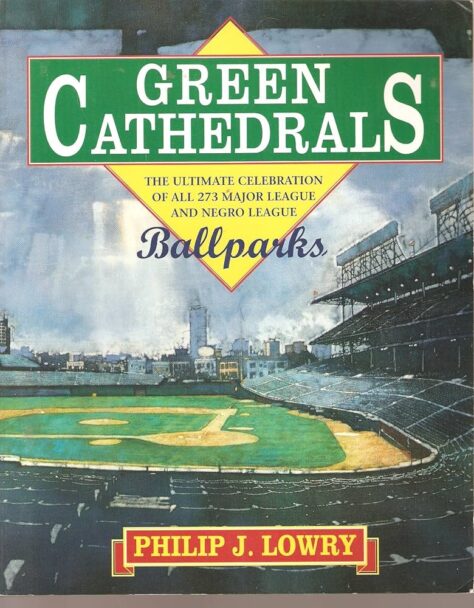
To understand how the physical dimensions of the game have shaped its cultural narrative, one must study the architectural bibles of the sport. Two foundational texts stand above the rest: Philip J. Lowry’s encyclopedic Green Cathedrals and Bruce Kuklick’s deeply sociological To Everything a Season. Reading these books side-by-side provides a masterclass in how baseball parks evolved from hastily assembled wooden grandstands into concrete monuments, and ultimately, into ghosts.
As we navigate the contemporary era of modern stadium economics, where public funds are routinely leveraged to build towering glass monoliths, these books serve as a vital grounding wire. They remind anyone attempting a deep dive into baseball history that the most enduring cathedrals were built not by algorithms, but by the jagged, restrictive grids of the cities that surrounded them.
The Atlas of Lost Diamonds: Green Cathedrals
Philip J. Lowry’s Green Cathedrals is the ultimate geographical ledger of the sport. Rather than focusing purely on the players who inhabited the fields, Lowry treats the ballparks themselves as the primary characters. His work meticulously catalogs the absurd, beautiful quirks of early stadium construction that modern zoning laws would never permit today.
Lowry’s text forces the reader to confront the reality that the playing field itself was once a defensive variable. Before standardized outfield walls and perfectly manicured turf, a team’s success was intrinsically linked to its mastery of its own bizarre geometry. He documents the sloping terraces of Crosley Field, the impossibly deep center field of the Polo Grounds, and the idiosyncratic dimensions forced upon builders by adjacent railroads and neighborhood avenues.
In a modern era where front offices strive for absolute statistical parity, Lowry’s encyclopedia captures an era of inherent, charming unfairness. This is a vital resource for readers exploring Classic Baseball Books, acting as a reference guide to the literal foundations of the game’s greatest mythological moments. Furthermore, Lowry captures the transient nature of these structures, echoing themes found in historic urban preservation by recording the exact coordinates of where long-forgotten grandstands once stood, turning empty modern parking lots into sacred ground.
A Sociology of Wood and Steel
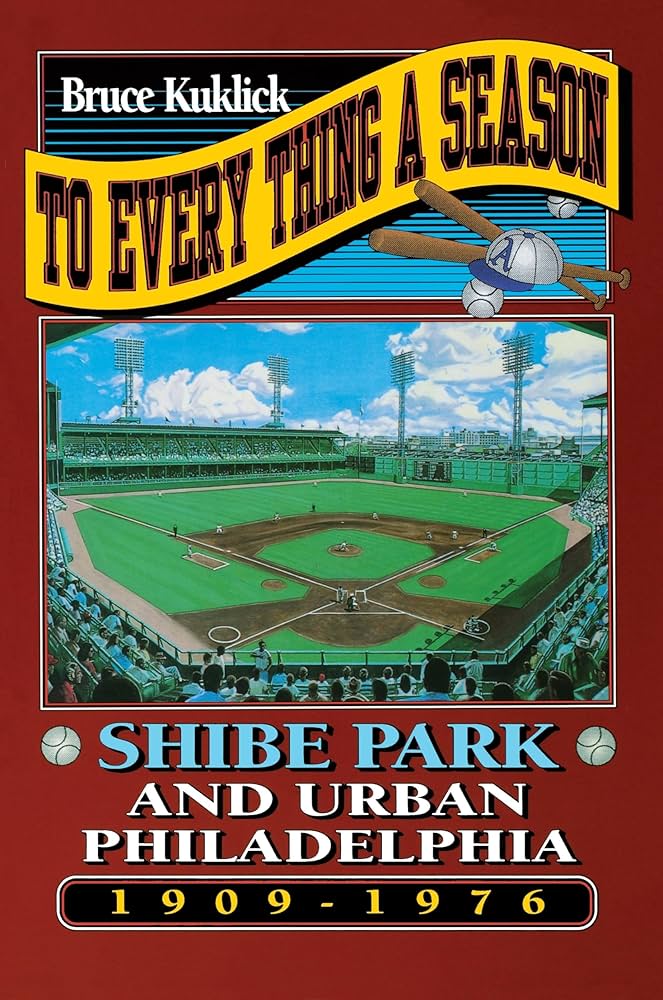
While Lowry provides the macroscopic atlas, Bruce Kuklick’s To Everything a Season: Shibe Park and Urban Philadelphia offers the microscopic, beating heart of stadium literature. Kuklick does not merely write about dimensions and seating capacities; he writes an autopsy of an American neighborhood.
Shibe Park, later known as Connie Mack Stadium, was a jewel box of the early 20th century, famously defined by its French Renaissance cupola and the working-class residents who would watch games from their rooftop bleachers across the street on 20th Street. Kuklick brilliantly illustrates how the ballpark was not a separate entity from the neighborhood, but its central organ. He tracks the racial, economic, and industrial shifts of Philadelphia over six decades, using the decaying stadium as a barometer for urban flight and industrial decline.
To read Kuklick’s work is to understand the profound history of Shibe Park not as a venue for athletic exhibition, but as a crucible for American social history. He captures the friction between the wealthy team owners and the local laborers, the changing demographics of the surrounding blocks, and the eventual tragic abandonment of the stadium.
Comparing the Literature of the Diamond
When synthesizing the history of baseball’s architectural evolution, these two books offer perfectly complementary frameworks for understanding the sport’s physical spaces:
| The Literary Approach | Green Cathedrals (Lowry) | To Everything a Season (Kuklick) |
| Primary Focus | The structural and statistical oddities of every major league ballpark. | The sociological and economic impact of one specific ballpark on its community. |
| View of the Stadium | A vessel for the game’s physical history and statistical anomalies. | A living, breathing organism tied to the fate of the urban working class. |
| The Inevitable Tragedy | The demolition of unique architecture in favor of symmetrical, multi-purpose concrete donuts. | The hollowing out of American industrial neighborhoods and the loss of community identity. |
Why We Mourn the Jewel Boxes
The most striking revelation from reading both Lowry and Kuklick in the late 2020s is the cyclical nature of our architectural grief. The jewel boxes of the early 1900s were torn down for the soulless, dual-purpose municipal stadiums of the 1970s. Those concrete donuts were then demolished to make way for the “retro-classic” parks sparked by Camden Yards in the 1990s, which are now themselves facing obsolescence in the face of modern, tech-infused stadium-cities.
By documenting these physical spaces before the wrecking ball arrived, these authors preserved the literal shape of the sport’s greatest memories. They remind us that the most significant landmark events in baseball did not happen in a vacuum; they happened on specific patches of grass, surrounded by specific neighborhoods, built by specific men. As baseball continues to abstract itself into a game of pure data and digital overlays, Green Cathedrals and To Everything a Season stand as a testament to the days when the game was deeply, physically rooted in the American soil.