
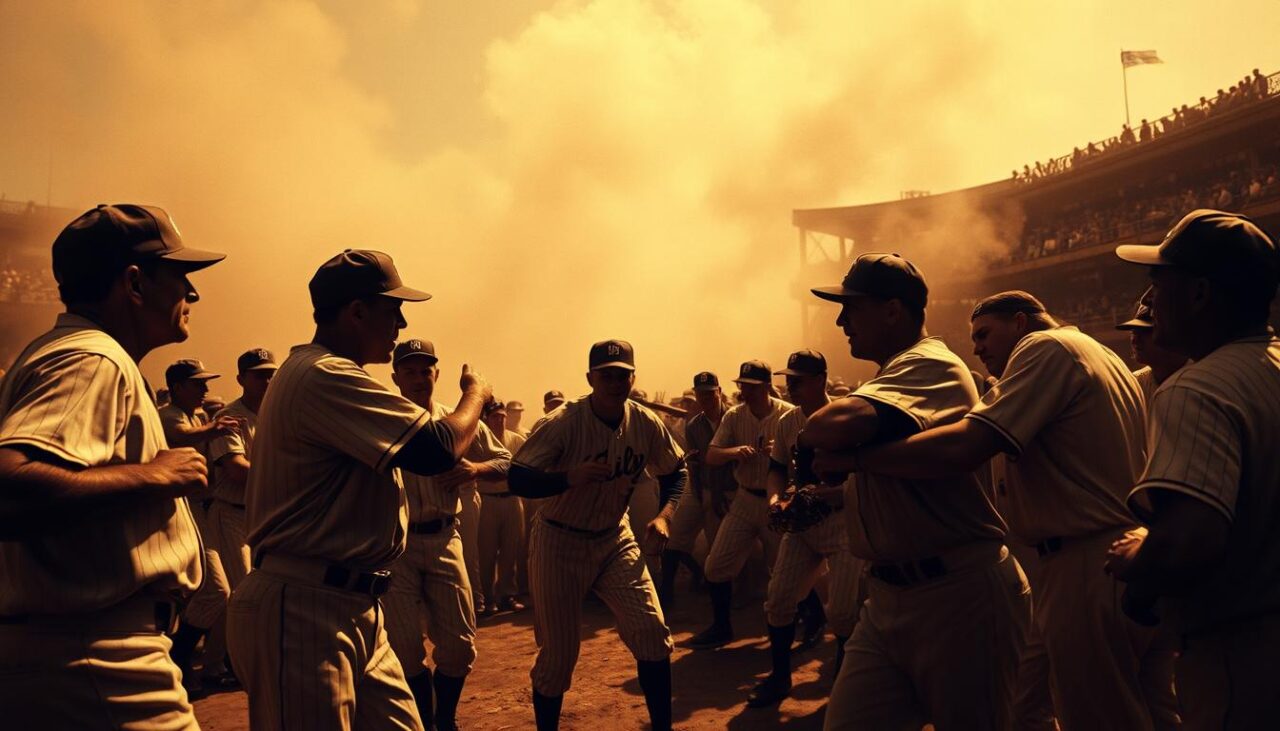
Imagine Shoeless Joe Jackson’s ghost high-fiving Barry Bonds’ statue. The 1919 Black Sox scandal involved eight players selling out for money. This echoes today’s players with inflated stats, making baseball’s story more than just numbers.
The 1908 Cubs-Giants pennant race is seen as the last “pure” game before cheating became common. It was a time of no steroids, just Merkle’s error and fan excitement. Now, we debate if players who used steroids should be in the Hall of Fame. Is baseball’s heart in its stats or in the law?
This isn’t just about cheating or using performance-enhancing drugs. It’s about baseball reflecting America’s complex mix of dreams, greed, and rules. We’ll look at how each scandal shapes the game’s lore. In baseball, as in life, no crime is truly victimless… except maybe the ’86 Mets’ fans who thought they were “just energetic.”
Origins: Early Use of PEDs in Sports
What do cocaine vials and collective bargaining agreements have in common? More than you’d think. Long before syringes entered locker rooms, baseball’s scandals were already scripting a playbook for performance enhancement—just with different vices. Let’s rewind to 1919, when the Black Sox Scandal didn’t involve needles but did involve gamblers stuffing cash into players’ mitts. Eight White Sox players took payouts to throw the World Series, proving America’s pastime had a corruption problem long before steroids entered the chat.
Fast-forward to 1969: Curt Flood’s lawsuit against MLB’s reserve clause became the real home run derby. His fight for free agency—a precursor to modern labor strikes baseball drama—shifted power to players. Suddenly, contracts ballooned, and so did pressure to deliver stats. As salaries skyrocketed, so did the Faustian bargains. By 1985, the Pittsburgh drug trials exposed a cocaine epidemic so rampant that Tim Raines famously slid headfirst… to protect the coke vial in his back pocket. Priorities, right?
The 1975 Messersmith case tore down MLB’s feudal system, but it also created a monster. Free agency meant stars could demand millions—if they stayed dominant. Enter the 1980s: an era where players swapped stories about fastballs and fast cars between lines of blow. The league’s response? A collective shrug. Why police substances when you’re busy counting ticket sales?
Here’s the kicker: each “crisis” made the next inevitable. The Black Sox’s gambling purge? It taught players to hide their tracks better. Flood’s labor rebellion? It turned athletes into brands with everything to lose. By the time cocaine trials made headlines, the blueprint was clear: win at all costs, but don’t get caught. Sound familiar, steroid era?
Baseball’s original sin wasn’t steroids—it was treating symptoms instead of diseases. The league cracked down on gamblers in 1920 but ignored the systemic greed that fueled them. It celebrated free agency’s capitalism while pretending money wouldn’t corrupt priorities. And when cocaine became the ’80s mascot? Owners clutched pearls but kept cashing checks. The stage was set for juiced-up sluggers before Mark McGwire ever touched a weight rack.
The 1990s-2000s Explosion in MLB
The MLB steroid era changed how we see sports. It made records seem like child’s play. By 1998, fans needed binoculars to see McGwire’s home runs.
In 1908, the Cubs-Giants race was like a chess game. The Deadball Era had a .239 batting average. This made home runs as rare as infielders who could catch.
Fast forward to the 1990s. Expansion teams made pitching weaker. This set the stage for the 1998 home run chase. McGwire and Sosa broke Maris’ record with 70 and 66 home runs.
The numbers tell a story of two giants:
| Statistic | 1908 Season | 1998 Season |
|---|---|---|
| Home Run Leader | Tim Jordan (12 HR) | Mark McGwire (70 HR) |
| Avg Player Weight | 172 lbs | 198 lbs |
| Team ERA Leader | 1.39 (Mordecai Brown) | 2.65 (Greg Maddux) |
| Ballpark Factors | Pitcher-friendly fields | Bandbox stadiums |
50-homer seasons became common. The league’s slugging percentage rose 25 points from 1992-2001. Was it baseball or biochemistry?
The 1908 Cubs-Giants pennant race needed strategy. The steroid era turned games into Home Run Derbies.
This change had big effects. Pitchers looked like crash test dummies. Trainers became like pharmacists. By 2000, fans needed a scorecard and a biology book.
Congressional Hearings and Media Firestorm
When Congress steps in, the game goes into overtime. The 2005 steroid investigations turned Capitol Hill into a surreal baseball dugout. It was a mix of political theater and locker-room denials.
Rafael Palmeiro’s finger-wagging was more like Little League than statesmanlike testimony. It was like CSI: Cooperstown, with subpoenas instead of bats.
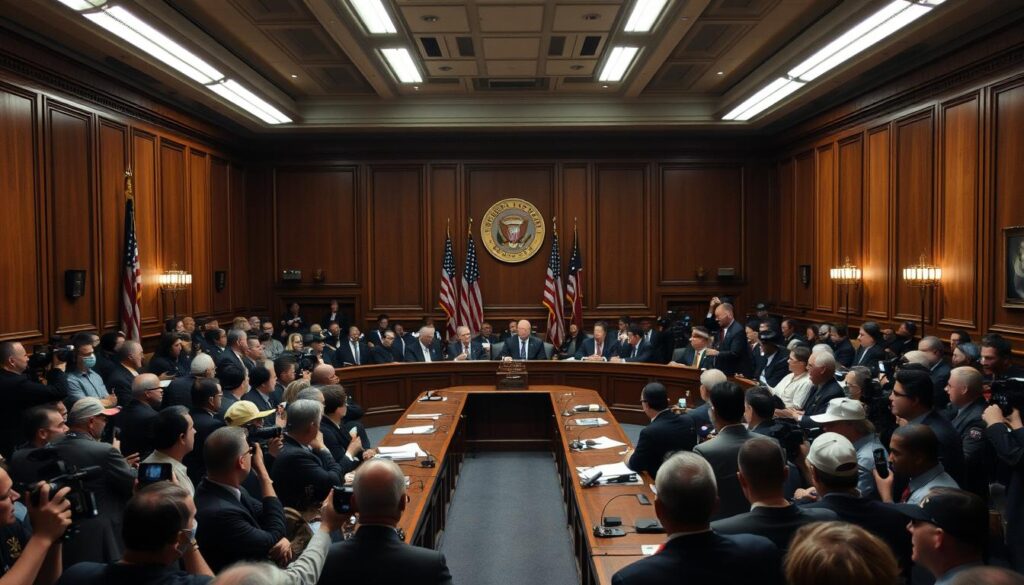
Bud Selig’s defense was a masterclass in plausible deniability. The MLB commissioner seemed to say, “I didn’t see anything.” This made Pontius Pilate look decisive by comparison.
Congress swung between moral outrage and campaign-ready soundbites. The hearings were more about drama than finding solutions. It was like Judge Judy but with $10M contracts and committee gavels.
Three key absurdities defined this circus:
- Lawmakers quoting RBI stats like Sabermetric analysts
- Players invoking the Fifth Amendment faster than a Nolan Ryan fastball
- Network cameras outnumbering actual constituents in the gallery
The media frenzy reached DEFCON 1. Newspapers ran steroid flowcharts instead of box scores. ESPN debated congressional procedure like it was the infield fly rule.
Sports Illustrated swapped swimsuit spreads for subpoena timelines. America’s pastime had become America’s guilty pleasure.
What did these hearings actually achieve? A new genre of political sports drama. They provided enough soundbites for a decade of late-night monologues. The real home run? Proving that in the baseball steroid era, everyone struck out looking.
Key Players under the Microscope: Bonds, McGwire & Sosa
Baseball’s steroid saga had its Mount Rushmore of Muscle in three sluggers. Barry Bonds’ career was like a Marvel story, with a 7-time MVP title. His hat size grew from 7⅛ to 7½ during his late-career “renaissance.”
Mark McGwire’s locker was like a pharmacy, filled with androstenedione. This made GNC executives blush.
The BALCO scandal showed baseball’s secret chemical world. Bonds’ “flaxseed oil” regimen was revealed. McGwire and Sosa’s 1998 home run chase was once America’s favorite story. But now, it seems tainted by steroids:
| Player | Pre-Steroid HR Avg | Peak Season | Lasting Legacy |
|---|---|---|---|
| Barry Bonds | 33 (1986-1998) | 73 HR (2001) | 7 MVPs, 8 Gold Gloves |
| Mark McGwire | 32 (1987-1994) | 70 HR (1998) | 12x All-Star, 3 Silver Sluggers |
| Sammy Sosa | 25 (1989-1997) | 66 HR (1998) | 609 Career HRs, 7x All-Star |
McGwire’s andro-stuffed locker was a cultural Rorschach test. Were we seeing superhuman feats or drug use? Bonds’ hat size grew, a clear sign of something wrong. Sosa’s corked bat incident was a fitting end to an era of tainted records.
These players didn’t just fly too close to the sun – they injected rocket fuel into their wings. Their falls from grace left baseball with a Lost Generation of records. Every record came with an asterisk, casting doubt on their legitimacy. The BALCO revelations turned box scores into crime scene photos, making fans question what they were cheering for.
The Public’s Response and Literary Reflections
Baseball’s steroid saga didn’t just happen on the field. It also hit bookshelves, turning journalists into detectives. Box scores became crime scenes. Fans turned to books like Game of Shadows and Jose Canseco’s Juiced for answers. These books were like pharmacological thrillers, not just sports stories.
Ten Innings at Wrigley by Kevin Cook explores the 1979 Cubs-Phillies game. It’s baseball’s last pre-steroid epic. Back then, winning felt real, not chemically enhanced. Game 6 of the 1975 World Series is a prime example. Carlton Fisk’s iconic homer was pure drama.
But after steroids, no clean player could match that moment. It became a standard that seemed impossible to reach.
| Game | Year | Significance | Legacy |
|---|---|---|---|
| WS Game 6 (BOS vs CIN) | 1975 | Peak “natural” drama | Unattainable standard |
| Ten Innings at Wrigley | 1979 | Last pre-PED offensive explosion | Historical benchmark |
| McGwire/Sosa HR Chase | 1998 | Pharmaceutical spectacle | Eroded trust |
Tom Verducci’s The Yankee Years exposed the sport’s dual reality. Players used steroids while owners made money. Eliot Asinof’s Eight Men Out about the 1919 Black Sox also gained new relevance. It showed baseball has always been a mix of sport and scam.
These books are more than just about scandals. They are cultural time capsules. The 1990s homerun race is now seen as a Greek tragedy. Game 6’s ghost haunts us, asking how to top perfection when players are enhanced?
Fans lost faith in players and the magic of unexplained greatness. Every big hit now raises questions. Literature became baseball’s truth serum, but some truths are hard to forget.
The Science: What Steroids Do for Performance

Ever wonder how steroids turned baseball’s stars into giants? It’s like a turbocharged version of nature’s plan. Think of it as evolution speeding up.
Anabolic steroids work like testosterone, making your body build muscle fast. They bind to androgen receptors, a process called receptor saturation. This leads to a muscle-building race where:
- Protein synthesis jumps by 25-50% (per Hoffman’s studies)
- Muscle recovery time cuts from 72 hours to 24
- Red blood cell production boosts oxygen delivery
Players found that mixing different PEDs had amazing effects. It’s like mixing espresso with energy drinks. This made muscles grow bigger and swings stronger.
| Natural Recovery | Steroid-Enhanced | Performance Boost |
|---|---|---|
| 48-72 hours | 24-36 hours | 2x training frequency |
| 0.5 lb muscle/month | 2-4 lbs muscle/month | 400% mass gain |
| 5% strength increase | 15-20% strength jump | Triple power output |
Barry Bonds’ famous 35-inch biceps were not just for show. They were biomechanical wonders. This extra muscle stored and released energy with each swing. This led to 73 home runs in a season.
But steroids don’t improve skills like hand-eye coordination or batting. The magic happened when skill met chemical enhancement. This dangerous mix changed baseball’s records.
The Long-Term Impact: Trust, Legacy, and Records
Does an asterisk in the record books heal a sport’s trust issues? The baseball steroid era left fans questioning every statistic. The 1998 home run chase, once a memorable baseball series, now seems tainted. MLB saw a 12% drop in attendance between 2001-2005, and Little League participation stalled.
Hall of Fame voting became a test of morality. Suspected PED users get just 34% of the vote, while clean athletes get 75%. The numbers are clear:
| Metric | Pre-Steroid Era (1980s) | Steroid Peak (1998-2005) | Post-Mitchell Report (2007-2015) |
|---|---|---|---|
| Avg. HOF Vote % | 83% | 61% | 54% |
| Season Attendance | 1.8M per team | 2.4M per team | 2.1M per team |
| HR Leader Avg. | 37 | 52 | 41 |
Today’s record book is like a CVS receipt, full of disclaimers. Barry Bonds’ 762 home runs are hotly debated. A study shows we now view sports with a critical eye.
The legacy is a generation of fans who doubt athletic greatness. When heroes’ achievements need a science degree to understand, trust is hard to find. Yet, those tainted seasons are remembered as memorable baseball series, like flawed but beloved TV characters.
Baseball’s identity crisis continues. Are we preserving history or showing the dark side of sports? The box scores won’t tell us, but every skeptical cheer in the stands does.
Ongoing Policy and Prevention
MLB’s steroid policy is like an Olympic sport, full of twists and turns. The league uses Ocean’s Eleven-like methods, including surprise blood tests and a biological passport system. This tracks players like rare stamps.
The 1994 labor strikes baseball fans remember created a perfect storm. There was no testing, no oversight, and a home run race that turned ballparks into chemistry fairs. Now, in 2023, clubs have more scientists than bullpen catchers. But does this high-tech approach really work?
The Biogenesis scandal forced MLB to change its ways. Today, they have:
- Year-round random testing (yes, even during your Hawaiian vacation)
- Carbon isotope ratio testing to spot synthetic testosterone
- HGH detection through blood plasma analysis
But, for every million-dollar mass spectrometer MLB buys, some garage chemist is trying to outsmart it. The league’s banned substance list is long, with over 200 compounds. This includes SARMs and myostatin inhibitors.
| Era | Testing Methods | Known Loopholes |
|---|---|---|
| Pre-2004 | Basic urine tests | Easy masking via epitestosterone creams |
| Post-Mitchell Report | Improved metabolite tracking | Undetectable designer steroids |
| Current Protocols | Blood + urine + biometric profiling | Gene doping precursors |
The real question is not if today’s policies could survive 1998’s locker rooms. It’s if 1998’s sluggers could survive today’s testing. With 138 players suspended, the message is clear: You might hit and slug well, but you won’t outrun the mass specs.
Yet, the game is always one step behind. The 2013 Biogenesis leaks showed more code names than a spy novel. Today, chemists use Telegram and cryptocurrency, showing baseball fuels pharmaceutical innovation.
So, we’re left with a league that can detect tiny steroid levels but can’t solve the sticky stuff problem. Maybe the real lesson is that in baseball’s endless battle with chemistry, the house always wins… until someone builds a better lab.
Book/Film Recommendations
Creating a syllabus on steroids in baseball history needs both serious study and a touch of dark humor. Start with Will Carroll’s The Juice. It dives deep into doping’s science without glossing over its harsh effects. Next, read Ken Caminiti’s 2002 Sports Illustrated piece. It’s a raw, honest look at the steroid era, told through the pain of a torn rotator cuff.
For movie fans, watch Moneyball with a critical eye. It hints at the steroid era’s influence. Billy Beane’s success with numbers came as players got stronger with steroids. The 1976 Bad News Bears also foreshadows the steroid era. Its young players and their coach’s antics mirror the later revelations about ’90s baseball.
Documentary lovers should check out ESPN’s 30 for 30: The Steroid Era. It raises questions about what’s legal and what’s not in baseball. Finish your learning with a “memorable baseball series” marathon. Just skip the 1998 home run chase episodes to avoid feeling conflicted.
What’s missing from this list? The actual syringes, of course. But also, the clear moral standards we thought we had before testing became common. The real treasure to keep exploring is the question: How many legends would lose their place in history if Cooperstown checked for metals?