
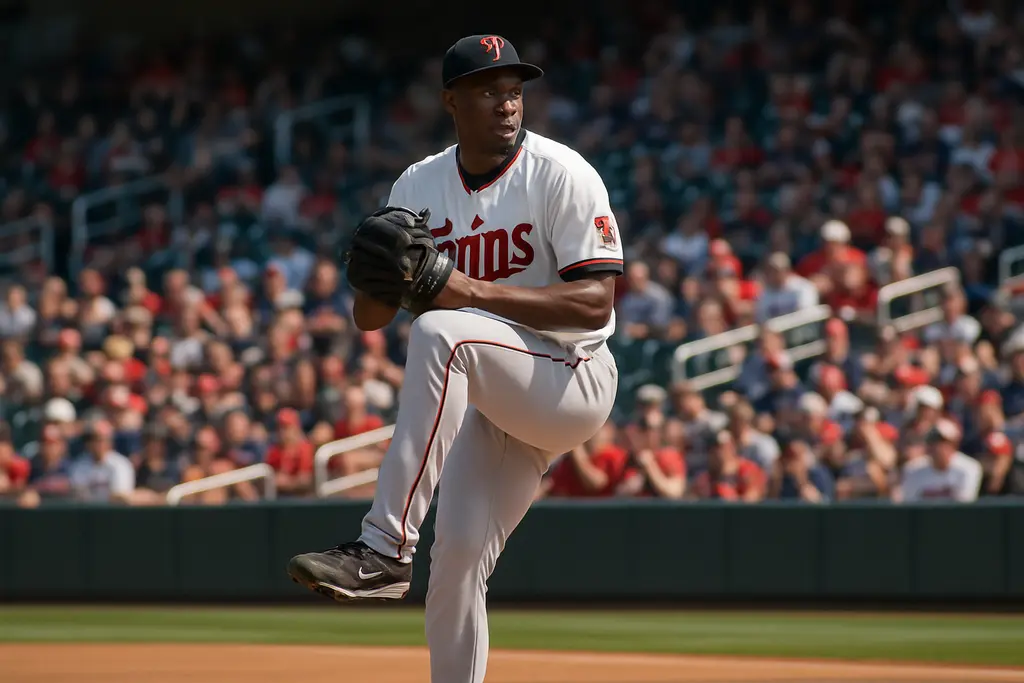
The Taj Bradley Emergence in Minnesota became one of the clearer player-development stories of the Twins’ 2026 season. It was not built on one isolated outing. Bradley’s case rested on volume, strikeout growth, and the way he held a larger place in the rotation after arriving from Tampa Bay in a July 31, 2025 trade for Griffin Jax.
By September 23, 2026, the shape of his season had become easier to measure. Against the San Francisco Giants at Oracle Park, Bradley worked six innings, struck out six, walked three, and helped Minnesota win 3-2. That start pushed him past 200 strikeouts in a season for the first time, and MLB’s Twins coverage credited him with a career-best year that included team highs in starts, innings, strikeouts, and wins in its recap of his 200-strikeout start.
For a baseball biographer, the value of the season is not only numerical. Bradley’s 2026 campaign marked a change in responsibility. He was no longer being discussed mainly as a talented arm with promise. He had become a pitcher whose workload and production shaped how the Twins organized their staff.
Taj Bradley Emergence In Minnesota
Why Taj Bradley Emergence Began Before September
Bradley’s late-September milestone mattered because it confirmed a pattern already visible in April and July. On April 8, 2026, against the Detroit Tigers, he threw 6⅓ innings, struck out 10, and owned a 1.08 ERA at the time of that start. That early performance gave Minnesota an immediate view of the pitcher it had acquired the previous summer: a power right-hander capable of missing bats while working deep enough to protect the bullpen.
The July 7, 2026 start against Cleveland added another reference point. Bradley threw seven innings, allowed one run, struck out 10, walked none, and helped the Twins to a 3-1 win. The research notes credited him with 25 swinging strikes in that outing. That detail matters because strikeout totals can sometimes be shaped by called strikes, opponent approach, or late-count chases. Swinging strikes point more directly to bat-missing force.
How The Trade Reset His Profile
Bradley joined the Twins after Minnesota acquired him from the Tampa Bay Rays on July 31, 2025. His 2026 season was his first full year with the club. That context is central to reading his breakthrough. The Twins were not only evaluating a pitcher’s raw performance; they were learning how his skills fit their game planning, catcher relationships, rest patterns, and defensive alignment.
The Taj Bradley Emergence also carried roster meaning because the Twins needed reliable innings. The research notes state that Bradley missed only two starts after a May injured-list stint, while Pablo López underwent season-ending Tommy John surgery. Without stretching the claim beyond the record, Bradley’s availability and production gave Minnesota a steadier rotation base than it would have had otherwise.
The Statistical Shape Of The Breakthrough
The 200-Strikeout Marker
The cleanest headline from Bradley’s season was the 200-strikeout threshold. MLB’s recap reported 205 strikeouts, 178⅓ innings, 31 starts, 12 wins, and a 3.73 ERA. Those numbers placed him at the top of several Twins categories in that report. Even allowing for the normal limits of win-loss record as a pitcher measure, the innings and strikeouts are harder to dismiss. They show both presence and bat-missing production.
A 200-strikeout season can mean different things depending on workload. In Bradley’s case, it came across 31 starts and just under 180 innings, according to the MLB report. That combination signals that Minnesota trusted him not only for short bursts but through a full starter’s assignment. The biographical significance is clear: he moved from projection to proof over a full major-league schedule.
Reconciling Public Stat Lines
There is one caution in reading the record. Public statistical pages did not present the season in identical form at the same point. Baseball Savant’s player page listed Bradley at 31 games and starts, 178.1 innings, an 11-6 record, a 3.81 ERA, 199 strikeouts, and a 1.23 WHIP on the cited line, while the research notes also recorded a Savant-related line closer to the MLB recap: 12-6, 3.73 ERA, 205 strikeouts, and a 1.22 WHIP. Readers can review the live player file at Baseball Savant.
That discrepancy does not erase the central finding. Both lines describe a starter who made 31 starts, approached or passed the 200-strikeout mark, and handled 178.1 or 178⅓ innings. The exact endpoint should be read with awareness that stat feeds can update around final scoring, team pages, and data refreshes. The safe analytical position is that Bradley produced a career-best season by volume and strikeout impact, with the MLB recap serving as the clearest published account of the 200-strikeout milestone.
Development Signals Inside The Season

Early Command And Swing-And-Miss
Bradley’s April and July starts point to two related growth areas: strikeout capacity and controlled damage. The April 8 line against Detroit showed early-season dominance. The July 7 line against Cleveland showed a version of Bradley that could miss bats without giving away free passes. Ten strikeouts and no walks over seven innings is a strong marker because it joins power with count control.
Pitchers can produce eye-catching strikeout totals while still straining a staff if they run high pitch counts or fail to finish innings. Bradley’s season, as described in the research record, leaned in the other direction often enough to change his role. He did not simply flash premium stuff. He accumulated innings at a level that mattered to a team dealing with rotation strain.
Durability Without Overstatement
Any biographical treatment should avoid turning one season into a settled career verdict. Bradley spent time on the injured list in early May 2026, and the research notes identify right pectoral inflammation as the issue. Before that absence, he was listed at 4-1 with a 2.87 ERA through eight starts, with 47 innings and 52 strikeouts. He returned to make enough starts for the season to read as a durability gain, but the injured-list stint remains part of the record.
Age also shapes the reading. The research notes list Bradley’s birth date as March 20, 2001. Using that date and the article date of September 29, 2026, he was 25 years old. That makes the season especially relevant for Minnesota’s planning because it came before the typical late-20s phase for many starting pitchers. For readers comparing player biographies across the same network, WikiApp provides reference-style sports pages that might offer additional insights.
Taj Bradley Emergence And The Twins’ Pitching Identity
The most useful way to place Bradley’s 2026 season is to see it as a shift in evidence. Before the season, the Twins had a pitcher with upside acquired from Tampa Bay. After September 23, they had a starter with a full-season workload, a 200-strikeout achievement according to MLB’s account, and repeated examples of high-strikeout starts against American League Central opponents.
The Taj Bradley Emergence did not solve every question about his long-term ceiling. ERA variation between public lines, the May injured-list period, and the normal year-to-year volatility of starting pitching all counsel caution. Still, the supported record shows a pitcher who became central to Minnesota’s 2026 staff. In biographical terms, this was the season when Bradley’s promise became attached to responsibility, not merely projection.