

Let’s start with a paradox: America’s pastime keeps rewriting its own history. The 2016 Cubs-Indians showdown wasn’t just seven games. It was 108 years of existential dread resolved by a rain delay and a David Ross homer. Think Shakespearean drama with chewing tobacco.
Now rewind to 1919. Eight White Sox players allegedly took payments smaller than a modern walk-up song fee. The Black Sox scandal turned baseball’s innocence into ”say it ain’t so” disillusionment. It was America’s first viral conspiracy theory, complete with grand jury testimonies instead of Twitter threads.
What makes these clashes endure? They’re not just athletic contests, but cultural Rorschach tests. The 1908 NL pennant race – baseball’s original reality show – featured Merkle’s Boner. Yes, that’s the official term, a baserunning blunder so cringeworthy it’d break TikTok’s servers today.
Can a championship rewrite civic identity? Ask Cleveland. The 2016 finale transformed Wrigleyville from lovable losers’ HQ to ground zero for champagne-soaked calculus. What’s the half-life of a century-old curse?
While, the Black Sox’s asterisked legacy birthed the commissioner’s office. Baseball’s first attempt at damage control before PR firms existed.
These aren’t games. They’re time capsules – frozen moments where athleticism collides with human frailty, greed, and redemption. And we’re just getting to the good part…
Introduction: Defining a “Memorable Series”
What makes nine innings legendary? Is it the sound of a bat or the shock when a ball slips through Bill Buckner’s legs? Let’s explore what makes epic MLB series unforgettable – those moments that live on long after the game.
Think back to 1994. A season cut short by labor strikes baseball fans are left with a void. No World Series, only what-ifs and a nation wondering: “Wait, did we just get blue-balled by Bud Selig?” This loss teaches us more about memorable moments than any trophy.
Three key elements create lasting memories:
- Historical consequence: The chase for home runs changed contracts and sparked congressional debates
- Shakespearean drama: The 1919 Black Sox scandal was full of betrayal, rivaling Game of Thrones
- Statistician’s nightmare: Moments where stats get lost in poetry
| Element | Memorable Series | Forgettable Series |
|---|---|---|
| Drama Quotient | Buckner’s error (1986) | Any mid-June Pirates game |
| Historical Impact | 1994 strike’s labor reforms | 2020 COVID bubble rules |
| Cultural Legacy | Bartman’s reach (2003) | Who won the 2012 NLDS? |
Even short seasons can leave a mark. The 2020 COVID season was unique, with empty stadiums and renegotiated labor strikes baseball debates. Did it feel like real baseball? Dodgers fans with their 60-game trophy say yes, no asterisk needed.
Memorable series aren’t about being perfect. They’re about the human side – errors, scandals, and moments that make us feel like we’re part of a story written by Sophocles.
The 1908 NL Race: Cubs, Giants, Pirates & Merkle’s Boner
Imagine a pennant race so chaotic it makes reality TV look like C-SPAN. The 1908 National League showdown between Chicago, New York, and Pittsburgh wasn’t just a baseball series—it was a three-act tragicomedy. Teenage brain fog altered the course of sports history. This wasn’t just a game; it was America’s first viral sports moment, complete with mob violence and rulebook loopholes.
The Phantom Play That Changed History
September 23, 1908. Polo Grounds. Bottom of the 9th. Giants rookie Fred Merkle—19 years young—forgets to touch second base on what should’ve been a game-winning hit. Cue the “ten innings at Wrigley” mythology. Cubs players literally snatched the ball from fans (yes, plural) who’d stormed the field, then appealed the play. The result? A forced replay that handed Chicago the pennant.
Let’s break down the madness:
| Team | Key Player | Season Wins | Ultimate Fate |
|---|---|---|---|
| Chicago Cubs | Three-Finger Brown | 99 | Last WS win until 2016 |
| New York Giants | Christy Mathewson | 98 | “Merkle’s Boner” immortality |
| Pittsburgh Pirates | Honus Wagner | 98 | Best team nobody remembers |
The aftermath? Police barricades at ballparks. Death threats via telegram. A 19-year-old became baseball’s first meme. Modern fans think they’ve seen collapses—this was the OG blueprint. The Cubs’ eventual World Series win? Just the cherry on this century-spanning drama sundae.
What makes this 1908 Cubs Giants pennant race truly unforgettable isn’t the error itself. It’s how three legendary franchises became trapped in a rules-lawyer’s paradise. This proves that baseball’s greatest stories aren’t written—they’re argued into existence by drunk fans and exasperated umpires.
Summer of ’49: Yankees vs Red Sox
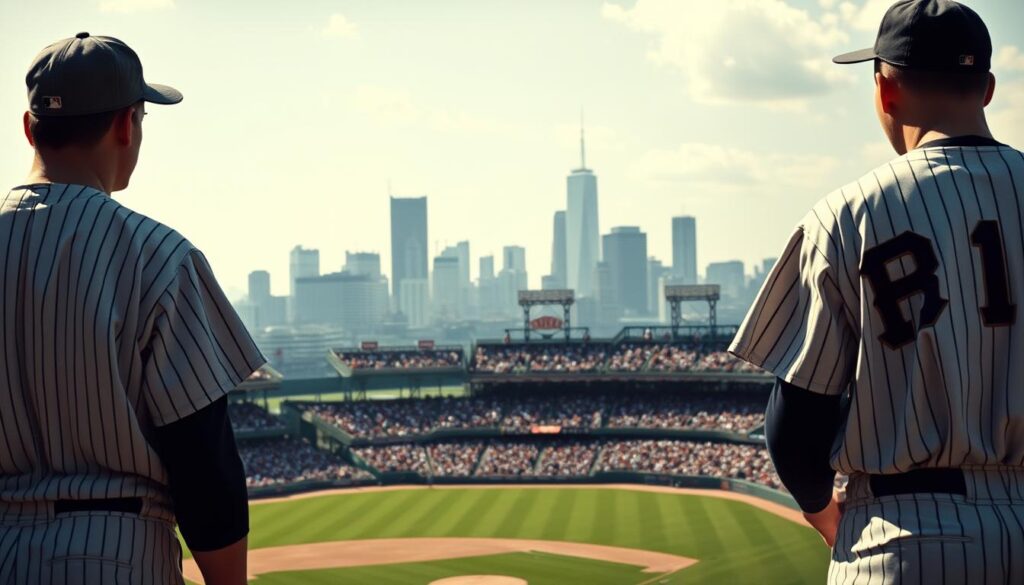
The summer of ’49 was more than a pennant race. It was a dramatic showdown where DiMaggio’s health issues were as intense as Boston’s hopes. This clash between the Yankees and Red Sox is the ultimate example of raw, unscripted drama in baseball.
The Birth of a Blood Feud
The New York Bronx Bombers were on a mission to win their 12th World Series in 15 years. They were so dominant, even their champagne seemed like a right. On the other side, Ted Williams’ Red Sox were a team of hard-hitting players who treated Yankee Stadium like their own turf. This set the stage for a legendary sports rivalry.
DiMaggio played through severe ulcers in August, maintaining a .346 average despite his pain. Williams, on the other hand, showed no mercy to Fenway fans, spitting at them during games. This was more than baseball—it was a spectacle with a raw, unfiltered edge.
| Team | Key Player | Pennant Race Record | Legacy Moment |
|---|---|---|---|
| 1949 Yankees | Joe DiMaggio | 97-57 (.630) | Won final 2 games vs Boston |
| 1949 Red Sox | Ted Williams | 96-58 (.623) | Lost 8 of last 11 games |
| Difference Maker | Phil Rizzuto’s glove | +23 defensive runs saved | Game-saving catch on Sept 30 |
The energy of World Series Game Six is timeless. It’s because of the genuine rivalry and no hidden scandals. When the Yankees won the pennant by a single game, they didn’t just win. They set the stage for all future underdog stories, from Rocky to today’s viral rivalries.
October 1964: Cardinals vs Yankees
Baseball’s world changed in 1964. The World Series became a clash of eras. Mickey Mantle’s fading swing met Bob Gibson’s fierce fastball. The Yankees’ glory days were fading, and the Cardinals were rising.
The Last Dynasty’s Final Bow
The Yankees came to St. Louis, but they were no longer the same. Their stars were injured and aging. Mantle’s knees were aching, and Roger Maris was fighting a broken hand.
The Cardinals had Gibson’s blazing fastball and Brock’s base stealing. They won Game 7, marking the end of an era. This victory was not just a win but a strike against tradition.
St. Louis’ victory was historic. It was their 10th championship. It also marked the start of a new era in baseball, with labor strikes becoming a reality. CBS bought the Yankees soon after, showing that even dynasties can fall.
Three big changes came from this unforgettable baseball series:
- The Yankees missed the playoffs for 12 years
- Gibson’s MVP performance foreshadowed his 1968 season
- Network TV coverage made stars into national icons
The Cardinals’ victory parade marked the end of an era. The clean-cut 1950s were gone, and the 1970s were on the horizon. Baseball was changing, and so was the world.
The Long Ball Era & Home Run Chases
Baseball in the late 90s was like a Vegas magic show. It had juiced balls, corked bats, and players who seemed superhuman. The 1998 home run chase was like our moon landing. Instead of astronauts, we saw Mark McGwire’s huge arms and Sammy Sosa’s showy antics.
McGwire vs Sosa vs Reality
70 home runs used to seem like a miracle. But it was just science. The McGwire-Sosa race gave us:
- Stadiums full of fans with “Chicks Dig the Long Ball” signs
- ESPN interrupting soap operas for live baseball updates
- A big leap of faith, bigger than McGwire’s androstenedione stash
But behind the scenes, there were secrets. Batting helmets hid more than just heads. Sosa’s “corked bat incident” showed the emptiness of the era.
Steroids’ Shadow Over the Record Books
The baseball steroid era changed sports history. It made us question everything. Here’s a messy comparison:
| Pre-1990s | 1996-2006 | Post-2006 Testing |
|---|---|---|
| 3 players with 50+ HR seasons | 23 players with 50+ HR seasons | 4 players with 50+ HR seasons |
| Natural power | Pharmaceutical power | “Clean” power (mostly) |
Congressional hearings made Clemens and Palmeiro look like actors. Their denials were as believable as a Little League pitcher’s curveball. The Houston Astros scandal showed cheating went beyond pills.
Today, fans face a hard truth: steroids in baseball history didn’t just ruin records. They made us question everything. Do we see talent, science, or cheating in the numbers?
1986 Mets vs Red Sox, 2016 Cubs vs Indians, and more
Baseball’s greatest moments aren’t scripted. They’re made in spectacular ways, like implosions and celebrations. Two series stand out: one where a ground ball betrayed, the other where a swing almost changed everything.
Curses, Collapses, and Champagne
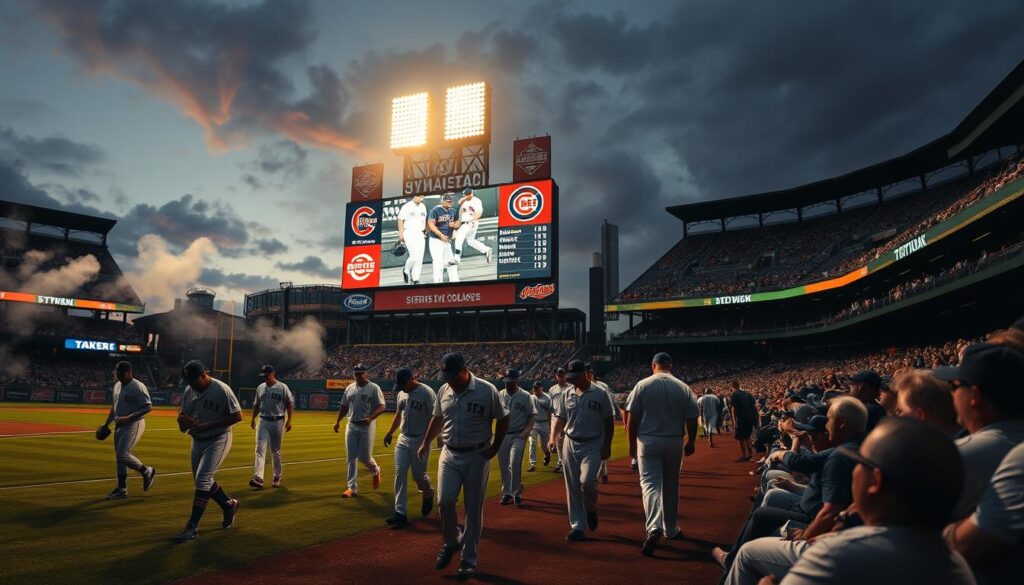
The 1986 World Series Game Six is a classic of late-game drama. The Red Sox were just one strike away from ending their 68-year wait. But Bill Buckner’s error turned a simple grounder into a tragedy.
The Mets’ comeback was not just unlikely—it was a lesson in psychological games. Boston’s team felt like they were facing the end, while New York celebrated like it was Mardi Gras.
Thirty years later, the 2016 Cubs-Indians series brought a new twist. Rajai Davis hit a home run in Game 7, a sign of Cleveland’s support. But baseball can be cruel. Ben Zobrist’s double in the 10th inning ended the Cubs’ drought, turning Wrigleyville into a sea of tears.
| Series | Collapse Catalyst | Redemption Arc | Cultural Impact |
|---|---|---|---|
| 1986 WS (Game 6) | Buckner’s error | Mets’ 3-run 10th inning | “The Curse of the Bambino” enters lexicon |
| 2016 WS (Game 7) | Chapman’s blown save | Zobrist’s go-ahead double | 108-year drought ends via Twitter meltdown |
These series show baseball’s true nature: momentum is just confidence wearing cleats. The ’86 Mets used chaos to their advantage. The 2016 Cubs turned a rain delay into a chance to heal.
Heyward’s speech in the weight room wasn’t just about winning. It was about letting go. Modern stats can’t measure the weight of history. Cleveland’s bullpen is haunted by Game 7. Boston’s ’86 team is forever explaining their loss.
Literary Echoes: Baseball’s Best Books on Classic Series
Baseball’s greatest stories aren’t just in highlight reels. They’re also in books, where box scores become epic tales. These books capture the smell of old hot dogs and the stress of front office decisions. They’re like binge-watching, but with baseball stats turned into poetry.
From Eliot Asinof to Moneyball
Eliot Asinof’s Eight Men Out is a masterpiece of baseball true crime. It dives deep into the 1919 Black Sox Scandal with the detail of a detective. Then, Buzz Bissinger’s Three Nights in August explores Tony La Russa’s mind with the depth of a documentary.
Modern classics show how advanced stats can be as dramatic as Shakespeare:
- Ten Innings at Wrigley: Kevin Cook turns a 1979 game into a time capsule, filled with 70s drama
- The Cubs Way: Tom Verducci makes WAR stats into a hero’s tale
- Michael Lewis’ Moneyball: A guide to using spreadsheets like a war strategy
| Book | Series Focus | Legacy |
|---|---|---|
| Eight Men Out | 1919 World Series | Definitive scandal autopsy |
| Three Nights in August | 2003 Cardinals-Cubs rivalry | Modern managerial blueprint |
| Ten Innings at Wrigley | 1979 Phillies-Cubs slugfest | Pre-Moneyball analytics snapshot |
These books are more than stories. They’re windows into America’s soul, showing how baseball reflects our culture. From the 1919 Black Sox Scandal to today’s front office battles, the best baseball writing is like a literary explosion.
Legacy and Cultural Impact
Baseball’s greatest irony? Its most infamous scandals became the stitches holding the game’s cultural fabric together. While purists clutch their pearls at every controversy, the truth is clear: without chaos, there’s no comeback story.
How Scandals Shaped the Modern Game
The Black Sox Scandal didn’t just ban Shoeless Joe – it birthed baseball’s first commissioner. Eight men out became 100 years of overcorrection. Fast-forward to 1994’s labor strikes baseball apocalypse: canceled World Series, burning jerseys, and a sport suddenly realizing it wasn’t bulletproof.
But here’s the curveball. That strike gave us interleague play – baseball’s version of “let’s distract them with shiny objects.” Suddenly, Yankees-Mets games mattered in June. Attendance records shattered. Who needs integrity when you’ve got subway series drama?
Modern “innovations” trace straight back to old sins. Robo-umps? Just MLB trying to prevent another Merkle’s Boner. The Astros’ trash-can symphony? A slapstick reminder that cheating never goes out of style. Each scandal plants seeds for tomorrow’s rule changes – and tomorrow’s memes.
Today’s game walks a tightrope between tradition and TikTok. The Black Sox taught us to monetize outrage. Labor strikes showed the power of fan forgiveness (or forgetfulness). And Houston’s antics? Proof that even billion-dollar industries can’t resist a little backyard mischief.
Further Reading and Analysis
Craving more baseball drama? Roger Kahn’s The Boys of Summer is a must-read. It dives into the Dodgers’ collapse and its lasting impact. For fans of the 1908 Cubs Giants pennant race, Edward G. Burns’ The First Fall Classic is a detailed look at Merkle’s infamous error.
Looking for a story with a twist? The Mitchell Report is like a Kafka novel, but with Jose Canseco’s diary. It’s a deep dive into steroids in baseball history. Eliot Asinof’s Eight Men Out is a poetic look at the Black Sox scandal, setting the stage for today’s controversies.
For stats lovers, Baseball-Reference’s leverage index is a game-changer. It measures tension like a Richter scale. It’s like fantasy baseball for those who love real numbers. Jane Leavy’s The Last Boy and Michael Lewis’ Moneyball offer unique perspectives on baseball legends.
Baseball’s stories are timeless. The real question is what we ignored while it happened. Pick up a book, dig into the details, and uncover the truth.