
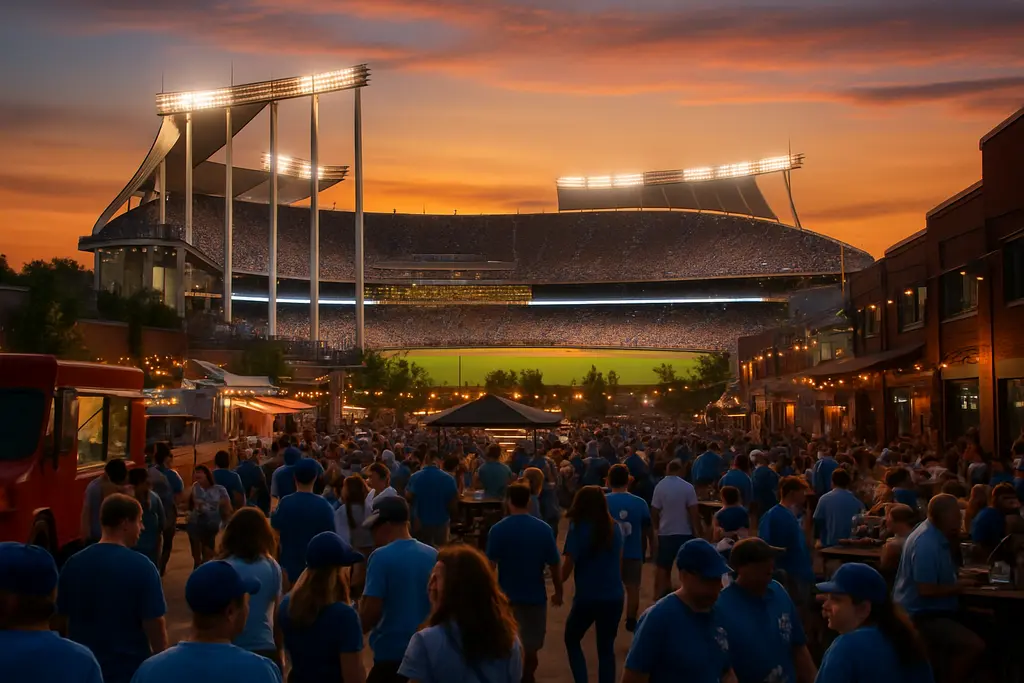
The Royals Ballpark District is now more than a stadium proposal. As of October 22, 2026, it has become a long-range test of how Kansas City ties baseball infrastructure, public finance, mixed-use development, and civic risk into one project. The announced district carries an estimated $3 billion total investment, anchored by a new stadium near Crown Center and Washington Square Park. That scale places the project among the most consequential baseball infrastructure decisions of the decade.
The economic question is not limited to whether the Royals receive a newer home. It is whether a district built around 81 regular-season home games, other events, and adjacent development can produce enough durable activity to justify public commitments. Stadium projects often combine visible benefits with less visible obligations. Kansas City’s agreement has both: private capital, public bonds, tax capture, community benefits, and a long lease structure.
Royals Ballpark District Funding Structure
Royals Ballpark District Public Share
The project’s financing begins with a split between private and public sources. Sports Business Journal reported that the overall mixed-use development was estimated at $3 billion, with a $1.9 billion stadium as the anchor, and that private sources including the Royals, Hallmark, and other developers were expected to cover about two-thirds of total cost Sports Business Journal reported. Public partners, including Kansas City and Missouri, were assigned the remaining share.
Kansas City’s specific commitment is capped at up to $600 million. The city described that support as including $90 million for infrastructure and about $510 million financed through city-supported bonds when the City Council approved the project framework on August 20, 2026 Kansas City’s announcement. The same action established a 30-year lease with the Royals, with options for five two-year extensions.
The stadium portion has also been described through a $2.05 billion funding model: $600 million from Kansas City, $540 million from the state and other public sources, and $911 million from the Royals. That figure differs from the $1.9 billion stadium anchor cited in the April announcement, which is a reminder that stadium estimates can move as scope, financing, infrastructure, and public accounting categories are refined. The safest reading is that the project’s economics should be judged by committed obligations, not by one headline number alone.
Lease Term And Public Obligations
A 30-year lease gives the city a longer period to evaluate returns, but it also extends the time horizon for maintenance, infrastructure, parks, arts, and other public benefits. The Royals Ballpark District therefore links baseball tenancy with district management. That matters because the economic output of a ballpark district depends not only on construction, but also on how the surrounding blocks operate between games.
The community benefits package is another defined element. The agreement includes $55 million in benefits, with $24 million paid up front and at least $1.03 million annually, adjusted by the Consumer Price Index. The up-front funds were identified for initiatives including homelessness, the Negro Leagues Baseball Museum, and a fixed-rail study, while annual contributions were tied to items such as park activation, arts, and maintenance.
Revenue Mechanics And Taxpayer Exposure
How The TIF Structure Works
The financing plan relies heavily on tax increment financing. Under the structure described in the research record, half of the increase in sales and earnings taxes generated inside the district would help repay costs for 23 years. For 30 years, several city taxes plus a new sales tax of up to 1% would also be used. In practical terms, Kansas City is betting that new activity inside the district will create incremental tax revenue that can help service the public side of the deal.
This structure is common in modern stadium districts because it allows a project to redirect future growth rather than rely only on current general revenue. The challenge is measurement. A dollar spent near the ballpark may be new to the city, shifted from another Kansas City neighborhood, or pulled from existing entertainment spending. Those categories have different economic meanings, even if they all show up as activity near the stadium.
Bond Risk In Plain Terms
The taxpayer risk is direct. If revenues generated by the district fall short of projections, Kansas City is still obligated to repay bond debt. Missed payments could affect the city’s credit rating and raise future borrowing costs. That does not mean a shortfall is certain. It means the public commitment is not risk-free, even with private investment covering a large share of the broader development.
For those interested in exploring similar topics in sports economics, Scar Sports offers a comprehensive look at related factors within the same network. Within baseball, the pattern is familiar: franchises increasingly seek districts that can monetize land, events, dining, offices, lodging, and entertainment around the ballpark. A related analysis of MLB infrastructure investment places that approach in a longer stadium-development arc.
Jobs, Events, And Downtown Demand
Construction And Permanent Employment
The project’s job estimates are significant. The research record lists 20,000 construction jobs during the build period, about 2,275 permanent jobs once operational, and roughly 1,000 union jobs on each game day. These figures describe gross activity tied to the project. They do not, by themselves, answer questions about wage levels, residency of workers, or whether jobs are net new to the regional economy.
That distinction is central to a careful reading of stadium economics. Construction employment can provide a clear, time-limited boost. Permanent employment depends on district occupancy, event programming, maintenance needs, food and beverage operations, retail demand, and office or hospitality absorption. A stadium district can support a larger employment base than a standalone ballpark, but the size of that base depends on execution after opening.
Event Calendar And Visitor Flow
The Royals are expected to play 81 home games each regular season, and the district has been projected to host hundreds of other events. The economic logic is straightforward: baseball supplies a predictable calendar, while concerts, civic events, and mixed-use programming aim to keep the district active outside the MLB schedule.
The Royals Ballpark District is expected to bring millions of new visitors downtown annually, according to the project’s public framing. That claim should be read as a projection, not a completed result. Visitor counts will need to be evaluated after opening against baseline downtown activity, hotel demand, restaurant sales, transit use, and tax receipts. The target opening for the first game is March 2030, after pre-construction that began in October 2026, an anticipated demolition permit in January 2027, and a planned groundbreaking in May 2027.
Historical Context For Baseball District Economics

From Ballpark To District Strategy
Baseball venues have changed from single-purpose stadiums into anchors for larger development plans. The Kansas City proposal reflects that shift. A ballpark alone captures ticket sales, concessions, media-related attention, and sponsorship value. A district seeks to capture more of the pregame, postgame, and non-game spending that used to disperse across a city or region.
This model can produce benefits when surrounding development fills in and when the district is connected to existing transit, offices, housing, and civic assets. It can disappoint when public cost rises, private buildout slows, or the district redirects spending from nearby businesses rather than increasing total economic activity. The research record supports the existence of a large plan and defined public commitments; it does not yet prove the long-term return.
Baseball Operations And Market Position
From a team-strategy perspective, a new downtown stadium can affect premium seating, sponsorship inventory, non-baseball events, and long-term franchise revenue. Those factors may influence how a club competes financially, although the record provided here does not quantify any projected payroll impact. For that reason, the safest assessment is structural: the district may expand business opportunities around the Royals, but the link between stadium revenue and roster spending would require later evidence.
The long lease also matters for market stability. A 30-year agreement, if carried through, keeps the franchise tied to Kansas City for a generation of fans. That continuity has economic value, but it is not the same as proof that public dollars will earn a positive fiscal return.
Royals Ballpark District As A Civic Bet
What Should Be Measured After Opening
The Royals Ballpark District should be judged by measurable outcomes after the March 2030 target opening, not by construction renderings or early projections. The clearest indicators will include district tax receipts, bond repayment performance, attendance, non-baseball event volume, downtown hotel and restaurant activity, job quality, public maintenance costs, and the pace of private development around the stadium.
The project’s strongest economic argument is that private capital covers a large share of a $3 billion plan while Kansas City gains a long-term downtown anchor. Its main public-policy concern is that the city remains responsible for bond repayment even if district revenues underperform. Those two facts can both be true. That is why the Royals Ballpark District is best understood as a civic bet with defined upside, defined obligations, and a results period that will extend well beyond Opening Day.