

Imagine Ty Cobb sharpening his spikes and contract demands. Baseball is more about money than peanuts and Cracker Jacks. The fight for fair pay started in the 1870s, when players were treated like property.
Before free agency, players were paid like factory workers. The National League in 1876 set player salaries at $2,000 (about $55k today). This was their first move, not scheduling games.
The Great Depression brought more challenges. While fans waited for soup, owners sold players to stay afloat. Babe Ruth famously asked for $80k in 1930, saying he had a better year than President Hoover.
This isn’t just sports history. It shows America’s labor struggles through baseball. From handshake deals to lockouts, it’s a game of power and money.
Baseball’s Early Reserve Clause and Labor Roots
Imagine a world where your boss can trade you like a pocket watch. Welcome to 19th century baseball, where athletes were treated like property. The game’s labor history was shaped by the same forces as the railroad and factories.
John Montgomery Ward was a key figure in labor history. He played for the New York Giants in 1885 and started the Brotherhood union. His goals were simple yet bold:
- End the reserve clause’s lifetime contracts
- Establish minimum salaries ($1,500 – serious money when beers cost a nickel)
- Create a profit-sharing model that would make Karl Marx tip his hat
Owners fought back like villains from a Mark Twain novel. They blacklisted Brotherhood members. This showed baseball’s labor battles were far from “Field of Dreams” and more like Les Misérables with pine tar. The reserve clause remained, a legal chain that today’s non-compete agreements seem lenient by comparison.
The Negro Leagues were a different story. They operated like jazz, with stars like Satchel Paige moving freely. Without contracts, Paige and others became early free agents, moving teams like a 1930s LeBron James. Their approach was ahead of its time, showing players could succeed without being owned:
| MLB System | Negro Leagues Model |
|---|---|
| Lifetime contracts | Seasonal agreements |
| Owner-controlled trades | Player-negotiated moves |
| Fixed salaries | Profit-sharing barnstorming |
Paige’s move to Cleveland in 1948 was more than just breaking barriers. It was a major labor victory, showing athletes could succeed without being owned.
The 1972 MLB Strike
When baseball owners tried to pay players less for pensions, they didn’t count on Marvin Miller. The 1972 MLB strike was about $500,000 in pension contributions, not huge salaries or social media fame. Owners laughed it off, but players were ready to fight.
Miller, the union leader, turned the game into a war. He united players, saying “No pension, no peace!”. Owners offered a cold “Take it or leave it” deal. Guess what? The players left it.
This 13-day strike was big:
- First strike in MLB history to cancel regular-season games
- Proved the union could stand up to owners
- Set the stage for baseball free agency fights
| What Owners Offered | What Players Wanted | What They Got | Lasting Impact |
|---|---|---|---|
| $250k pension boost | $500k pension funding | $500k + interest | Proved collective action works |
| “Final” take-it-or-leave deal | Binding arbitration rights | Partial arbitration | Paved way for 1976 free agency |
| Threats of replacement players | Guaranteed union recognition | Union legitimacy | Set stage for ’81 & ’94 strikes |
Hall of Famer Reggie Jackson said it best: “We weren’t asking for yachts—just dignity.” The deal gave players both, plus something even more valuable: power. Owners had to start treating players like equals, not just employees.
This strike was a rehearsal for future mlb labor strikes. Miller’s tactics—using the media, educating players, and timing their actions—became the standard. The ’72 strike showed owners could be hurt, and players could make them bleed.
1981 and 1994 Major Strikes: Causes and Effects

Imagine Thanos erasing the World Series. That’s what happened in 1994 due to baseball’s labor wars. To understand why, we must go back to 1981 and the start of baseball free agency.
The 1981 strike was like a messy divorce over money and control. Owners wanted to take back free agency rights. Players walked out for 50 days, causing chaos. This led to a $146 million loss and a complicated playoff system.
In 1994, the conflict grew worse. Owners wanted a salary cap; players saw it as a threat. The standoff resulted in:
- The first canceled World Series in 90 years
- $580 million in losses (enough to buy 580 million hot dogs)
- Bud Selig becoming a comic book villain (“This time it’s personal!”)
The 1994 MLB strike didn’t just end a season. It also killed Hollywood dreams. Disney put off their Angels in the Outfield sequel because of the strike.
The strike’s economic impact changed baseball. Merchandise sales dropped 45%, and attendance took five years to bounce back. Casual fans turned to the NBA instead. Yet, the strike led to better negotiations between owners and players.
The 1981 conflict was a small fight over baseball free agency. But 1994 was a war that changed labor relations. It showed that even America’s pastime can be destroyed by greed. The real tragedy? We’ll never know if that Angels sequel could’ve been great.
Lockouts, Arbitration, and Player Rights
Ever wonder why MLB lockouts feel like a high-stakes game of Monopoly? It’s not about who can afford more yachts. It’s a battle for control. Owners lock doors like bouncers at an exclusive club. Players respond by holding back their fastballs like gunslingers in a spaghetti-western.
Arbitration began in the 1970s as a peace offer. It was meant to avoid big contract disputes. Now, it’s baseball’s most awkward salary speed-dating event. Teams bring spreadsheets to argue their players are underpaid. Players counter with stats showing they’re worth more.
The 2016 Kris Bryant saga is a prime example. The Cubs undervalued their superstar, losing the case spectacularly.
| Labor Mechanism | Who Holds the Leverage? | Real-World Impact |
|---|---|---|
| Lockouts | Owners | Freezes roster moves, pressures players pre-season |
| Strikes | Players | Halts games, risks fan backlash |
| Arbitration | Neutral judges | Sets market value precedents for future stars |
Arbitration has become young players’ secret weapon. While veterans chase big money, rookies use arbitration to get paid. The 2022 Juan Soto situation showed this. The Nationals had to choose between paying a star player or losing out.
Modern labor tactics show a harsh truth. Teams would prefer to lose games than lose financial control. The 2021-22 MLB lockout was about owning the chessboard. Owners delayed the season, hoping players would give in. But they didn’t. And that’s how arbitration became a powerful tool.
How Labor Disputes Changed the Game
Baseball’s biggest battles aren’t just on the field. They’re in the courtroom too. Welcome to the Lawyer Ball Era. Here, agreements changed everything from pitcher rotations to where teams play. Let’s look at how labor disputes changed the game.
The baseball westward expansion wasn’t just about moving west. After the 1970s strikes, MLB sought peace. Teams moved to new markets with better TV deals. Sorry, Montreal – your Expos were traded for Washington’s money and Denver’s air.
The designated hitter rule was a clever distraction. Introduced in 1973, it was used to avoid real issues like pensions. It split strategy between leagues, and American League fans are not happy.
Today’s big bonuses for Dominican prospects? Thanks to the ’70s strike. Those battles led to free agency and arbitration. Now, talent from the Caribbean is a big deal, thanks to street agents.
Revenue sharing brought us the art of tanking. Why win games when you can make money from losing? Small-market teams learned to profit from losing, keeping payrolls low. Moneyball meets Monopoly money.
Labor disputes changed the game in many ways. They altered rules and where teams play. Next time you see a DH or a team tanking, remember: it’s all about lawyerball.
The Owners, Players Union, and Free Agency Battles
Imagine Succession meets Moneyball with nine innings of high-stakes poker. The MLB labor history is a 50-year battle between billionaires and millionaires. It’s about contracts and fairness, with baseball free agency as the main prize.
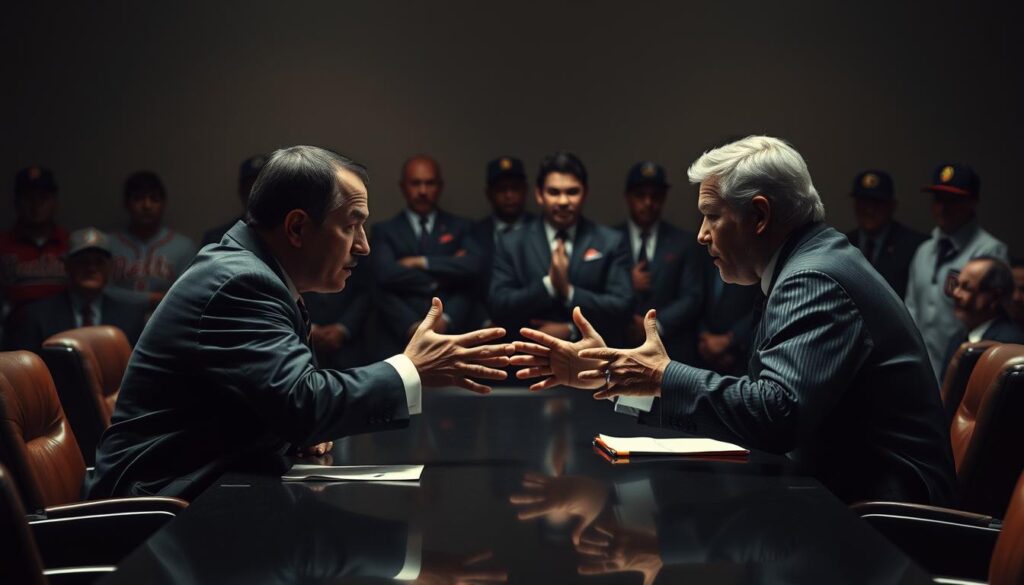
The MLBPA’s journey started with Curt Flood’s 1972 Supreme Court gamble. His lawsuit failed, but it sent a strong message. Players weren’t livestock to be traded like cattle futures.
By 1976, free agency arrived, and salaries skyrocketed 400% in a decade. Owners then used three collusion schemes in the 1980s to secretly block free agents.
Here’s what they did:
- 1985-87: Secret database tracking player negotiations
- Phantom “final offers” from imaginary teams
- $280 million in damages paid to players (the union’s first nuclear win)
Enter Scott Boras’ private jets and Alex Rodriguez’s $252 million Texas deal. These were not just contracts but deterrents. When owners tried to cap salaries, the union showed A-Rod’s deal as proof.
Today’s battles are over service time manipulation. Teams now:
- Delay prospect call-ups to control cheap contract years
- Use “optional assignments” as contractual sleight-of-hand
- Turn WAR metrics into salary suppression algorithms
The 2022 lockout introduced new rules, like a $230 million luxury tax threshold. But, as one agent said: “It’s Monopoly, just with better hotels.” Players now earn $4.9 million annually, while owners’ values soar past $2.3 billion. It’s a stalemate, not a victory.
Notable Books and Documentation
MLB’s official labor histories are like a slow pitch. But these books? They’re like fastballs to the brain. Let’s find the best in baseball’s books, because we don’t need another “Owners’ Guide to Pretending They’re Broke.”
Lords of the Realm by John Helyar is a must-read. It’s like Ball Four but for the labor movement. Owners are the villains, and it’s a thrilling story about basic worker rights. Why read MLB’s boring papers when you can see Bowie Kuhn’s ghost squirm?
Marvin Miller’s A Whole Different Ball Game is a masterpiece. It’s like a playbook and origin story all in one. Imagine Bruce Wayne unionizing Gotham’s workers. Miller’s story of taking down the reserve clause is powerful.
For those who want real sources without falling asleep:
- The Players’ Union by Robert Burk: Labor law meets sabermetrics
- Moneyball meets Marx in Andrew Zimbalist’s economic deep dives
- Collective bargaining agreements as “How to Spot Billionaire Bullshit” textbooks
These aren’t just books. They’re tools to fight “But the owners built the stadiums!” arguments. Learn this stuff, and you’ll be the smartest person at Cooperstown. You’ll know more about Curt Flood than his batting average.
Impact on Fans and the Sport’s Image
Baseball’s labor disputes are more than just owner-player issues. They hurt fan loyalty deeply. The 1994 MLB labor strike didn’t just cancel a World Series. It also led to a loss of 18.5 million ticket sales the next year.
It took a decade for attendance to start getting better. Even today, some fans remember “the betrayal” like it was a family split.
The Montreal Expos, on the verge of winning in ’94, were lost forever. The strike sank their chances, attendance, and eventually the team itself. Fans turned against the game, burning jerseys and holding pitchforks.
Owners tried to win fans back with “Think of the children!” messages. But players union reps seemed out of touch, tweeting “We’ll explain later” messages.
MLB’s PR disasters made the steroid era seem tame by comparison. At least McGwire and Sosa gave us something to watch. But labor fights turned ballparks into ghost towns and ESPN into C-SPAN with peanuts.
| PR Strategy | Owners’ Playbook | Players’ Counter |
|---|---|---|
| Emotional Appeal | “Save our national pastime!” | “We’re fighting for your kids’ heroes” |
| Fan Outreach | Free hot dog coupons | Autograph sessions with caveats |
| Media Spin | Blame “greedy players” | Blame “billionaire owners” |
Today, fans view baseball like a flaky ex. They’ll come for nostalgia and TikTok moments, but the blind devotion is gone. Labor peace now feels like a truce in a rigged game, with fans as the scorekeepers.
Learnings for Modern Sports Labor Relations
Doug DeCinces might not be as famous as LeBron James, but his fight is important. In 1976, he challenged MLB’s reserve clause, starting a movement for athlete rights. Today, NBA stars use labor negotiations like chess players. MLS players broke free from salary limits, and WNBA players are changing ownership rules.
The fight in baseball didn’t just free players. It showed how to change sports for the better.
Think about how sports have grown. Leagues now play in places like Tokyo and Riyadh. The MLB lockout seems small compared to soccer’s huge transfer markets or F1’s complex sponsorships.
Digital assets are changing the game. Imagine Shohei Ohtani’s next contract including NFTs for strikeout milestones. It’s a new way to pay players based on their performance.
Three big changes are happening in sports labor:
- Data sovereignty: Players use biometrics and AI in contract talks
- Cross-league solidarity: The NBPA and MLBPA work together
- Fan-as-stakeholder: Social media makes fans’ voices heard
While athletes gain power, owners act like they’re stuck in the past. The 2022 MLB lockout showed that billionaires would cancel games before sharing revenue. But Generation Z athletes want more than just money. They want equity, creative control, and green stadiums.
The next big thing? Robots calling balls and strikes. Someone will ask why they don’t get health insurance.
So, what do today’s negotiators need to know? Learn from Marvin Miller, treat NFTs like a new tax, and remember: players who changed baseball didn’t just swing bats. They changed systems. Now, grab your bargaining agreement and a coffee. The future of sports labor is coming, and it won’t wait.
Conclusion
Baseball’s labor disputes are more than just about money. They show how America’s favorite sport reflects the ups and downs of capitalism. Every strike and lockout has changed the game, making players both workers and entertainers.
The history of MLB strikes is a story of power and change. It shows how players moved from being treated like property to being true partners. The 1994 strike, for example, highlighted the deep issues in labor relations, revealing the dark side of the game’s past.
The real battle in baseball isn’t just about the game itself. It’s about the fight between labor and capital. Today’s free agency battles are much bigger than the ones in the past. The current negotiations are like corporate deals, not simple agreements.
This isn’t just about baseball history. It’s about American history, seen through the lens of sports. The MLB strikes tell us about the clash between national myths and economic realities. They remind us why player pensions are as important as winning championships.
As we look forward to the next labor dispute, we must think about its impact. Will future fans see these struggles as growing pains or warning signs? The answer will shape the future of baseball and American sports.