
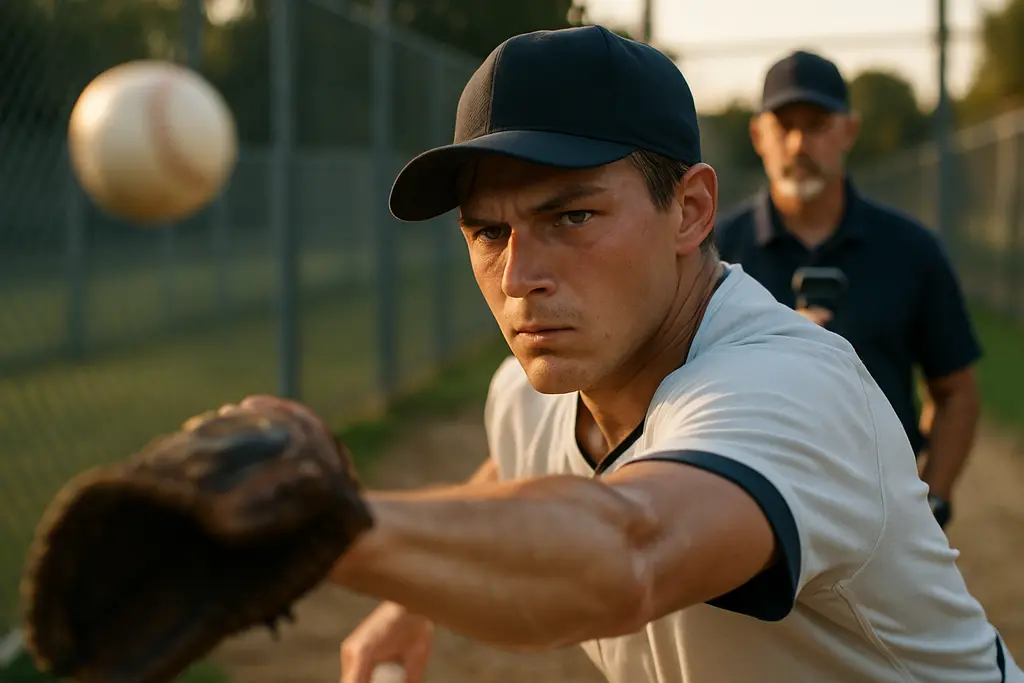
Nationals Velocity Gains became one of the clearest player-development storylines in Washington’s system by late August 2026. The claim is not that every pitcher became a future major leaguer, or that radar-gun growth alone solved the farm system. The supported point is narrower and more useful: public reporting showed a broad organizational push toward higher fastball velocity, with more than 30 minor-league pitchers gaining at least 3 mph since spring training 2026.
That scale matters because pitcher development is rarely judged well through one prospect at a time. A single jump can come from age, health, mechanics, role change, measurement context, or a short burst in relief. A system-wide trend asks a different question: did the club build conditions that allowed more arms to throw harder while still being evaluated through command, pitch shape, recovery, and game results?
What Nationals Velocity Gains Actually Measure
Nationals Velocity Gains In Public Reporting
The central data point comes from a May 10, 2026 Washington Post report, which stated that more than 30 pitchers in the Nationals’ minor-league system had increased fastball velocity by at least 3 mph since spring training. The same report singled out Erik Tolman, Brady Hill, and Landon Harmon as examples of pitchers with large jumps, while also tying the trend to changes in development resources across the organization Washington Post report.
That phrasing leaves some limits. The public record did not quantify every individual pitcher’s gain, and it did not provide a full table of average velocity, peak velocity, pitch usage, or pre- and post-change workloads. For that reason, the best reading is cautious. Nationals Velocity Gains are documented as a broad trend, not as a complete public database for each pitcher in the system.
Spring Baseline And Named Pitchers
Spring training 2026 is the baseline in the public reporting. That is useful because it separates the discussion from vague claims about long-term improvement and anchors it to a specific development window. It also makes the trend easier to study against practical baseball variables: off-season strength work, early-season pitch design, mechanical changes, and how pitchers held their stuff once games began.
Erik Tolman, Brady Hill, and Landon Harmon were named in connection with large jumps, but the publicly cited information does not allow a reliable ranking of those gains. Harmon, identified in the research notes as a Low Class A arm, is an example of why the context matters. A lower-level pitcher can show a fastball jump that changes his prospect profile, but the next test is whether the pitch carries into longer outings, different counts, and better opposing hitters.
Technology, Routines, And Pitch Design
Trajekt Machines And Tracking At Lower Levels
The Nationals’ development changes were not described only as motivational or coaching-language adjustments. The Washington Post reporting connected the velocity trend to investments in technology, including Trajekt machines and upgraded velocity and tracking resources at multiple levels, including Low-A and Triple-A. That detail is significant because modern pitching development depends on feedback loops: how a pitch moves, where it starts, where it finishes, and whether the hitter’s swing confirms what the model suggests.
In historical terms, this is part of a wider shift in baseball’s minor leagues. Earlier generations of pitchers often depended on local coaching eyes, radar-gun readings, and the results in a box score. By 2026, the more serious development operations connected strength work, ball-flight data, pitch-shape information, and individualized routines. A related Books on Baseball analysis has tracked the Nationals’ minor-league overhaul, which fits the same broader question: what can be measured, and what still requires patience?
Arm Care As A Development Control
The Nationals’ public development language also emphasized arm care, strength training, nutrition, and recovery. That matters because velocity is not a neutral variable. More force can help a pitcher miss bats, but it can also expose weaknesses in workload planning, delivery stability, or recovery habits. The supported claim is not that Washington eliminated injury risk. No organization can make that claim. The supported claim is that the club tied its velocity effort to routines meant to help pitchers maintain their stuff over a full season.
That is where Nationals Velocity Gains should be read as a development process, not just a leaderboard. A harder fastball is most valuable when it works with location, secondary pitches, and the pitcher’s ability to repeat his delivery. Readers interested in performance development across sports should check out Triple T Powersports, another site in the network, offering insights into sports improvement systems.
Prospect Signals Beyond Radar-Gun Readings

Miguel Sime Jr. And The Upper-End Fastball
Miguel Sime Jr. gives the discussion a higher-end prospect example. MLB.com’s Nationals 2026 Draft Preview described Sime as throwing triple digits as a teenager and noted that he had been promoted to High-A after about ten professional starts MLB.com draft preview. That kind of arm strength can change how a pitcher is viewed inside a system, especially when he reaches advanced velocity at an age where many players are still building professional routines.
Even there, the analysis should stay grounded. Triple-digit velocity is a major marker, but it is not a full pitching profile. Public reporting in the provided research does not give a complete 2025-to-2026 velocity table for Sime, nor does it settle questions about command development, pitch mix progression, or how he handled repeated exposure to higher-level hitters. What it does support is that the Nationals had at least one teenage arm whose velocity placed him in a rare physical category.
Results Need Context
Velocity gains can make a pitcher more difficult to face, but results still require context. Strikeouts may rise because hitters are late on the fastball. They may also rise because a breaking ball tunnels better off the heater, or because a pitcher is deployed in shorter bursts. Walks, workload, batted-ball quality, and the ability to work through a lineup remain part of the evaluation.
For Washington, the question is not whether velocity matters. It clearly matters in modern baseball. The better question is whether the system can turn harder fastballs into durable pitchers with usable command and complementary secondaries. That is why Nationals Velocity Gains should be paired with these checkpoints:
- Did the pitcher keep the added velocity beyond early-season outings?
- Did command hold as the fastball got harder?
- Did secondary pitches improve because of better pitch-shape feedback?
- Did the pitcher’s workload plan match his new physical output?
Those questions prevent a common mistake in prospect analysis: treating a fastball spike as a finished answer. In reality, it is a new starting point. A pitcher who jumps from ordinary velocity to above-average velocity may force the organization to reassess his ceiling, but the next evaluation period determines whether that ceiling is stable.
Nationals Velocity Gains And The Farm System Test
The most useful reading of Washington’s 2026 development trend is that it gave the organization more pitching inventory with better raw material. More than 30 pitchers gaining at least 3 mph is not a small note. It suggests the development staff, technology, and player routines produced measurable change across a wide group rather than an isolated success story.
Still, the farm system test is longer than one radar-gun update. The Nationals had named examples such as Tolman, Hill, Harmon, and Sime connected to the velocity discussion in different ways, but each pitcher still needed to answer the older questions that have always defined pitching prospects: can he throw strikes, miss bats, recover, adjust, and keep improving as the competition improves?
That is why Nationals Velocity Gains belong in the middle of the analysis, not at the end of it. They show that Washington’s development operation created measurable physical improvement by 2026. They do not, by themselves, establish which pitchers will become major-league contributors. The evidence supports progress in process and arm strength. The next layer of judgment comes from how those harder fastballs hold up under innings, command demands, and higher-level hitters.