
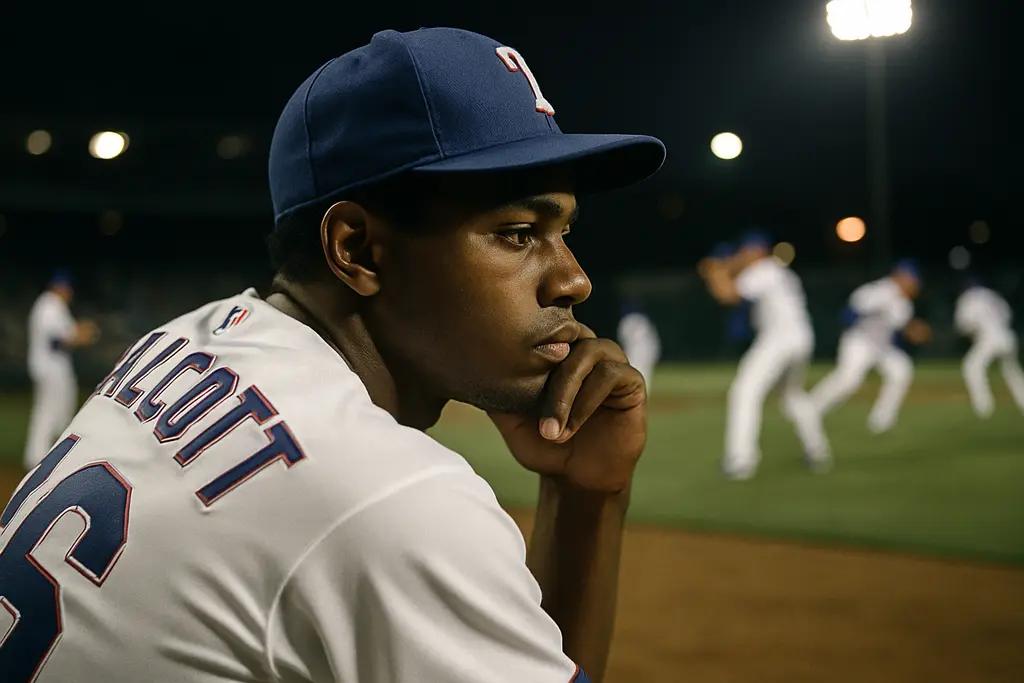
The Sebastian Walcott return became one of the more useful player-development case studies in the Texas Rangers system in 2026. It was not just a story about a top prospect getting back into games. It offered a clearer view of how the organization balanced medical limits, offensive reps, defensive timing, and long-range roster value after a significant elbow procedure.
On February 24, 2026, Walcott underwent successful internal brace surgery on his right elbow and avoided a full Tommy John procedure, with the initial recovery projection placing him about five to six months from hitting activity, according to MLB’s report on the surgery. That distinction mattered because it preserved part of his 2026 season rather than removing the entire campaign from his development file.
Walcott had been placed on the 60-day injured list in early March 2026 and missed the first half of the season while working through throwing and rehabilitation activities. By June 16, 2026, he had joined the Rangers in Arlington for rehabilitation work with the big league club. His first in-game action after surgery came on July 14, 2026, in the Arizona Complex League, and he returned to Frisco, the Rangers’ Double-A affiliate, on July 17, 2026.
Sebastian Walcott Return In Development Context
What Sebastian Walcott Return Changed
The Sebastian Walcott return changed the evidence available to Texas. Before July 2026, the Rangers were working from medical checkpoints and controlled activity. After July 14, they had game data again: timing against live pitching, swing quality, base-running activity, and later a limited look at his return to shortstop. For a player ranked at the top of the club’s prospect group, that difference was not minor.
Texas did not receive a full season of information, but it did avoid a total blank year. In player-development terms, that is a meaningful distinction. A lost year can interrupt pitch recognition, defensive rhythm, and workload planning. Walcott’s 2026 season still carried those concerns, but his mid-July return allowed the Rangers to assess how much offensive timing had remained intact after surgery.
The Timeline That Shaped The Sample
The timeline also explains why his 2026 data needs careful handling. He did not play a normal opening-to-finale minor league schedule. He returned through the Arizona Complex League, moved back to Double-A, spent much of the period as a designated hitter, and had a separate interruption in early August after being struck in the head by a pickoff throw. That August 2–3, 2026 incident led to a seven-day injured list placement for Frisco.
| Date | Development Point | Analytical Relevance |
|---|---|---|
| February 24, 2026 | Internal brace surgery on right elbow | Created a shorter projected absence than full Tommy John surgery |
| Early March 2026 | Placed on 60-day injured list | Removed first-half game exposure |
| June 16, 2026 | Rehab work with Rangers in Arlington | Marked a transition toward baseball activity |
| July 14, 2026 | Rehab game action in the ACL | Restored live-game evaluation |
| July 17, 2026 | Activated with Frisco | Returned to upper-minors competition |
| September 2026 finale | First shortstop appearance of 2026 | Provided a late defensive checkpoint |
Offensive Signals After Surgery
Power Production In Limited Games
Walcott’s offensive output after returning was the clearest positive signal. Through 39 regular-season games in 2026, including two in the Arizona Complex League, he hit .329/.404/.608 with 10 home runs, 14 doubles, 12 steals, and 48 runs scored. In his first 31 games back between the ACL and Double-A, he produced a .325/.411/.626 line, eight home runs, and a 1.037 OPS.
Those numbers came in a limited sample, so they should not be treated as a final statement about his major league readiness. They do show that his swing and power production returned quickly enough to matter. For Texas, that was central. Walcott’s value is tied not only to defensive projection but also to the possibility that his bat can carry impact power from the middle infield.
Why Designated Hitter Usage Matters
Much of the post-surgery usage came at designated hitter because of the elbow recovery. That protected the throwing side of his game, but it also narrowed the evaluation. The Rangers could measure offensive timing, running activity, and game rhythm, yet they had far less evidence on throwing accuracy, infield footwork, and repeated defensive workload.
This is where the context is more valuable than the slash line alone. A prospect can hit well while still lacking a full defensive workload after elbow surgery. Walcott’s offensive numbers suggested that the bat did not lose much visible force in the short term. The defensive side required more patience, and the organization treated it that way.
Defensive Timing And Rangers Planning
Shortstop Reintroduction In September
In the Double-A regular-season finale in September 2026, Walcott played shortstop for the first time that year. He made three infield assists and one putout in four chances and went 1-for-3 with a run scored. The appearance did not prove that he was ready for a full shortstop workload, but it did show that the Rangers were willing to reintroduce him to the position before the season ended.
That late defensive step carried analytical weight because shortstop is central to his prospect profile. If he remains viable there, his offensive production has a different roster meaning than it would at a corner position or in a bat-first role. The September game was only one data point, but it prevented the defensive file from being entirely theoretical in 2026.
System Value Without Overstating Certainty
Walcott remained the Rangers’ top-ranked prospect and was listed as MLB’s No. 9 overall prospect, with arm strength graded as a 70 tool and power potential among his best attributes on Baseball Savant’s player page. That combination explains why Texas had reason to protect both the short-term rehab process and the long-term positional outcome.
His return strengthened the Rangers’ internal depth picture, but it did not settle every question. The club still needed to evaluate how his throwing arm responded to a fuller defensive routine, how the bat played over a larger sample, and how he handled upper-minors adjustments after pitchers had more looks at him. For readers exploring broader sports coverage from the same network, noticiasbo.com offers a related perspective; the analysis here remains concentrated on the Rangers’ player-development journey.
Sebastian Walcott Return And Rangers Development
What The Return Proved And Did Not Prove
The Sebastian Walcott return proved that the 2026 season still held developmental value after a serious elbow procedure. It showed that he could re-enter games in mid-July, produce at a high offensive level in Double-A, run the bases, and eventually take the field at shortstop before the minor league regular season ended.
It did not prove a complete recovery arc by itself. The sample was short, the designated hitter usage limited defensive information, and the August injured list stint created another break in continuity. A cautious reading is the most accurate one: Walcott preserved enough of the season to reinforce his status as a premium Rangers prospect, while leaving the organization with specific checkpoints to carry into its next development phase.
For Texas, that was still a favorable outcome compared with the alternative of a full lost season. The Rangers entered late September 2026 with fresh evidence on his bat, a first defensive step back at shortstop, and a better basis for planning than they had in March. That is why his return mattered beyond the box scores.