
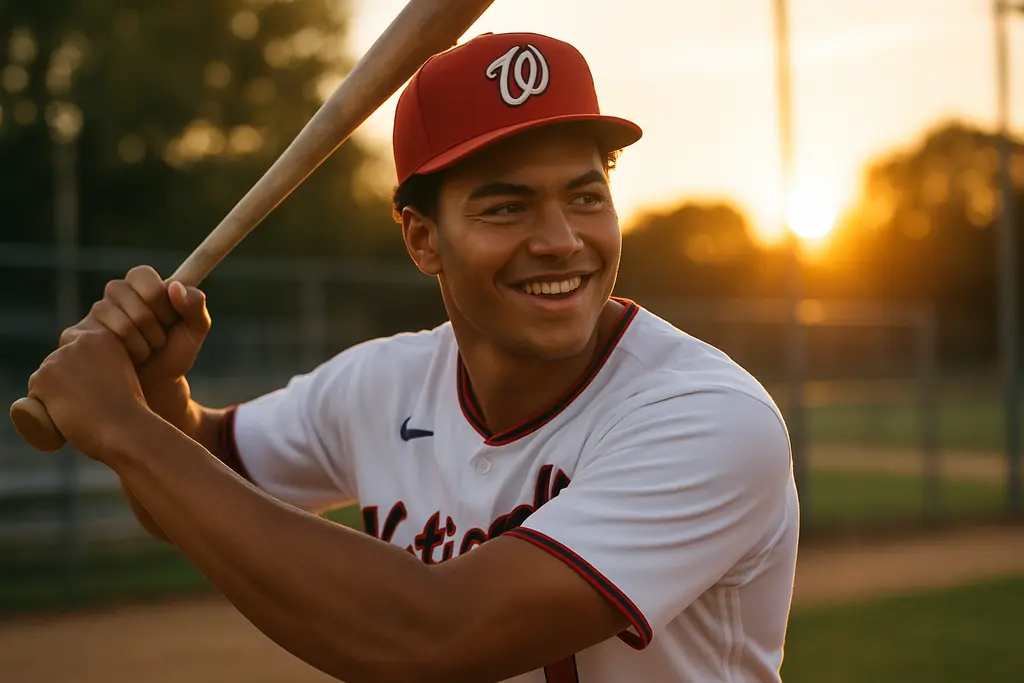
The Seaver King prospect profile has changed quickly since Washington selected him 10th overall in the 2024 MLB Draft. Born on April 25, 2003, in Athens, Georgia, King is listed at 6-foot and 195 pounds, bats right-handed, and throws right-handed, according to his MiLB player page. His rise is not built on one short hot stretch alone. It includes Division II production, an ACC transfer year, first-round draft status, a difficult full-season adjustment in 2025, a strong Arizona Fall League showing, and a much louder 2026 across Double-A Harrisburg and Triple-A Rochester.
That path makes King a useful case study in player development. The record shows a hitter with multi-position background, speed, contact history, and later power growth. It also shows that his 2025 season raised questions about swing decisions and strikeouts before his 2026 output changed the discussion. The safest reading is not that every concern disappeared, but that the public performance record improved in several areas at once.
From Athens To The First Round
Amateur Production Before Washington
King’s amateur base began at Wingate University, a Division II program. During his 2022-23 sophomore season, he hit .381 with 18 doubles, 4 home runs, 44 RBIs, and 7 stolen bases. The standout marker from that stage was a 47-game hitting streak that included the final two games of 2022. The research record identifies that streak as the third-longest in Division II history.
He then transferred to Wake Forest for the 2023-24 season. In 60 games as a junior, King hit .308 with a .377 on-base percentage and .577 slugging percentage, adding 16 home runs. That one-year jump in level matters in evaluating his background. He moved from a Division II setting to the ACC and still produced power while maintaining an above-.300 batting average.
Draft Position And Early Pro Ball
Washington selected King with the 10th overall pick in June 2024. He signed on July 19, 2024, for $5.15 million. That draft position placed him among the central position-player investments in the Nationals’ system. His professional sample that year was brief but useful: at Low-A Fredericksburg late in the 2024 season, he played 20 games, hit .295, and posted a .752 OPS.
The early pro line did not answer every question. Twenty games can point to a baseline adjustment, but it does not define a player’s long-term hitting profile. What it did show is that King entered affiliated ball without an immediate statistical collapse after a college season and a draft process.
Seaver King Prospect Timeline In Washington
Seaver King Prospect Skill Markers
The Seaver King prospect evaluation includes speed, defensive range of experience, and a changing offensive line. In college, he saw time at shortstop, third base, second base, and center field. In the minors, he has primarily played shortstop. The research record describes him as an average defender at shortstop, with arm strength that could allow movement to other infield or outfield spots if Washington chose that route.
That versatility should be read carefully. A player having experience at several spots is not the same as having a settled major league role. In King’s case, the defensive record supports flexibility, but the publicly available information does not confirm a permanent position. The offensive changes from 2025 to 2026 are the clearer part of the profile.
2026 Production Across Two Levels
King was invited to Nationals spring training as a non-roster invitee on January 26, 2026. He opened the 2026 season with Double-A Harrisburg and later moved to Triple-A Rochester. Across both levels in 2026, over 112 games and 455 at-bats, he hit .303 with 21 home runs, 74 RBIs, 15 stolen bases, and an OPS around .898.
MLB.com highlighted his early Triple-A stretch in late May 2026, including a 2-for-4 game with two doubles and 4 RBIs that raised his average to .368 through his first five Triple-A games, per MLB.com’s report. That detail matters because it gives a date-specific view of the promotion period rather than treating the full 2026 line as one undivided result.
| Stage | Key Date Or Season | Reported Output |
|---|---|---|
| Wingate | 2022-23 | .381, 18 doubles, 4 home runs, 44 RBIs |
| Wake Forest | 2023-24 | .308/.377/.577 with 16 home runs |
| Draft | June 2024 | Selected 10th overall by Washington |
| Low-A Fredericksburg | Late 2024 | .295 average, .752 OPS in 20 games |
| High-A/Double-A | 2025 | .244/.294/.337, 6 home runs, 30 stolen bases |
| Double-A/Triple-A | 2026 | .303, 21 home runs, 74 RBIs, 15 stolen bases |
Why The 2025-26 Turn Matters

Approach Signals In The Arizona Fall League
The 2025 season tested King. Between High-A Wilmington and Double-A Harrisburg, he played 125 games and hit .244/.294/.337 with 6 home runs and 30 stolen bases. The research notes cite swing decisions and too many strikeouts as challenges. That context is necessary because the 2026 rise looks different if the 2025 line is ignored.
After the 2025 minor league season, King played for the Scottsdale Scorpions in the Arizona Fall League. In 18 games, he hit .359/.468/.563 with 3 home runs and 11 stolen bases. The research record also notes an improved walk-to-strikeout profile. For the Seaver King prospect case, that AFL stretch stands out because it paired on-base growth with damage and speed rather than showing only batting average.
Power And Speed In The Same Profile
The change from 6 home runs in 125 games in 2025 to 21 home runs in 112 games in 2026 is the most visible statistical shift. The stolen-base record also stayed relevant, with 30 steals in 2025 and 15 in 2026. Those figures do not prove a finished product, but they do show that King’s value has not depended on one tool alone.
Public prospect notes entering and during 2026 rated him as Washington’s No. 2 prospect and cited athleticism, speed, and power gains. Those grades and rankings can change, so the safer anchor is the performance record: more impact contact in 2026, prior speed production, and a defensive background that gives Washington options. For broader context on Washington’s farm development, our look at Nationals velocity gains covers the pitching side of the same organization. Cross-sport readers can also explore player development topics on a similar note at FSGolf, a related site in the same network.
What Seaver King Prospect Data Says About His Nationals Fit
Defensive Flexibility In Context
The Seaver King prospect record points to a player who has handled several defensive assignments, even if shortstop has been his primary professional home. His college time at shortstop, third base, second base, and center field gives Washington a wider set of developmental choices. The known record does not establish where he would play in the majors, and no confirmed major league timeline is supported by the supplied research.
That uncertainty is not a weakness in the analysis. Prospect evaluation often separates what is documented from what is assumed. In King’s case, the documented items are clear: first-round draft status, a strong Division II track record, ACC production at Wake Forest, a 2025 full-season challenge, an AFL rebound, and a 2026 breakout line across the upper minors.
What Is Known And What Is Not
King’s biography is best read as a development arc rather than a straight climb. The 2025 line showed that upper-level pitching could pressure his approach. The Arizona Fall League and 2026 season showed a response in the available performance record. That does not guarantee a major league outcome, and the research does not verify a Nationals debut as of October 6, 2026.
The measured takeaway is that King had become one of Washington’s most productive upper-minors hitters by the 2026 data provided. The Seaver King prospect profile now rests on a stronger blend of average, power, speed, and positional background than it did after the 2025 regular season. For a Nationals farm system still sorting long-term position-player answers, his next confirmed step should be judged by the same standard: verified performance, level context, and role clarity rather than assumption.