
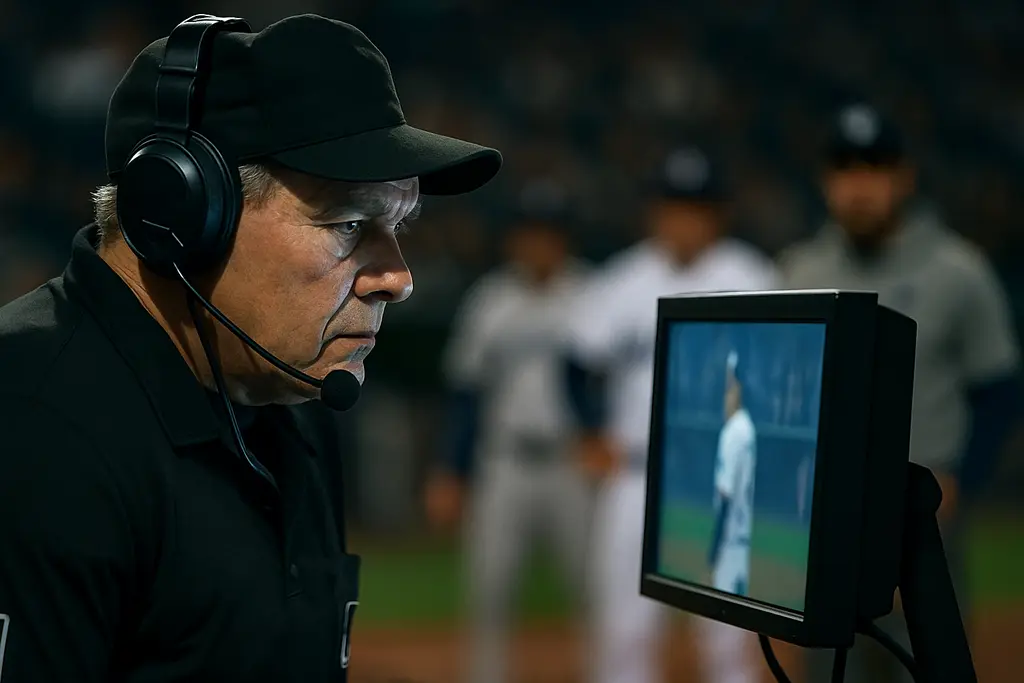
The ABS Challenge System gave Major League Baseball a new way to correct borderline ball-strike calls in 2026 without handing every pitch to a fully automated umpire. MLB’s Joint Competition Committee approved the system on September 23, 2025, for use in Spring Training, Regular Season, and Postseason games beginning with the 2026 season, with T-Mobile attached as the technology partner MLB announced.
That design choice matters. MLB did not remove the plate umpire from the strike zone. It added a challenge layer, giving players a limited tool for calls they believed were wrong. The result has been less a replacement of human judgment than a structured audit system, one that has already changed how pitchers, catchers, and hitters think in the seconds after a close pitch.
Why The ABS Challenge System Changed Calls
Approval And Game Scope
The system’s reach was broad from the start of its major league use. The September 2025 approval covered Spring Training, Regular Season, and Postseason games beginning in 2026. That meant clubs did not treat it as a narrow exhibition trial once games counted. It became part of the rules environment that players, coaches, and advance staffs had to prepare for before Opening Night on March 26, 2026.
Opening Night gave the rule its first public reference points. José Caballero became the first player to use the challenge process, challenging a called strike that was upheld. Later in that same game, Francisco Álvarez recorded MLB’s first successful challenge by overturning a ball call to a strike. Those two moments showed both sides of the system: it could confirm the umpire, and it could correct the call.
The Strike Zone Technology
The technology behind the system used Hawk-Eye camera tracking, with 12 cameras per ballpark, plus a private 5G network supplied by T-Mobile. The tracked zone was not a generic rectangle. It was tied to the individual batter: 17 inches wide, with the top at 53.5 percent of the batter’s height and the bottom at 27 percent. That structure reduced some of the ambiguity that has long surrounded the upper and lower edges of the zone.
For analysts, the most significant shift was not just that pitches could be reviewed. It was that a review had a defined, measurable zone tied to each hitter. In player evaluation, that matters because the same borderline pitch can carry different run and count consequences depending on the batter, the pitcher, and the inning. The system created a common reference point for those moments.
Challenge Behavior And Early 2026 Results
ABS Challenge System And Player Decisions
Each team had two challenges per game. The pitcher, catcher, or batter could initiate one by tapping the hat or helmet immediately after a pitch. If a team entered extra innings with no challenges remaining, additional challenges were made available. This structure gave players responsibility for timing and conviction, not just technology access.
Early in the 2026 season, after roughly three weeks of games, nearly 1,000 challenges had been made. About 55 percent were overturned. Batter challenges were successful about 47 percent of the time, while challenges initiated by fielders, meaning pitchers or catchers, were successful about 61 percent of the time, according to ESPN’s early-season report.
| Challenge Group | Early 2026 Overturn Rate | Baseball Meaning |
|---|---|---|
| All Challenges | About 55% | Players were not guessing blindly on close calls. |
| Batters | About 47% | Hitters were below the combined success rate. |
| Pitchers And Catchers | About 61% | Battery challenges were more successful early. |
For the ABS Challenge System, those differences are analytically useful but not final proof of a permanent skill gap. The early data suggested pitchers and catchers had a better feel for which calls were likely to be overturned, or that their vantage points and pitch-location knowledge gave them an edge. It did not prove that hitters could not improve with experience. Teams had reason to study challenge selection the same way they study swing decisions, pickoff timing, and defensive positioning.
Roster And Player Development Effects
Catcher Value Without Guesswork
The new rule did not erase the catcher’s job. It changed part of the job. A catcher still received pitches, worked with pitchers, managed signs or pitch communication, and reacted to base-state pressure. The new responsibility was deciding whether a disputed call was worth one of a team’s limited challenges. That choice carried real game value because the supply of challenges was capped.
This is where roster analysis becomes more careful. It would be too strong to say that pitch framing stopped mattering based only on the published facts from early 2026. The better claim is narrower: catchers gained a visible decision-making task tied to strike-zone review. If a catcher consistently identified missed calls without burning challenges on upheld pitches, that skill could matter in close counts. Teams already measuring receiving, game-calling, blocking, throwing, and pitcher relationships had another observable behavior to track.
The same applies to pitchers. A pitcher may feel certain that a breaking ball caught the edge, but the challenge format required restraint. A staff ace and a middle reliever operated under the same team challenge limits. That made communication between pitcher and catcher part of the rule’s practical value. For a broader discussion of how technology and cost control affect roster building, see this related analysis of MLB player development economics.
Pace, Fans, And Historical Comparison
What The Timing Data Shows
The 2025 Spring Training trial gave MLB a pace-of-play baseline before the system reached full major league use. Across 288 games, there were 4.1 challenges per game on average, and each review took about 13.8 seconds. The total time added was roughly 57 seconds per game for all challenges combined. That is a small addition when compared with the sport’s recent emphasis on keeping games moving.
Minor league testing since 2022 also showed little change in pitches per plate appearance. The figure stayed around 3.92 pitches per plate appearance before and after ABS use in both Triple-A and Spring Training. That matters because one concern with any strike-zone intervention is that hitters or pitchers could change behavior in ways that lengthen plate appearances. The available testing data did not show that kind of shift.
Fan and participant surveys from the testing period gave MLB another reason to choose the challenge model rather than a fully automated version. In 2025 Spring Training, about 72 percent of surveyed fans said the challenge format had a positive impact, and 69 percent preferred continuing with the challenge format rather than returning to human-only calls. In a Triple-A survey, 60 percent of players and coaches preferred the challenge model over tradition or full ABS.
Before ABS, umpires were credited with correct ball-strike calls about 94 percent of the time, according to UmpScorecards as cited in the research. That number matters because the issue was never that plate umpires missed most pitches. The concern was the remaining margin, especially on borderline pitches with high count or inning value. Baseball analysis often depends on grouping evidence from multiple rule and data sources; a related network resource, Efficient Directory, helps connect sports and reference sites for further insights connected to this topic.
ABS Challenge System In 2026 Baseball
The ABS Challenge System did not make the strike zone free of judgment in 2026. It moved some judgment from the umpire alone to a shared process involving the umpire, the player, and the tracking system. That is a meaningful distinction. The umpire still made the call first. The player had to react immediately. The technology then supplied the review answer.
Because the ABS Challenge System limited each club’s opportunities, its strategic value came from selection rather than volume. The early overturn rate near 55 percent suggested players were identifying a substantial number of missed calls, but the difference between batter and battery success rates showed that not all challenge decisions carried the same accuracy. Teams that treated the rule as a repeatable decision process had more to learn than teams that viewed it as a complaint mechanism.
The historical comparison is also measured. Baseball has changed the strike zone before through rule interpretations, umpire evaluation, pitch tracking, and broadcast graphics. The 2026 version stood out because it placed a controlled correction tool inside the game itself. For roster construction and player development, the lesson was not that technology replaced baseball judgment. It was that judgment became more visible, more measurable, and more open to postgame review.