
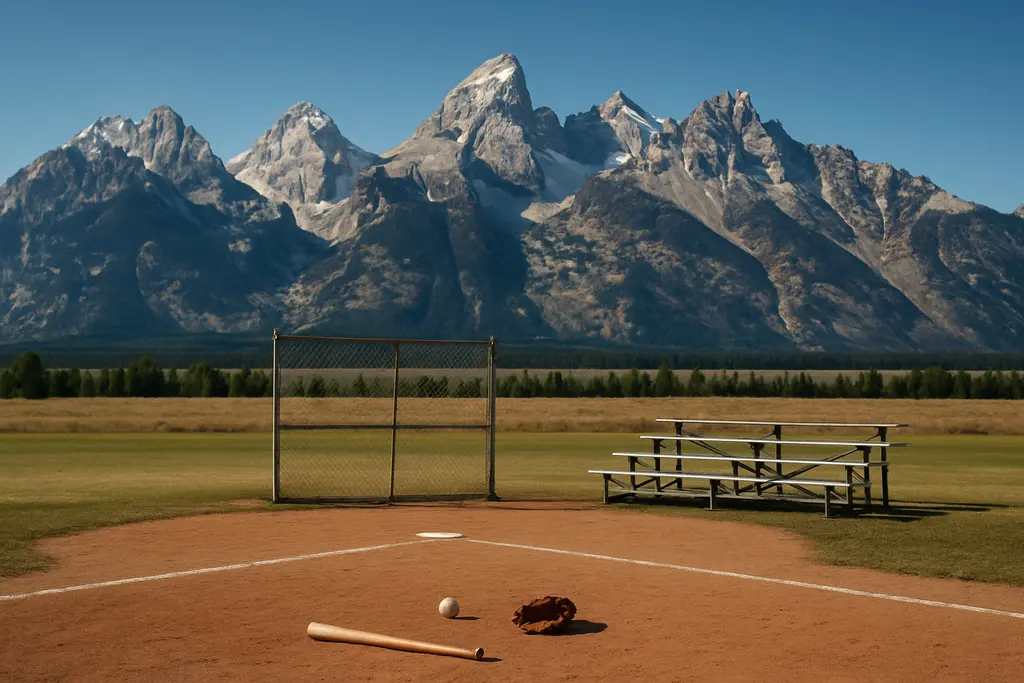
The Grand Teton Game lasted only as a proposal, but its short public life made it a useful case study in how Major League Baseball tests the limits of alternative venues. By October 1, 2026, MLB had backed away from considering Grand Teton National Park as a site for a future regular-season game, after local leaders in Teton County, Wyoming, objected to the idea on environmental, infrastructure, and community grounds.
For baseball historians, the decision belongs less to the box-score record than to the sport’s long-running search for symbolic settings. MLB has used non-traditional venues to connect the modern game with memory, geography, and civic identity. Yet Grand Teton was different. A national park is not a dormant ballpark, a converted speedway, or a nostalgia site built around baseball imagery. It is protected public land, with wildlife habitat, visitor-use limits, and a stewardship mission that does not start with sports programming.
The Grand Teton Game Timeline
The public timeline moved quickly. On September 30, 2026, local leaders in Teton County, including county commissioners, the mayor of Jackson, and the Jackson Hole Chamber of Commerce, sent letters opposing proposals to stage an MLB regular-season game inside Grand Teton National Park. Their stated concerns included infrastructure strain, wildlife disruption, light and noise pollution, and the integrity of park resources, according to The Washington Post.
Grand Teton Game Proposal In Early Review
The Grand Teton Game never reached a formal event plan. Based on the reported sequence, MLB had contacted the Trump administration about the possibility, and National Park Service officials had scouted three potential sites inside the park. The league later described the work as an early due-diligence stage, not a completed proposal with environmental review or full community outreach.
That distinction matters, but it did not quiet local opposition. In sports-business terms, early review can still create public consequences. Once a league as visible as MLB studies a protected site, local officials may treat the review itself as a signal that a serious proposal could follow. In this case, the local response made the viability question clear before the league advanced further.
Local Opposition Moved Quickly
By October 1, 2026, Commissioner Rob Manfred had issued a letter saying MLB would no longer evaluate Grand Teton National Park as a potential site. The league’s reversal came after local officials and conservation voices framed the idea as inconsistent with the park’s mission. The Guardian reported that MLB rescinded the idea after backlash and noted concerns tied to the park’s wildlife and protected status The Guardian.
The speed of the reversal is historically significant because MLB has not generally retreated from special-event concepts simply because they are unusual. The issue here was not novelty alone. It was the category of land under consideration and the degree of local resistance before any formal environmental or community process had been completed.
Community Impact And Park Stewardship
The community impact question was not limited to whether a baseball crowd could be managed for one day. Local objections addressed the effects of temporary construction, lighting, sound, traffic, staging, and concentrated human presence. Those concerns are sharper in a national park setting than in a built sports district because the surrounding environment is part of the protected resource.
Why Local Leaders Objected
Opposition in the research record came from the Teton County Board of County Commissioners, the Jackson Town Council, and the Jackson Hole Chamber of Commerce. That breadth is notable. In many sports-venue debates, business groups and civic officials divide over tourism benefits, costs, and brand exposure. Here, the available record shows unified local resistance among those public and business-facing institutions.
Their framing also challenged a common assumption behind destination sports events: that national attention is inherently welcome. Several community leaders described the proposal in sharply negative terms, including as “deeply unwelcome” and contrary to the mission of national parks. The language suggests that the central issue was not whether baseball could produce attention for Jackson Hole or Grand Teton. It was whether that attention aligned with local stewardship priorities.
Protected Land Was The Central Issue
Grand Teton National Park covers about 310,000 acres and is associated with wildlife that includes grizzly bears, bison, and osprey. Even a temporary sports venue would have required decisions about access, lighting, crowd movement, staging areas, and the post-event condition of the site. Environmental groups cited risks such as habitat fragmentation, noise and light disturbance, increased human presence in wildlife areas, and strain on park resources.
From a baseball history perspective, this is where the proposal separated from previous special-event models. A temporary ballpark can be removed, but the process of installing and servicing one still leaves questions about disturbance. The historical lesson is not that baseball cannot leave its standard stadiums. It is that the venue type changes the burden of proof. A protected natural area requires a stronger public case than a heritage ballpark or purpose-built event field.
MLB Special Events And Historical Context

MLB’s interest in special venues did not begin with the Grand Teton proposal. The league has held or planned games in places meant to carry symbolic weight, including the Field of Dreams site in Dyersville, Iowa; the Little League Classic in Williamsport, Pennsylvania; Bristol Motor Speedway in Tennessee; and Rickwood Field in Birmingham, Alabama. Those events fit a pattern: baseball uses place to turn a regular-season game into a cultural marker.
From Nostalgia Sites To Protected Parks
The Field of Dreams concept worked because the location was already tied to baseball memory. Rickwood Field carried a different historical meaning because of its connection to the Negro Leagues and older ballpark architecture. Bristol Motor Speedway represented scale and spectacle. Each setting asked fans to view baseball through a different frame, but each was already a venue or a site connected to organized public gathering.
This contrast illustrates why the Grand Teton idea faced significant challenges, making it a distinct case. If you’re interested in more insights and historical comparisons across various sports events, you can visit myalltimebest, a related site in the same network, which delves into these topics further.
The Process Lesson For Baseball
For MLB, the Grand Teton Game became a process lesson as much as a venue lesson. The research record indicates that environmental impact assessments and full community engagement had not yet been completed before the proposal drew public attention. That sequence left the league defending an exploratory step in a place where local officials wanted consultation and protection concerns addressed first.
There is a practical lesson here for future event planning. A league can treat an idea as preliminary, but affected communities may judge it by the consequences it appears to invite. In sensitive locations, early outreach is not only a public-relations device. It is part of the feasibility test. If local government, conservation groups, and civic institutions begin from a position of opposition, the event’s symbolic value can turn negative before baseball operations enter the discussion.
What The Grand Teton Game Decision Leaves Behind
The abandoned plan leaves a clear historical marker: MLB’s alternative-site strategy met a firm limit when it reached federally protected land with strong local resistance. The league’s decision to step back by October 1, 2026, prevented a longer fight over environmental review, federal permissions, and community consent. It also preserved the possibility that MLB can keep staging special events elsewhere without making national parks a routine target for venue experimentation.
The Grand Teton Game decision should not be read as a rejection of baseball spectacle. It is better understood as a reminder that place carries obligations. A ballpark, a speedway, a youth-baseball setting, and a national park are not interchangeable stages. Each brings a different public meaning and a different standard for approval.
Future MLB proposals in unusual settings will likely be judged by the same questions raised in Wyoming: Who supports the event locally? What resources would be affected? Has the league completed credible environmental and stakeholder review before advancing the idea? The answers will matter more than scenic value. Baseball has often gained power from where it is played, but the Grand Teton episode showed that some places require restraint before romance.