

Ever wonder why a routine fly ball gets called a “can of corn” or a bloop single becomes a “ducksnort”? America’s pastime doesn’t just swing bats—it swings metaphors. It crafts a vernacular as layered as a seventh-inning stretch. This isn’t mere jargon; it’s cultural DNA encoded in leather and pine tar.
Paul Dickson’s Dickson Baseball Dictionary—the Oxford English Dictionary of diamond lingo—documents over 10,000 terms. These terms reveal how the game shapes, and is shaped by, society. Consider “around the horn”, a phrase born from nautical slang that now describes infield warm-up throws. Or “ace”, a term borrowed from poker to crown a team’s top pitcher. These aren’t just words—they’re time capsules.
What makes this lexicon Shakespearean? Like the Bard’s plays, baseball’s language thrives on contradiction. “Sabermetrics” (the analytics revolution) coexists with “small ball” (bunts and steals), creating a linguistic tug-of-war between data and romance. Where else but America could a grand slam’s thunderous glory share dugout air with the self-deprecating “Texas Leaguer”?
We’re not just decoding terms here—we’re excavating the wit, strategy, and accidental poetry that make this sport’s vocabulary a mirror for American ingenuity. Batter up.
Origins of Baseball Slang
Baseball’s language didn’t start from scratch. It borrowed words from America’s past. Early baseball slang was about repurposing words, like a magpie collecting treasures. “Doubleheader” came from railroad schedules, “southpaw” from the Civil War, and “rhubarb” from vaudeville.
- Bullpen theology: Born from literal bullpens in early ballparks where relievers warmed up beside livestock
- Annie Oakley: Free tickets (named after the sharpshooter’s habit of shooting holes in tickets for comps)
- Alabaster blast: A line drive so white-hot it resembled marble
Baseball borrowed from vaudeville because it’s part theater. The origins of baseball’s terms show how it reflected America’s class differences. “Bush league” mocked rural teams, and “beanball” hinted at industrial violence. “Can of corn” came from grocery clerks knocking canned goods off shelves.
This language evolution was not random. As cities grew and immigrants came, baseball helped Americans understand each other. A Sicilian steelworker might not know “fungo,” but he’d get “banana stick” (a curved bat). Baseball’s slang brought people together, bridging cultural gaps.
When someone calls a home run a “moon shot,” it’s more than just baseball talk. It’s a peek into American history, one slang term at a time.
Iconic Terms and Their Stories

Baseball slang is more than just words—it’s a way to make a game exciting. The “grand salami” is a perfect example. It’s a term that sounds crazy but perfectly describes a rare baseball achievement.
Alex Rodriguez hit a grand slam 25 times, making him the all-time leader. This shows how special this term is.
The “circus catch” is another term that’s full of drama. It describes catches that are so amazing, they seem like they belong in a circus. Willie Mays’ 1954 World Series catch is a great example of this.
These phrases are not just words. They’re a way to remember the most exciting moments in baseball history.
The “hot corner” is a term that’s all about speed. It refers to third base, where line drives come in fast. Roger Connor hit the first grand slam in 1881, and it needed a big term to describe it.
Then there’s Fernando Tatís’ 1999 game. He hit two grand slams in one inning against Chan Ho Park. It was like a crazy dream come true.
This game became a legend, showing how baseball’s language is always evolving. It’s full of surprises that make fans go wild.
Terms like “grand salami!” are more than just words. They’re a way to connect with other fans. When you say it, you’re sharing in the excitement of amazing baseball moments.
“Dickson Baseball Dictionary” Review
Paul Dickson’s masterpiece is more than a glossary. It’s a journey through time. Open this baseball dictionary and discover over 1,000 terms. They whisper secrets from the early days to today’s analytics.
Ever curious about the origins of “grand slam”? Dickson uncovers its roots in 19th-century card games. He shows how baseball slang evolves, just like a rookie learning new signs.
The book treats jargon as part of baseball’s culture. “Spitball” started as a cheat and became a term for political tricks. The “Mendoza Line” honors a player’s .200 batting average. Dickson gives these terms gravitas, like they’re Cooperstown plaques for phrases.
This isn’t just trivia. It’s the early days of sabermetrics. Before today’s stats, old slang told the game’s story. Dickson connects terms like “can of corn” and “ducks on the pond” to today’s analytics. It’s like Moneyball in a leather book.
Here’s why you need this book:
- Context over catalog: Each entry is a short story, not a quick fact
- Linguistic archaeology: Links old slang to today’s memes
- Cultural mirror: Shows how baseball terms entered politics and business
Dickson’s work is like Vin Scully’s play-by-play. It turns niche knowledge into national poetry. It’s the perfect baseball analytics book for anyone to enjoy. You’ll find yourself reading one entry after another.
How Lingo Shapes Identity
Ever wonder why a .220 hitter is called a “toolshed” and a brief MLB stint is a “cup of coffee”? Baseball’s words don’t just describe what happens. They create a sense of belonging. Think of the “fireman” relief pitcher. This term comes from the 1940s, when saving games was like saving kittens from fires. It’s not just slang; it’s cultural taxidermy.
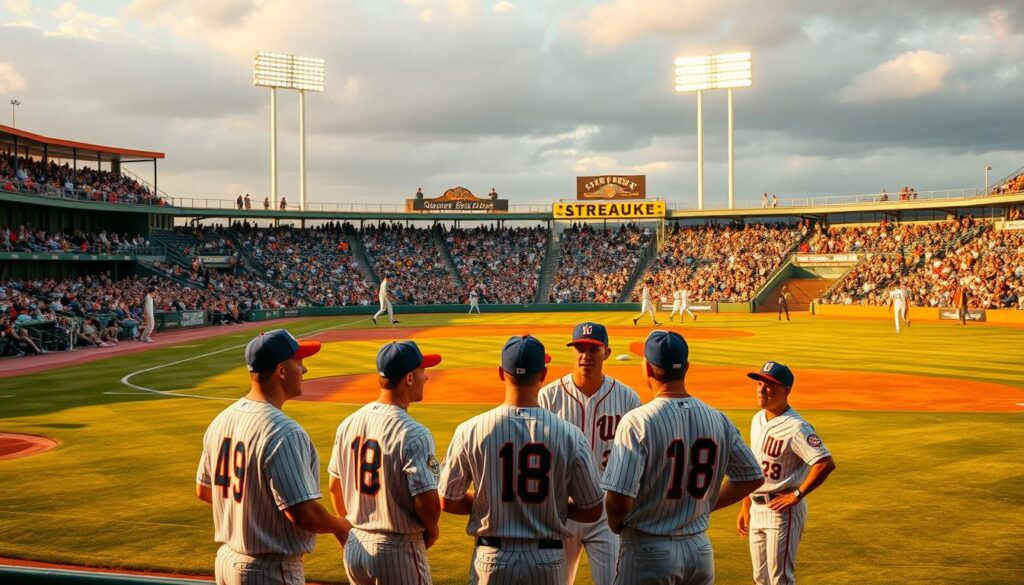
Regional dialects become like battle hymns. Boston’s “Sweet Caroline” is more than a Neil Diamond song; it’s a Fenway tradition. New York’s “Bronx Bombers” is more than a nickname; it’s a urban identity tattoo. And that Cubs fan saying “wait ’til next year”? They’re not just whining; they’re practicing hope as performance art.
What makes these terms stick? They’re linguistic secret handshakes that:
- Turn geography into mythology (Dodgers fans don’t “cheer” – they “bleed blue”)
- Make stats into inside jokes (calling strikeouts “whiffs” turns failure into comedy)
- See ballparks as cathedrals (Wrigley’s ivy isn’t foliage – it’s “God’s outfield decor”)
This coded language is what anthropologists call “tribal fluency”. You either get why “can of corn” means an easy catch (it’s 19th-century grocery humor), or you’re forever the rookie holding your glove upside down. And that’s the magic – baseball society & culture thrives on knowing what outsiders don’t.
So next time you hear someone say “chin music!” at a high fastball, remember: They’re not just calling a pitch. They’re reciting poetry from baseball’s dog-eared playbook of identity.
Modern Evolutions
If Babe Ruth swung a bat today, he’d need data science to keep up. Baseball now talks about “spin rate” and “WAR” (Wins Above Replacement). These terms sound like space launch codes, not sports talk. The Moneyball era turned clubs into analytics labs, grading players like startups.
Statcast’s tracking systems introduced new terms that would confuse Ty Cobb. Today, a “five-tool player” is analyzed with 3D motion capture. “Launch angle” turns home runs into math problems. Pitching strategy now involves “tunneling,” making pitches look the same until they’re close to the plate.
The sabermetrics history books will show how tech changed baseball’s language:
| Traditional Term | Modern Equivalent | Tech Influence |
|---|---|---|
| “Five-tool player” | “Exit velocity + launch angle combo” | Doppler radar tracking |
| “Clutch hitter” | “High-leverage WAR contributor” | Win probability algorithms |
| “Slider” | “Spin efficiency outlier” | Gyroscopic sensors |
| “Umpire” | “Robot ump beta tester” | Automated strike zones |
Fans now talk about “spin mirroring” instead of pine tar scandals. Broadcasters casually mention “arm slot variance” like it’s a machine learning podcast. These terms stick. When your teammate talks about his “vertical approach angle,” you know analytics have taken over baseball.
What’s next? AI-generated nicknames based on biometric data? A neural network that creates the next “knuckleball”? Tomorrow’s baseball slang will be written in Python code, just like locker-room sharpie.
Sources for Deeper Study
Ever wondered where baseball’s secrets are hidden? Grab a shovel—we’re on a treasure hunt. For fans who love third-deck moonshots of knowledge, these resources will turn you into a diamond expert.
Let’s dive into the top resource: Paul Dickson’s baseball dictionary. It’s not just a glossary—it’s a journey through time. It shows how “can of corn” became a term for an easy catch (thanks to 19th-century grocery clerks). But there’s more to explore:
- Bill James’ Historical Baseball Abstract: This book is like Moneyball before Moneyball. James breaks down stats like a detective, proving WAR (Wins Above Replacement) is more than just a nerd debate.
- MLB Scouting Manuals: These player development books explain how scouts find “five-tool players.” Spoiler: It’s not about being handy with tools.
- Arizona Fall League Reports: These documents follow tomorrow’s stars today. They show why a “plus slider” is more than just math.
Why just scratch the surface when you can dive deep? These sources are perfect for those who love to geek out. They don’t just explain terms—they show how baseball’s language shapes its heart. Now, go impress your friends with “fungo” like a true enlightened dugout philosopher.
Conclusion
Baseball language is more than just words—it’s a cultural code. It keeps alive old sayings like “grand slam” and “can of corn.” At the same time, it welcomes new terms like “spin rate” and “launch angle.”
Paul Dickson’s dictionary shows how baseball slang has changed. But the true treasure lies in the conversations at the ballpark and on TV.
What makes baseball special is how phrases define us. A “walk-off” isn’t just a hit—it’s a moment of drama. When announcers say “going, going, gone!”, they’re telling a story as old as Fenway Park.
These terms give fans a sense of belonging. They know the difference between a Baltimore chop and a Texas Leaguer.
Some say analytics have ruined the game’s charm. But fans who love stats and those who love viral videos both have their say. Baseball’s language is alive because it changes with the times.
It’s not just about the game; it’s about the stories it tells. Next time you hear “he’s painting the black,” think of Rembrandt. Baseball turns numbers into tales and stats into poetry.
Think baseball is just a game? Try explaining a suicide squeeze to someone who calls home runs “four-base hits.” See what I mean?