

The Jacob Misiorowski Season had become one of the defining pitching stories in Major League Baseball by September 1, 2026. The case rests on two connected forms of dominance: traditional run prevention and a power profile that has produced documented pitch-tracking records. As of that date, the regular season had not ended, so any award judgment remained incomplete. Still, the evidence through late August gave Misiorowski a front-runner-level National League Cy Young profile and a more difficult, but not dismissible, MVP argument.
Through approximately 25 starts, Misiorowski’s 2026 line was 14–5 with a 1.73 ERA, 151.0 innings pitched, 222 strikeouts, and a 0.75 WHIP. StatMuse listed him as the National League leader in WHIP in its career-stat table for the pitcher, which framed his season as more than a velocity story StatMuse stats. The numbers matter because they show a starter who was not only overpowering hitters but also limiting baserunners at a rate that made each run allowed unusually expensive for opponents.
For a comprehensive view in the sports-reference landscape, you can visit Wikiapp. In this context, the central evidence remains Misiorowski’s 2026 performance record, not reputation or projection.
Why The Jacob Misiorowski Season Fits Cy Young Criteria
Jacob Misiorowski Season By The Rates
Cy Young voting usually begins with run prevention, innings, strikeouts, and the degree to which a pitcher separated from his peers. Misiorowski’s 1.73 ERA through 151.0 innings placed him in rare statistical territory for a modern starter, while his 222 strikeouts created a second path to value: reducing balls in play and limiting the defense-dependent variance that can decide games. A 0.75 WHIP is especially important in that discussion because it shows that the low ERA was paired with a low volume of traffic.
That is the core of the Jacob Misiorowski Season as an awards case. A pitcher can compile strikeouts without controlling the running game of an inning if walks or hits accumulate. Misiorowski’s reported WHIP suggests the opposite pattern: hitters were not reaching base often enough to turn isolated mistakes into sustained rallies. The 14–5 record should be treated carefully because pitcher wins are shaped by run support, bullpen protection, and scoring environment. Even so, a winning record paired with elite rate statistics strengthens the public-facing argument because it aligns team outcomes with individual performance.
Separating Results From Style
Misiorowski’s delivery of value should not be reduced to radar-gun readings. Velocity helps explain why hitters struggled, but the award case depends on outcomes. The available research showed high strikeout totals, a low ERA, and a league-leading WHIP in the National League. That combination supports a Cy Young argument without needing to inflate the meaning of any single start.
The caution is workload. At 151.0 innings through late August, Misiorowski had given Milwaukee a meaningful starter’s volume, but the season still had September games remaining. Voters have often rewarded dominance, yet innings can shape comparisons if another candidate finishes with a larger workload while remaining effective. As of September 1, 2026, Misiorowski’s case was strong, but it still depended on the complete regular-season record.
Velocity Records And The Shape Of Dominance
The Coors Field Marker
On June 7, 2026, against the Rockies at Coors Field, Misiorowski threw 103.7 mph, which MLB reported as the fastest pitch by a starting pitcher since pitch tracking began in 2008. He also threw 45 pitches at or above 101 mph in that game MLB report. That start mattered because Coors Field has long been associated with difficult pitching conditions, and the velocity record came in a setting where pitchers rarely receive the benefit of doubt from the environment.
Power pitching has been part of baseball’s development arc for more than a century, but pitch tracking changed the way the sport records it. Earlier generations could be described as hard throwers through scouting reports, anecdote, or limited measurement. Misiorowski’s case is different because pitch-by-pitch tracking supplies a verified record of both peak velocity and repeated velocity. That distinction is central to evaluating 2026. A single 103.7 mph pitch is notable; repeating triple-digit fastballs across a start points to a workload of force that hitters had to solve across multiple plate appearances.
Repeated Triple-Digit Volume
The research also cited two other concluded starts that added to the historical profile. On May 25, 2026, against the Cardinals, Misiorowski threw 57 pitches at 100 mph or faster and tied his career high with 12 strikeouts. On July 26, 2026, he surpassed that volume by throwing 66 of 83 pitches at or above 100 mph while striking out seven straight batters to start a game, a Brewers franchise record according to the research notes.
Those games help explain why the Jacob Misiorowski Season carried unusual weight in award discussion. His best outings were not simply efficient wins or short flashes of overpowering stuff. They were documented examples of sustained speed paired with swing-and-miss production. The analytical question is whether that kind of dominance translates into season-long value. Through September 1, the ERA, WHIP, and strikeout totals indicated that it had.
MVP Standards For A Starting Pitcher
Why The MVP Case Is Harder
The MVP argument is more restrictive than the Cy Young case because a starting pitcher participates on a schedule that differs from an everyday position player. Misiorowski could dominate every fifth day, but position players influence games through daily plate appearances, defense, and baserunning. That structural gap is one reason pitchers face a higher bar in MVP voting.
Misiorowski’s path to MVP consideration depends on whether voters view his run prevention as valuable enough to outweigh the playing-time pattern of position-player candidates. His case was not built on volume alone. It was built on elite prevention of baserunners, a strikeout total that ranked among the sport’s most prominent pitching lines in the research, and several starts that created measurable separation from typical power-pitching performances.
Value Beyond The Radar Gun
An MVP case cannot rest only on spectacle. The strongest version of Misiorowski’s candidacy is that his performance altered Milwaukee’s run environment in a measurable way. A 0.75 WHIP means fewer stressful innings. A 1.73 ERA means opponents had limited scoring access across a large number of starts. A 222-strikeout total means many plate appearances ended without defensive pressure. Those are baseball values, not just pitching aesthetics.
Still, caution is necessary. As of September 1, 2026, the regular season remained unfinished, and MVP voters were not choosing from pitchers alone. Misiorowski had a credible case to be discussed, but the evidence made the Cy Young argument clearer than the MVP argument.
Team Context And Workload Signals
Milwaukee’s Award Environment
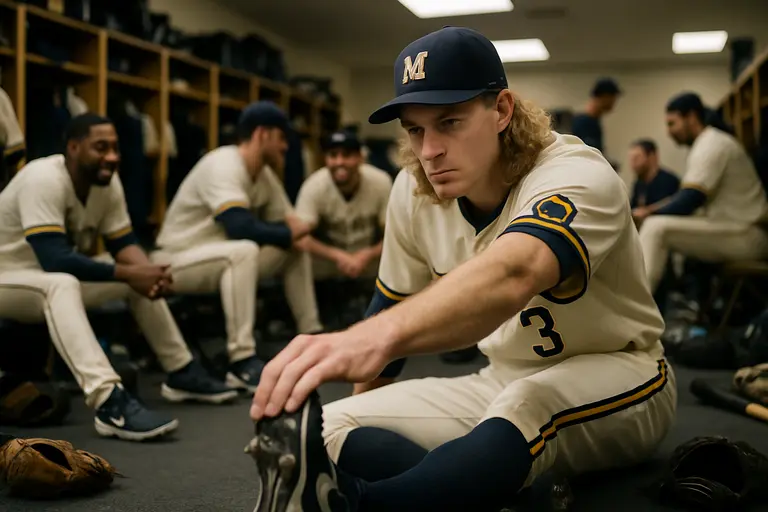
At the July 2026 All-Star break, the research noted that Misiorowski led MLB starters in ERA at roughly 1.62 and strikeouts at roughly 167. Milwaukee also led MLB in wins through reliever Aaron Ashby, giving the Brewers a pitching “Triple Crown” context at the break in the research summary. That team setting matters because award voters often notice players whose production sits at the center of a successful club.
Team success should not decide an individual award on its own, but it can clarify how a player’s value appeared inside a pennant-race structure. Misiorowski’s starts gave Milwaukee a recurring advantage: elite run prevention at the beginning of games and a high probability of strikeouts when contact management alone would have been riskier.
Managing A Power Starter
The research also stated that Milwaukee monitored his innings and workload. That is not a small detail. A pitcher throwing repeated triple-digit fastballs creates a development and usage question for any club. The Brewers had to balance immediate competitive value with the physical demands of a full major-league schedule.
That balance did not weaken the Jacob Misiorowski Season through late August, but it shaped how the rest of the award case would be judged. If a pitcher’s usage becomes more limited in September, voters may weigh peak dominance against total workload. If he continues to add effective innings, the Cy Young argument becomes cleaner.
What The Jacob Misiorowski Season Means For Awards
The strongest case for the Jacob Misiorowski Season is that it combined modern power pitching with old award fundamentals: run prevention, strikeouts, and suppression of baserunners. Through September 1, 2026, the statistical record supported him as a leading NL Cy Young candidate. The MVP case required a broader comparison against everyday players and therefore remained less certain.
Historically, pitchers have needed an exceptional regular season to break through in MVP voting because their schedule gives them fewer appearances than position players. Misiorowski’s 2026 record through late August met the first part of that test: it was exceptional on rate and dominance. Whether it was enough for MVP depended on the final regular-season totals and how voters balanced peak pitching value against daily position-player impact. For the Cy Young, the evidence was more direct. Misiorowski had built the kind of season that voters are designed to reward.