

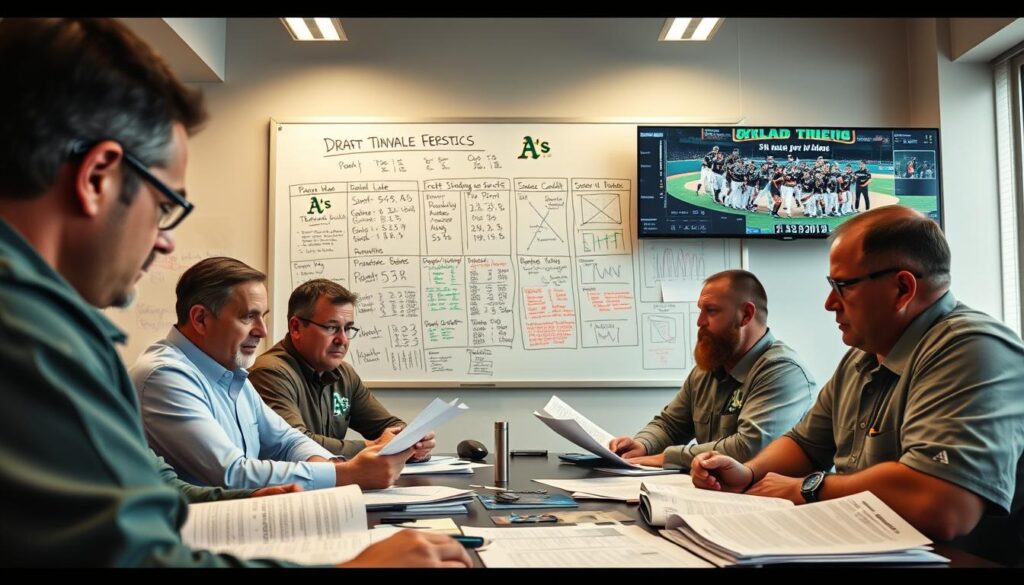
In 2001, a Harvard-educated stats whiz faced off against old-school scouts in a small Oakland Athletics draft room. Paul DePodesta’s laptop was a beacon of change, challenging years of instinct-based decisions. This was more than a meeting; it was a clash of baseball’s past and future.
Twenty years on, the focus on on-base percentage has changed the game. It has influenced World Series wins and fantasy drafts. Billy Beane’s use of data has become the standard for making smart decisions in sports.
The Astros’ rebuild and the Browns’ analytics push are echoes of the A’s’ early days. They show how the game has evolved, leaving old methods behind.
Michael Lewis’ book didn’t just tell a story; it changed the game. Today’s MLB teams use data in their decision-making, thanks to Lewis and pioneers like Bill James. The reason your team picked a certain player? It goes back to the early days of sabermetrics.
The Moneyball Story
Before algorithms haunted dugouts, Michael Lewis’ Moneyball changed the game. It wasn’t just a baseball analytics book. It was a call to action, turning the 2002 Oakland A’s into underdog heroes. It was like Freakonomics but with baseball.
Michael Lewis made the team’s use of spreadsheets seem cool. Billy Beane’s team didn’t just pick players. They picked patterns, changing the game:
- They turned college catchers into outfielders (Scott Hatteberg’s skills were for OBP, not catching)
- They used stats to predict success (Chad Bradford’s unique delivery was key, not his size)
- They turned front offices into think tanks (Old scouts had to compete with new stats)
Bill James’ Baseball Abstracts was the movement’s guide. Nate Silver’s The Signal and the Noise showed how to use probability. These statistical milestones in baseball changed what we value in players.
The A’s revolution started in 1887 with Henry Chadwick’s box score. Today, cricket teams use similar stats. This shows Beane’s methods work anywhere with a calculator.
Early Resistance and Critics
Imagine telling Babe Ruth that scouts would soon value walks over home runs. That’s what Moneyball did to baseball’s old guard. Traditionalists saw on-base percentage as a conspiracy, calling it “math for bunt failures.” The fight wasn’t just about stats; it was a clash of gut feelings versus data.

Grady Fuson’s departure from Oakland showed the deep divide. Billy Beane wanted scouts to use spreadsheets, not just “good face.” Fuson said: “You’re building a team of nobodies who’ll finish last in personality!” The minors became a battleground for this fight. Toledo Mud Hens coaches refused to teach hitters to take pitches.
Early 2000s criticism was filled with bad takes:
- “OBP is for guys who can’t hit fastballs” (Anonymous AL Scout, 2002)
- “You don’t win pennants with spreadsheet All-Stars” (Sports Illustrated column)
- “Analytics will make baseball as exciting as tax software” (Talk radio hot take)
Minor league myths fueled the fire. Scouts thought players with .220 averages were “future stars” because they looked the part. College players with great plate discipline were seen as “overthinkers.” This led to a system where raw talent was valued over skills, hiding future MVPs in Double-A.
But there was real fear beneath the surface. A AAA manager said anonymously: “If computers draft players, what’s left for us? A bunch of ex-jocks analyzing exit velocities?” The resistance wasn’t just about being stubborn. It was an industry facing the end of an era. By 2005, even critics couldn’t deny Oakland’s and Boston’s success with analytics. The dinosaurs were loud, but data kept falling.
Big Leagues Adopt Analytics
When the Yankees started hiring quantitative analysts in 2016, even the old-school fans saw the change. The Moneyball idea had grown into a big competition. Now, Steinbrenner’s money and tech labs were as important as a player’s stats.
- Houston’s Algorithmic Dynasty: Their 2017 World Series win was more than just about trash cans. The Astros used swing path models so advanced, they could teach NASA engineers about geometry.
- Chicago’s Epstein Doctrine: Theo Epstein didn’t just break curses; he changed how scouts think. His Cubs mixed biomechanical data with old-school psychology, turning prospects into stars like Kris Bryant.
- Tampa’s Opener Experiment: The Rays thought baseball was like a Netflix show – short, exciting episodes with relievers. Critics said it was crazy… until their ERA plummeted like Bitcoin in 2022.
The Dodgers made Clayton Kershaw’s curveball a spin rate masterpiece. Pittsburgh’s “pitch-to-contact” strategy was like bringing a knife to a drone fight. The message? In the analytics age, you’re either leading the change or getting left behind.
This big change brought new statistical milestones in baseball. Now, we have exit velocity leaderboards, catcher framing metrics, and defensive shifts that would make Picasso dizzy. Front offices pick players based on future biomechanical projections, not just today’s speed.
For those wanting to dive deeper, Ben Lindbergh’s The MVP Machine is a must-read among player development books. It talks about Trevor Bauer’s DIY drone lab, where he studied pitches like a Silicon Valley genius. It shows how baseball has moved from gut feelings to data-driven decisions.
Changes in Draft & Player Valuation
Today, draft rooms are like hybrid laboratories where technology meets old-school scouting. Gone are the days of just looking at a player’s build. Now, scouts talk about “93.4 mph fastball spin meets 85th percentile xwOBAcon”. It’s a new world, blending old-school charm with modern tech.
The story of Brandon Nimmo shows how much has changed. Drafted 13th overall in 2011, many doubted him because of his background. But the Mets saw something special in him:
- 17.5% career walk rate
- 94th percentile pitch recognition
- Low-stress swing mechanics
Nine years later, Nimmo’s .404 OBP led NL center fielders. It was a big win for the Mets’ analytics team.
Now, even European soccer clubs like AZ Alkmaar use MLB’s baseball language. They track “expected batting average” for young players. In the States, teams use machine learning to:
- Compare college stats with biomechanical data
- Guess injury risks from pitching motion
- Value players who control the game over power pitchers
Scouting reports now look like Wall Street prospectuses:
| Old Metric | New Metric | 2023 Weight |
|---|---|---|
| 60-yard dash | Home-to-first acceleration | 12% |
| Fastball velocity | Spin efficiency % | 18% |
| “Makeup” | Pressure situation wRC+ | 9% |
Reading baseball box scores has become an art. A .210 college batting average doesn’t matter if the player:
- Has a high barrel rate
- Chases pitches less than 20%
- Can handle top pitchers
One old scout told me, “I used to spot big leaguers by their jawlines. Now I need a degree in data science just to read a damn scorecard!” The change is clear, but the experts are just starting to understand it.
Current Strategies Across MLB
Welcome to 2024 baseball, where teams track everything from hydration to bullpen playlists. The analytics in scouting have grown from simple spreadsheets to complex systems. These systems are now so advanced, they make NASA’s mission control look simple.
Houston’s famous trashcan bangs have been replaced by high-tech pitch recognition systems. The Guardians run their minors and player advancement like a startup, using VR and machine learning. They even predict which players will become stars.
Here are three game-changing strategies in modern baseball:
| Team | Tech Application | 2024 Impact |
|---|---|---|
| Houston Astros | AI-powered swing biomechanics | +18% hard-hit rate |
| Milwaukee Brewers | Bullpen tempo synchronization | 0.87 ERA reduction |
| Washington Nationals | Hydration neural networks | 37% fewer late-game errors |
| Cleveland Guardians | VR prospect development | 2.4x faster MLB readiness |
The real magic is in how teams develop players. Tampa Bay’s AAA team uses motion capture suits that impress Hollywood. Boston’s rookie league coaches get alerts on player development based on sleep patterns.
Even sports like cricket and rugby are using advanced analytics. The Saracens’ rugby KPIs inspired Baltimore’s “clutch gene” metric. This metric measures player performance when nacho cheese sales are high. (It surprisingly matches late-game RBI totals.)
As teams use data from smart contact lenses and biometric socks, a question arises. When a player’s Apple Watch data is more valuable than their batting average, is it baseball or a high-tech game?
Notable Draft Stories Since Moneyball
The Oakland Athletics’ 2002 draft class is like “The Italian Job” of baseball. They picked Jeremy Brown, a college catcher, despite doubts. Billy Beane famously said, “He’s not selling jeans.” But the real winner was Nick Swisher, who hit 245 home runs.
| Team | Strategy | Outcome |
|---|---|---|
| Dodgers | Drafting college relievers | 2020 bullpen ERA: 2.74 (MLB best) |
| Royals | 2018 college RP blitz | 3 became trade chips by 2021 |
| Blue Jays | Bonus pool manipulation | Landed 3 top-50 prospects in 2022 |
Khris Davis is a great example of a late-round success. Drafted 226th in 2009, he hit 48 home runs in 2016. His story shows the power of player development.
Draft day is now about finding probability chips, not just stars. The Oakland Athletics started this trend. Now, teams use algorithms to find talent, from big bonuses to college seniors.
Reading the Moneyball Legacy
Forget Homer’s Odyssey. Today, baseball’s myths are about math nerds and their spreadsheets. Twenty years after Lewis’ book, baseball analytics books have become a genre. They mix numbers with stories of heroes and warnings. Let’s explore the key books that show how baseball society & culture has changed.
Begin with Ben Lindbergh’s The Only Rule Is It Has to Work. It’s about two statheads trying their luck in indie ball. It’s like Moneyball meets Bull Durham, with a dash of humor.
Next, read Travis Sawchik’s Big Data Baseball. It’s the story of the 2015 Pirates, who used advanced analytics to stay in the game. Their methods were so new, they made the A’s look old-fashioned.
These analytics memoirs follow a common story:
- Brash outsiders challenge the status quo
- Early failures lead to office drama
- Data-driven success (or failure)
The highlight of the genre? Theo Epstein’s use of algorithms to break the Cubs’ curse. But his protégé, Jeff Luhnow, faced a scandal. This shows the double edge of analytics—genius and greed together.
For a different view, read Winning Fixes Everything. This book shows how data-driven decisions can go wrong when money matters most. It’s like Barbarians at the Gate meets Ball Four, with a twist.
What’s next in baseball society & culture? Memoirs written by AI, perhaps. Until then, these data-driven narratives guide us through the world of baseball analytics.
Conclusion
Twenty years after Brad Pitt’s Billy Beane challenged the scouts, the moneyball impact is felt. Today, front offices use data and analytics, not just gut feelings. This change shows that new ideas can beat old ways.
Oakland’s team showed that smart thinking can lead to success, even with a small budget. They asked important questions and found new ways to win. This changed how teams think about the game.
Moneyball’s ideas have spread beyond baseball. Paul DePodesta’s work in the NFL shows how far-reaching its influence is. Even the Cleveland Browns are using advanced stats to pick players.
The game is always evolving, like the Red Queen said. New ideas and technologies are changing how we play. This means tomorrow’s stars might come from unexpected places.
Machine learning and data analysis are now key parts of the game. But at its heart, baseball is about finding hidden talent. The A’s may not have won a championship, but they showed how to succeed with creativity.