
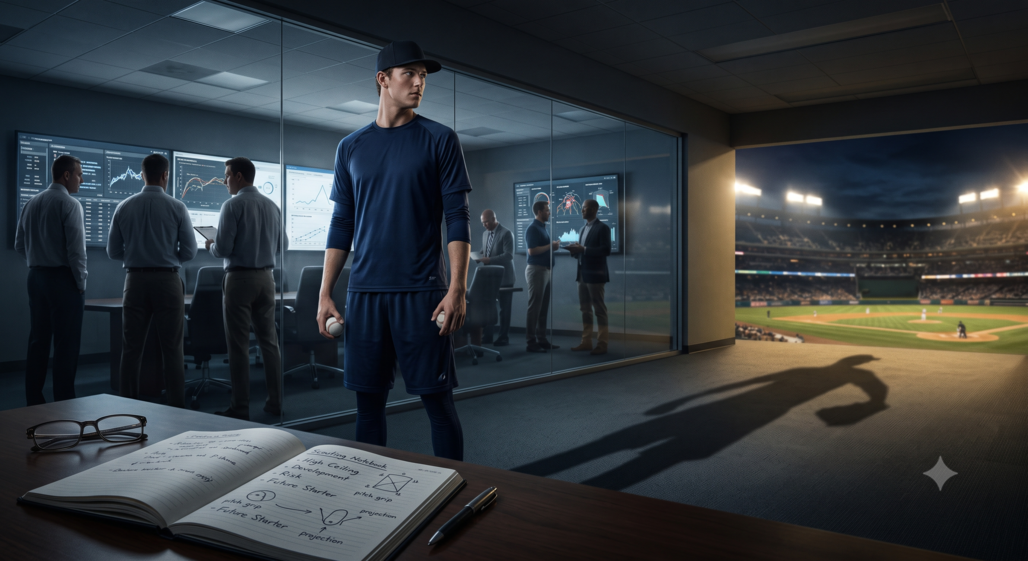
Hunter Dietz became a New York Yankees prospect the moment his name was called with the 35th overall pick in the 2026 MLB Draft, but he also entered something older than the modern draft system. He entered baseball’s prospect myth: the belief that a young player’s future can be seen before it has happened. The Yankees did not just select a 6-foot-6 left-handed pitcher from the University of Arkansas. They selected injury history, velocity, projection, player-development confidence, and the familiar promise that a new arm can one day explain why a draft room believed before everyone else did.
Why Dietz Became The Perfect First Chapter

The Yankees’ 2026 draft class begins with Dietz because he gives the class a clean narrative shape. MLB.com reported that New York selected him No. 35 overall and later signed him for a $2,497,500 bonus, below the $2,826,700 slot value for that pick. He was MLB Pipeline’s No. 17 overall prospect in the draft, making him an unusually strong talent still available when the Yankees made their first selection. The Hunter Dietz signing story also noted that he would report to the Yankees’ player development complex in Tampa, with the organization likely to be careful about how quickly he pitches in games.
That alone gives the story its baseball-book texture. Dietz is not a simple college ace with a clean straight line to pro ball. He barely pitched during his first two seasons at Arkansas because of injury issues, then used 2026 to turn himself into one of the country’s most closely watched college arms. MLB.com listed his 2026 Arkansas season at 3.57 ERA, 131 strikeouts, and 31 walks over 85 2/3 innings, with All-SEC First Team honors and a 14-strikeout final start in the NCAA Lawrence Regional against Kansas.
The prospect myth thrives on that combination. There is proof, but not too much proof. There is risk, but not enough to erase the upside. There is a player-development system that thinks it can add the missing pieces. Dietz gives the Yankees exactly the kind of story baseball fans have been trained to read: the pitcher who has already shown enough, yet still seems unfinished.
How The Yankees Drafted A Development Story
Every draft pick is partly a player and partly an organizational statement. Dietz says something direct about the Yankees. They believe in pitching development, physical traits, and the ability to turn a high-upside arm into a more complete professional starter. MLB.com quoted Damon Oppenheimer, the Yankees’ vice president of domestic amateur scouting, saying the club was thrilled to get a pitcher with “top-end-of-the-rotation ceiling” where it picked him.
That phrase matters because it is the language of prospect mythology. A player does not need to be a finished top-of-the-rotation starter on draft day. He needs to carry enough traits for scouts, analysts, coaches, and fans to imagine one. Dietz’s fastball sits in the mid-90s and can touch 98 mph. His slider and cutter grade as plus pitches. His high release and large frame create a visual identity before the professional results arrive.
The Yankees’ 2026 draft recap described Dietz as a left-hander whose fastball works at 94-96 mph and touches 98, with an unusually high arm angle that can help induce ground-ball contact. That description is not just a scouting report. It is the beginning of a player image. Fans can picture the delivery, the angle, the fastball, and the possibility that the Yankees’ pitching infrastructure can turn raw material into a future Yankee Stadium moment.
That is why the class feels larger than a list of names. The Yankees did not draft a single prospect myth. They drafted several versions of one. Dietz is the first because he has the loudest blend of risk and ceiling.
Sean Duncan And The Long View Of Projection

If Dietz is the first chapter, Sean Duncan is the reminder that baseball’s prospect myth often requires patience before proof. The Yankees selected Duncan in the second round, No. 63 overall, out of Terry Fox Secondary School in British Columbia. MLB.com described him as a projectable 6-foot-3 left-hander with a three-pitch mix, a history with Canada’s junior national team, and steady progress in front of scouts since age 14.
Duncan also brings a medical timeline. MLB.com noted that he underwent Tommy John surgery in June, which means the Yankees drafted a pitcher whose early professional story will likely begin with rehab rather than box scores. In a purely short-term view, that sounds like delay. In baseball’s prospect language, it sounds like a long-range wager.
That is where the Yankees’ 2026 draft class becomes useful for booksonbaseball.com. The site’s recent Nationals draft signings analysis treated draft bonuses and amateur scouting as part of baseball’s old scouting-room mystique. The Yankees’ class belongs in the same conversation. Dietz and Duncan show two versions of the pitching bet: the college lefty who finally broke through, and the prep lefty whose best professional evidence may come years after draft day.
Baseball’s prospect myth depends on that kind of delayed imagination. Fans are not only following current performance. They are following a future version of a player that a team claims it can see. In Duncan’s case, the myth begins with body, arm, background, pitch mix, and belief that recovery will unlock what the draft room valued.
Why Catchers And Hitters Complete The Class
The Yankees did not only draft left-handed arms. They used their third-round pick on Oklahoma catcher Brendan Brock and their fourth-round pick on Cal State Fullerton outfielder Paul Gutierrez-Contreras II. That gave the class a broader shape: pitching ceiling at the top, positional athleticism behind it, and enough college performance to keep the group from becoming pure projection.
Brock is especially interesting because catching prospects carry their own kind of myth. MLB.com described him as a right-handed hitter with uncommon speed and athleticism for a catcher, raw power, and experience across all three outfield spots. That profile creates uncertainty about defensive home, but it also creates possibility. A catcher who can run changes the usual frame. A player who might move around the field invites the development staff to decide which future version matters most.
Gutierrez-Contreras gives the class a different offensive identity. MLB.com listed him as a Cal State Fullerton outfielder who hit .346/.441/.633 with 14 home runs in 2026 and earned Big West Co-Player of the Year honors. Oppenheimer described him as a big, athletic right-handed hitter with power, bat-to-ball ability, and the chance to play all three outfield spots.
Those picks matter because they keep the class from becoming only a pitching story. Dietz may define the top of the draft, but Brock and Gutierrez-Contreras show how the Yankees built different player archetypes into the same class. One is an athletic catcher with defensive questions and offensive tools. The other is a performance-based college outfielder whose power and contact record are already easier to read.
Prospect mythology needs variety. A class filled with only “safe” players lacks drama. A class filled with only high-risk projections lacks balance. The Yankees’ early 2026 group gives readers both.
Why Luke Pettitte Shows The Pull Of Baseball Names
The eighth-round selection of Luke Pettitte added a familiar surname to the Yankees’ 2026 draft story. Pettitte, the son of former Yankees pitcher Andy Pettitte, came from Dallas Baptist University as a two-way player. MLB.com reported that he posted a 3.19 ERA across 48 innings in parts of his first two seasons at Dallas Baptist, then hit .337/.403/.693 with 16 home runs and 48 RBIs as a full-time designated hitter while recovering from Tommy John surgery.
That is a baseball-book subplot almost too neat to ignore. A Yankees special advisor’s son, drafted by the organization most closely associated with his father, enters as a player whose identity is not yet fixed. Pitcher? Hitter? Two-way curiosity? Organizational legacy? Draft-day family story? All of those labels compete before he plays a professional game.
Famous names can distort prospect coverage, but they also reveal how baseball memory works. Fans do not encounter Luke Pettitte as a blank player file. They encounter him through Andy Pettitte’s postseason history, his place in Yankees championship memory, and the familiar emotional shortcut of a son following a father into professional baseball.
That does not guarantee anything. Baseball is full of second-generation players whose careers moved in different directions from the public expectation. That uncertainty is exactly why the myth survives. The name creates the first paragraph. The player still has to write the rest.
How The Yankees’ Class Turns Risk Into Narrative
The Yankees signed all 20 players from their 2026 draft class, according to Pinstripe Alley’s draft tracker, which was updated on July 21. That matters because the draft is not complete when names are announced. It becomes real when players sign, report, rehab, train, and begin the slow process of turning scouting reports into professional results.
Dietz’s below-slot bonus helped define him as both a top talent and a draft value. Duncan’s injury timeline turns him into a patience test. Brock’s athletic catching profile makes him a developmental puzzle. Gutierrez-Contreras’ college production gives the class a more measurable bat. Pettitte’s name adds history, but his two-way background adds genuine curiosity.
| Player | Draft Slot | School | Core Prospect Story |
|---|---|---|---|
| Hunter Dietz | No. 35 | Arkansas | High-ceiling college lefty with injury history and major velocity |
| Sean Duncan | No. 63 | Terry Fox Secondary School | Projectable Canadian prep lefty recovering from Tommy John surgery |
| Brendan Brock | No. 99 | Oklahoma | Athletic catcher with speed, power, and defensive flexibility |
| Paul Gutierrez-Contreras II | No. 127 | Cal State Fullerton | Productive college outfielder with right-handed power |
| Luke Pettitte | No. 248 | Dallas Baptist | Two-way player with a famous Yankees surname |
This table is the class in miniature. It shows why baseball’s prospect myth never dies: every player is a question disguised as an answer. Draft position gives order. Scouting reports give language. Bonuses give commitment. None of them gives certainty.
That uncertainty is why fans keep returning to draft classes years later. They want to know who became real, who stalled, who changed positions, who recovered, who surprised the industry, and who became a footnote. Baseball turns young players into public figures before it knows whether those futures exist.
Why The Prospect Myth Still Matters
The modern prospect industry has more data than ever. Exit velocity, pitch shape, spin, release height, bat tracking, biomechanics, medical imaging, and international performance history all shape how teams evaluate players. That has not killed the prospect myth. It has made it more elaborate.
Dietz shows why. The Yankees can measure his fastball, study his arm path, compare his pitch shapes, monitor his workload, and map out a development plan in Tampa. Fans can read his ERA, strikeouts, walk totals, injury history, bonus figure, and scouting grades. Still, the central question remains the same one baseball has asked for generations: what will he become?
That question cannot be answered on draft day. It is why a player like Dietz can feel so compelling before he throws a professional pitch. He carries the evidence of a breakout season, the scar tissue of missed time, the body of a modern power left-hander, and the organizational context of the Yankees’ pitching machine. He is already both fact and projection.
The Yankees’ 2026 draft class shows that baseball’s prospect myth survives because it serves a real emotional function. It lets fans imagine the next era before the current one ends. It turns scouting into storytelling. It gives a club’s development system a cast of characters. It lets a name called in Philadelphia become a future scene in Tampa, Somerset, Scranton, or the Bronx.
Dietz may become the pitcher the Yankees believe they drafted. He may become something smaller, stranger, delayed, or redirected. The same is true for Duncan, Brock, Gutierrez-Contreras, Pettitte, and the rest of the class. That uncertainty is not a flaw in the story. It is the story.
Baseball’s prospect myth never dies because the sport keeps asking people to believe in players before time has finished its work. The Yankees’ 2026 draft class is the latest proof.