
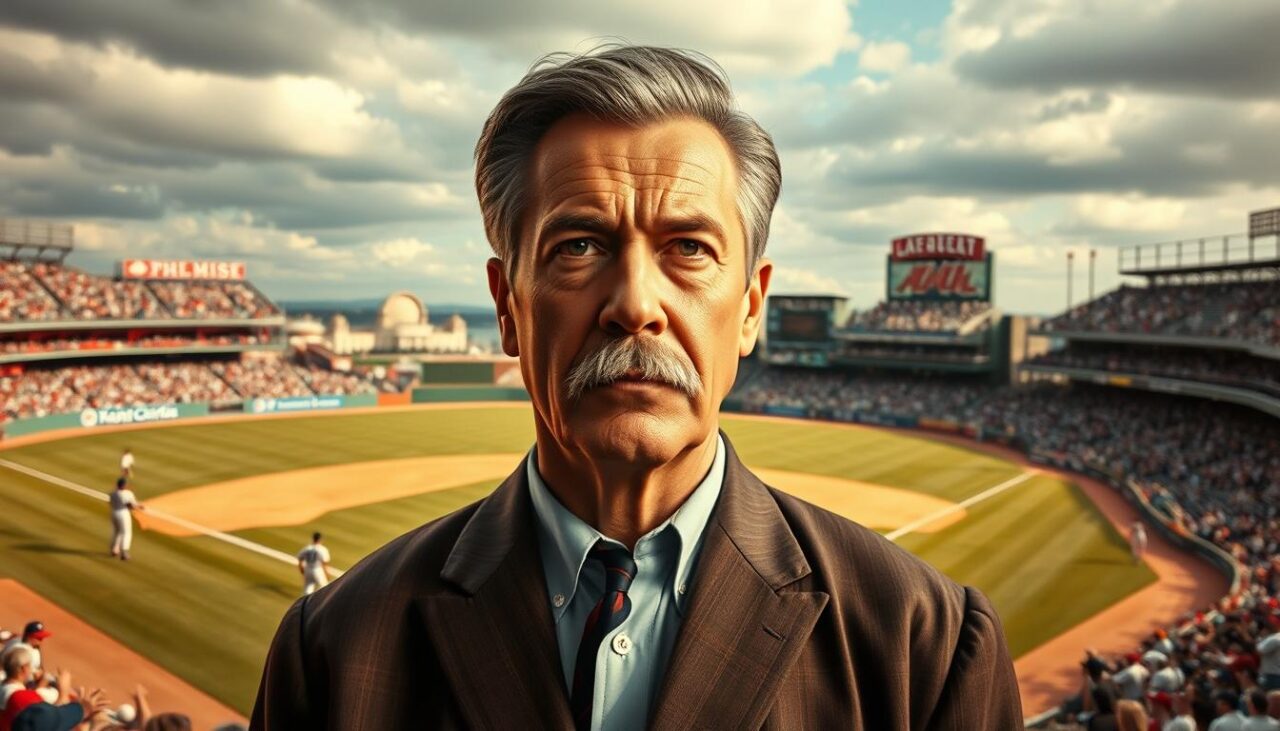
The Hall of Fame welcomed its most reluctant legend in 2020. This was three years after his death and fifty years after he changed baseball. Marvin Miller’s plaque now sits next to Babe Ruth’s, a mix of Karl Marx and Henry Ford in sports.
Ruth showed us how to watch games. Miller taught players to count the money. He turned baseball into a $10 billion industry, ensuring players got fair pay.
How did Miller, from Brooklyn, become so influential? He introduced collective bargaining. This gave players free agency, arbitration, and leverage over owners.
Miller’s legacy is in contracts, not home runs. He’s the unsung hero in a sport that values wins over player welfare. This is the tale of labor law’s impact on baseball.
Profile: The Man and His Times
Marvin Miller was like a chess player, not a checker player. He was born in Brooklyn’s tough neighborhoods to a Jewish family. This was during a time when baseball was segregated.
Miller got his economics degree from NYU and worked at the Steelworkers Union. He wasn’t just a book-smart guy; he was street-smart too. He knew how things really worked.
At first, owners thought he was just a “statistical bureaucrat.” They saw him as a weak link. But they soon found out he was a master strategist.
While others focused on entertainment, Miller taught players about making money. He used his sharp debating skills, honed from watching garment workers, to outmaneuver owners.
Miller’s approach was a mix of economics and common sense. He used Adam Smith’s ideas in salary talks, while owners thought of collective bargaining as a fun group activity. This clash changed baseball into a huge industry.
Miller’s impact on baseball is huge, even bigger than any home run record. His work on contracts has made baseball a multibillion-dollar business. It shows that baseball is really about making money, not just playing the game.
Miller’s legacy is in every big contract in baseball. He proved that baseball is all about money, not just the game. And he won, showing that brains can beat brawn.
Unionizing the Players
When Miller entered baseball’s labor scene, the MLBPA was like a tee-ball team facing Mike Tyson. Owners treated players poorly until Miller showed them the power of numbers. His 1966 election was a landslide, won with facts, not just words.
The 1968 collective bargaining agreement was Miller’s masterpiece. While owners focused on the reserve clause, he secured a 43% minimum wage increase. This was like Nolan Ryan’s fastball to the owners’ solar plexus. Miller used pension fund growth to show players their true worth.
| Pre-Miller (1965) | Post-CBA (1968) | % Change |
|---|---|---|
| $6,000 minimum salary | $10,000 minimum salary | +66.7% |
| No dental coverage | Full medical benefits | N/A |
| Owner-controlled pension | Joint player-owner management | – |
Miller’s strategy was to make unionization seem like personal finance coaching. He taught players about compound interest during spring training. This approach made even struggling players strong in negotiations.
The first CBA’s key move was making owners open their books. Players saw profits rising while their salaries stayed the same. This transparency turned the game’s economics upside down.
“A Whole Different Ball Game” Book Review
If Sun Tzu had negotiated baseball contracts, he might’ve written something like Robert Burk’s biography of Marvin Miller. A Whole Different Ball Game is more than a history lesson. It’s a deep dive into labor strategy, wrapped in a sports memoir. Imagine The Art of War and Moneyball combined, but with a focus on collective bargaining.
Burk’s sharp analysis shows how Miller outsmarted owners. Miller turned player complaints into powerful tools, like a bunt single becoming a grand slam. One chapter is like a heist movie, where Miller secretly organizes players while owners ignore the signs.
The book highlights Miller’s famous quote after being snubbed for the Hall of Fame in 2007: “I’d prefer to be ignored by a thousand sportswriters than one group of players.” Burk calls this a major baseball mistake. It’s the refusal to honor the man who changed player rights forever.
| Strategy Element | Miller’s Approach | Owners’ Countermove |
|---|---|---|
| Negotiation Style | Data-driven coalition building | Emotional appeals to “tradition” |
| Economic Vision | Free agency as inevitable evolution | Reserve clause as “sacred baseball institution” |
| Player Relations | Education through union newsletters | Divide-and-conquer contract offers |
| Public Tactics | Media framing as fairness crusade | Leaking fake salary demands to press |
Burk’s most striking point? Miller wasn’t just playing poker; he created a new game while owners were stuck in the past. The book shows Miller’s 1968 prediction of free agency’s impact was spot on, beating any front-office model.
For today’s labor leaders, this biography is both a source of inspiration and a guide. It shows that collective bargaining is more than just about money. It’s about changing the game of power.
Free Agency and Player Power
Imagine your boss trading you to Fargo without asking, and you’d owe them money. That was baseball’s world until Marvin Miller changed it. He used labor law to challenge the system.
Curt Flood’s 1972 Supreme Court case was a big deal. It was like the Brown v. Board of Education for jock straps. Miller was like Thurgood Marshall, fighting for players’ rights. Though Flood lost, the dissent showed baseball’s unfairness.
The real change came in 1975 with Messersmith-McNally arbitration. An arbitrator said Messersmith and McNally had earned free agency. This led to big changes.
- Messersmith’s 1977 Yankees deal: $3.5 million
- 1966 minimum salary: $7,000
- Inflation-adjusted equivalent: $1.14 million per season today
Owners were shocked by the new rules. *Warning to historians: Comparing old salaries to today’s might shock you.* The average player salary jumped from $29,000 in 1976 to $143,756 by 1980.
| Era | Avg Salary | Equivalent Today |
|---|---|---|
| Pre-Miller (1966) | $7,000 | $64,000 |
| Post-Free Agency (1980) | $143,756 | $523,000 |
| Modern (2023) | $4.9 million | N/A |
Miller was a genius. He used legal terms to challenge ownership. He taught players to fight for their rights. Now, even .250 hitters can afford fancy things.
Lasting Impact on MLB Economics
Marvin Miller didn’t just negotiate contracts; he changed baseball’s economic landscape. When he joined the MLBPA in 1966, players made less than $19,000. Now, the league minimum is over $740,000. This change made players more than just workers.
| Metric | Pre-Miller (1965) | Post-Miller (2023) |
|---|---|---|
| Average Salary | $19,000 | $4.9 million |
| Revenue Share | 18% (owners kept 82%) | 48% (players’ cut) |
| Player Mobility | Indentured servitude | Free agency buffet |
The Competitive Balance Tax (CBT) system today shows Miller’s influence. Owners say it hurts small-market teams, but their concerns seem fake. Franchise values have skyrocketed, with the Yankees now worth $7.1 billion.
Ironically, baseball unions have made owners richer than any antitrust law. Players pushing for fair pay led to new revenue streams. The MLBPA didn’t just fight for dental plans; they built the economic engine of baseball.
When owners complain about salaries, remember the past. Their ancestors made $19K, while today’s players make $740K. Miller taught players to think like CEOs, turning baseball into a fascinating labor study.
Miller’s Place in History Books
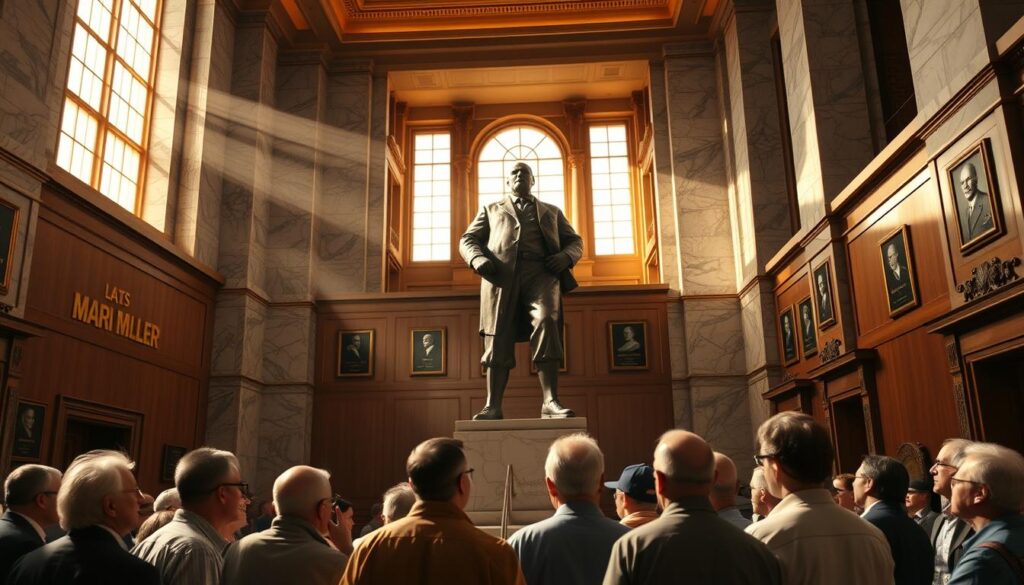
Why did it take 20 years for Marvin Miller to get into the Hall of Fame? His wait was like Galileo’s trial, showing baseball’s leaders were slow to accept salaries orbit supply/demand. Miller had shown this mathematically long before.
Tom Seaver called Miller’s exclusion a national shame. Owners voted on inductees until 2010, and Miller faced a lot of resistance. Bowie Kuhn’s memoir even called Miller stubborn, but it was the owners who held grudges.
The 2020 induction was a victory for Miller. It was like a walk-off World Series homer, 50 years after he rounded third. Today’s $10M average salary is a testament to Miller’s lasting impact.
Today, labor leaders study Miller’s methods. His marvin miller bio shows him as a master negotiator. He used economics and psychology to challenge MLB, saying players expect fair pay because it benefits owners too.
Cooperstown now honors Miller’s work. In 1966, players knew he was changing baseball’s labor and economics. Miller’s legacy is in every collective bargaining agreement.
Further Reading
Ready to dive deep into baseball’s labor wars? Get ready for our literary lineup of unsung heroes. They turned collective bargaining into a thrilling sport. These books show labor history is full of twists and great characters.
- “The Dred Scott of Sliders” (Curt Flood’s memoir): Curt Flood’s antitrust lawsuit is more intense than Moneyball. It’s a must-read for any baseball fan.
- “The Fastball That Broke the Bank” (Andy Messersmith bio): Andy Messersmith’s $10,000 contract fight is like the Boston Tea Party of baseball. It’s full of high-stakes drama.
- “Barnum with a Box Score” (Bill Veeck autobiography): Bill Veeck treated labor relations like a circus. His story is filled with fireworks and big controversies.
For more in-depth stories, check out Robert Burk’s Marvin Miller, Architect of Revolution. Pair it with Doug Locker’s ThanksMarvin.com for a complete look at labor history.
⚠️ Warning: These books might make you want to talk about collective bargaining at barbecues. Proceed with caution.
Conclusion
Marvin Miller’s impact on baseball is huge. Every arbitration hearing and luxury tax threshold shows his work. Former commissioner Fay Vincent said, “We never found a pitch he couldn’t hit.”
Today, the MLBPA has a $500 million war chest. They use Miller’s strategies in CBA fights over revenue sharing and service-time manipulation.
When rookies get contracts worth more than small nations’ GDP, Miller’s spirit is at work. Those huge $300 million deals are a result of his efforts. He didn’t just negotiate contracts. He made locker rooms into boardrooms where even bat boys earn more than CEOs.
Baseball’s labor wars keep changing, but Miller’s mark is everywhere. He showed athletes are more than just numbers. This lesson has cost leagues in NBA and NFL dearly.
In a world where team values grow fast, today’s players stand on Miller’s shoulders. They wear 1970s uniforms but have his legacy.
When people talk about Juan Soto’s huge contract, remember Miller’s role. He built the modern athlete’s pay structure. The real question is, “Would baseball charge nickel beers without his efforts?”