
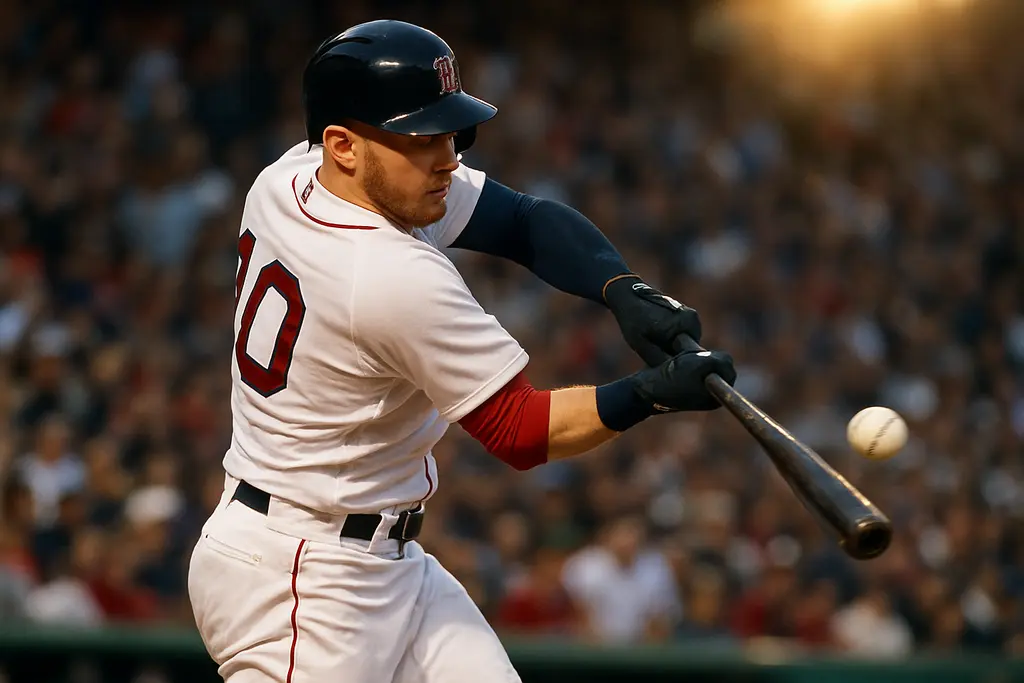
Trevor Story Homer is best understood as one decisive swing inside a broader late-season pattern. On September 18, 2026, Story hit a go-ahead three-run home run in the eighth inning against the Texas Rangers in Arlington, lifting Boston to a 4-3 comeback win, helping the Red Sox avoid their first sweep since July, and keeping them in the postseason race, according to the MLB.com recap.
Trevor Story Homer And The September Swing
The September 18 swing stood out because it arrived late, with Boston trailing, against a team trying to finish off a sweep. One at-bat did not define Story’s full 2026 offensive profile, but it carried playoff-race weight because of timing, score, and standings context. Boston was fighting for Wild Card position in mid-to-late September 2026, and the research notes place the Red Sox in the second AL Wild Card spot at that point, five games ahead of Cleveland and 5.5 games behind the Yankees for the top Wild Card position.
Why The Trevor Story Homer Mattered
The Trevor Story Homer turned a likely damaging road loss into a narrow win. In late September, that type of result can alter how a club manages the next day’s bullpen, how much pressure sits on the next starter, and how narrow the margin becomes in the Wild Card race. The value was not just that Boston scored three runs. It was that all three came in the eighth inning, when run expectancy and time to recover were limited.
That is where clutch performance needs careful handling. A single late homer should not erase months of data, and it should not create an unsupported claim that a player has permanently changed his offensive level. It can, though, be evaluated as a high-impact event. In Story’s case, the event matched a short-term rise in contact production after his return from injury, giving Boston both a tangible win and a needed sign of lineup depth.
Contact Form Before Power Returned
Story’s September was not built on repeated home runs. The research notes show that his offense in the month leaned more on hits, doubles, and general contact than on a power spike. During September 2026, through the available early-month data, Story carried an approximate .303/.303/.394 line, with his slugging percentage and OPS among his better recent monthly marks, per his Baseball Savant player page.
Short-Term Production Versus Season-Level Data
That distinction matters. A hitter can be below his expected career peak across a season while still supplying a valuable two-week stretch. Story entered the September 18 win on an eight-game hitting streak and had recorded a hit in all but one of his previous 16 games since returning from injury. The research does not detail the injury, so the safest read is limited: he returned, he hit more consistently in the available stretch, and Boston received production at a point in the schedule when every win carried sharper standings value.
The Trevor Story Homer also fit the shape of his September line. In the same month, over 37 at-bats in the cited span, he collected 11 hits, including three doubles and one triple, for a batting average close to .297. That is not enough volume to declare a full offensive rebound. It is enough to say he gave Boston a steadier bat during a pressurized segment of the schedule.
How Boston’s Wild Card Margin Shaped The At-Bat
Late-season analysis often centers on standings, but the standings are built from individual moments. A late three-run homer does not carry the same practical meaning in April that it carries in mid-September, even if the box score value is identical. By September 18, Boston’s position in the Wild Card race made the comeback meaningful beyond a single night in Arlington.
Small Margins In A Playoff Race
One reason the swing deserves attention is that it prevented a sweep. The research states that Boston had not been swept since July, so the comeback preserved that trend at a time when a series loss could have narrowed the club’s cushion. In a Wild Card race, avoiding the worst-case result in a road series can be nearly as useful as producing a clean series win.
This is also where team construction and game state intersect. Boston did not need Story to be its best hitter for six months to benefit from his September stretch. It needed a credible lower- or middle-order threat who could punish a mistake with runners on base. For readers interested in how narrow playoff races are shaped by roster depth, on-base pressure, and defense, this related analysis of playoff race strategy gives historical framing without reducing the sport to one statistic.
Player Value Beyond A Season Line
Story’s season-level offensive numbers, as provided in the research, were modest: approximately a .237 average, .270 on-base percentage, .353 slugging percentage, five home runs, 29 RBIs, and five stolen bases in around 249 at-bats. His OPS+ was cited at about 75, meaning his total offensive output sat below league average. Those numbers matter because they prevent the September story from being overstated.
Why Context Changes The Reading
Season lines measure broad performance. Pennant-race moments measure impact inside tight windows. Both are valid, but they answer different questions. The full line asks how much value a player produced across the season. The September 18 plate appearance asks whether a player changed a specific game at a specific time. Story clearly did the latter.
That is the central analytical tension in clutch-performance writing. If the focus is too narrow, one swing becomes inflated. If the focus is too broad, the late-game value disappears into a season average. The best reading sits between those poles: Story was not established by the available numbers as an above-average 2026 hitter, yet he supplied meaningful late-season production that helped Boston hold ground.
There was also a roster-confidence angle, though it should be stated carefully. A veteran returning from injury and producing hits in 15 of 16 games gives a manager more workable lineup options. The research supports the hitting pattern; it does not support broad claims about clubhouse mood, private leadership, or medical status. Readers comparing baseball analysis across the same publishing network can find related sports coverage at Back2Tap.
Trevor Story Homer In Red Sox Context
The September 18 home run should be remembered as a high-leverage contribution, not as proof that all concerns about Story’s bat had vanished. Its value came from leverage: eighth inning, three runs, one-run final margin, road setting, and a Wild Card race that had little room for wasted chances. That combination made the swing one of the clearer examples of Boston converting veteran experience into a standings-relevant result.
The available research does not establish Boston’s final postseason outcome as of October 1, 2026, so the supported conclusion is narrower. Story’s late September run helped the Red Sox protect their position during a key stretch. The Trevor Story Homer in Arlington was the loudest moment, but the surrounding contact trend made it more than an isolated highlight. For a club trying to survive the final weeks, that blend of timing and short-term form had real baseball value.