

Why does America’s so-called boring pastime produce the most compelling stories? While football offers brute force and basketball constant motion, baseball gives us something different entirely.
Think about it: where else do you find postmodern dice games sitting beside horror tales and magical realism? From Robert Coover to Stephen King, this sport somehow works everywhere.
The secret lies in baseball’s unique rhythm. Those built-in pauses create natural tension. The clear dramatic stakes—runs instead of points—build perfect narrative structure.
I’ve even written baseball sci-fi myself. There’s something about the diamond that becomes the perfect metaphor for American life. It’s not just a game—it’s our national storytelling vehicle.
Thematic Elements (Myth, Nostalgia, Heroism)
Why does baseball in literature resonate more than other sports stories? It’s not just the game. It’s the grand American story unfolding on the diamond.
Baseball is our national Rorschach test. We see our deepest fears, fondest memories, and complex identities in its ninety feet. The bat’s crack is more than wood hitting leather; it’s metaphor striking meaning.
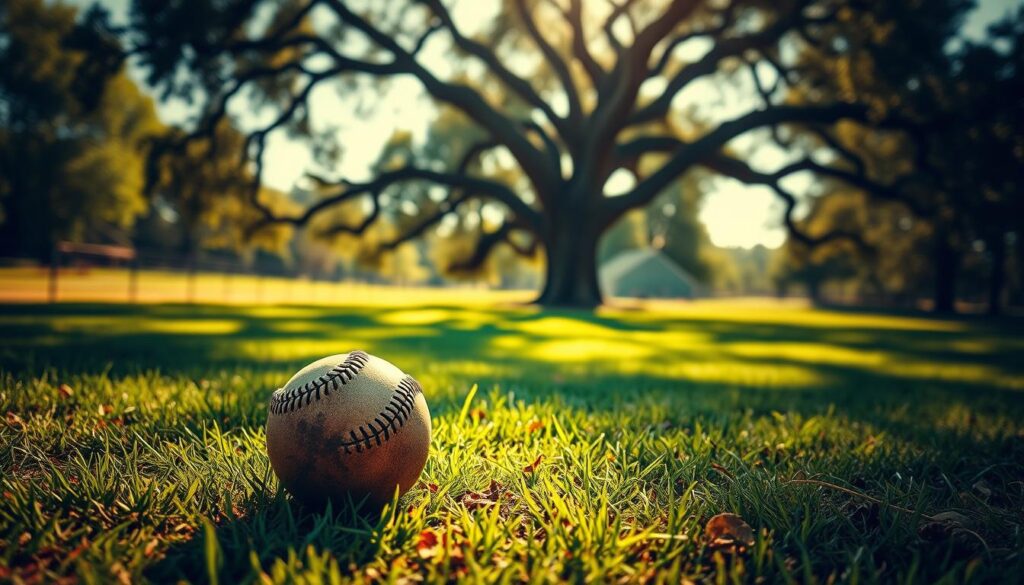
Mythology is key. Kinsella’s Field of Dreams gave us “If you build it, they will come.” It’s a perfect allegory for America’s past romance. An Iowa cornfield becomes our collective unconscious, where we revive heroes to heal today’s hurts.
Nostalgia is baseball literature’s secret strength. These stories offer a simpler America, whether real or not. They give us green fields, crackerjack, and endless summers. It’s our collective memory as national therapy.
But authors also subvert these expectations. Malamud’s The Natural gives us Roy Hobbs, a flawed hero whose mighty swing can’t fix his morality. That’s literary genius.
Today’s authors tackle big themes. They explore identity crises, belonging, and redemption arcs that rival Shakespeare. They’re not playing small ball.
The new baseball in literature tackles race, gender, and sexuality head-on. Jackie Robinson’s legacy is more than history; it’s a commentary on America’s equality struggle.
Women and LGBTQ+ players in the majors? These aren’t niche topics. They’re the next step in baseball as America’s metaphor. The diamond is a microscope on our society’s complexities.
As scholarship shows, baseball literature reflects Cold War fears and historical changes. The pitcher’s mound is a philosophical podium. The outfield wall is a cultural barrier.
Baseball in literature is powerful. It’s not just about the game. It’s about us. Our myths, memories, and heroes, both flawed and genuine. Next time you read a baseball novel, remember: you’re reading America’s diary.
In-depth Analysis of 3–4 Novels
Forget box scores – these baseball novels dive deep into myth and psychology. Our literary baseball analysis starts with Bernard Malamud’s The Natural. Here, Roy Hobbs battles through dreams and disappointments with his magical bat. It’s not just sports fiction; it’s a tale of legend.
Philip Roth’s The Great American Novel brings satire to the game with Gil Gamesh, a fiery pitcher. The story is set against a backdrop of Cold War fears, thanks to a communist-hunting owner and a manager obsessed with the Bible. Roth shows how baseball can be both funny and disturbingly timely.

Robert Coover’s The Universal Baseball Association follows an accountant who escapes reality through dice games. This postmodern work wonders: when does fantasy become more real than life? The answer might be found in the seventh inning.
Don DeLillo’s Underworld begins with the famous “Shot Heard ‘Round the World.” DeLillo uses baseball to link decades through a single moment of greatness. It’s a historical tale that shows how sports shape eras.
W.P. Kinsella’s Shoeless Joe creates dream fields where redemption waits. It asks what we’d give up for one more game with legends. The answer often involves Iowa’s cornfields.
Chad Harbach’s The Art of Fielding explores modern college baseball with deep insight. It’s a mix of Melville and MLB, filled with existential questions. Harbach shows the baseball novel is far from over.
Each writer uses baseball in their own way: Malamud’s tragedy, Roth’s satire, Coover’s escape, DeLillo’s history. They all see baseball’s magic in the spaces between the field and the page. For more on these novels’ impact on sports literature, check out this fresh take on classic baseball fiction.
This literary baseball analysis shows how America’s game is also America’s metaphor. The best baseball novels aren’t just about sports; they’re about life, using sports as a backdrop.
Broader Impact on Sports Literature
Baseball has dominated sports literature, leaving other sports in the dust. The Library of America’s Baseball: A Literary Anthology highlights this dominance. It features famous writers like Robert Frost and John Updike, showing baseball’s deep impact.
Recent books like Gish Jen’s “The Resisters” and Emily Nemens’ “The Cactus League” show baseball’s lasting appeal. They use baseball to tell stories of resistance and human drama. This proves why baseball is perfect for literature.
Baseball has set a high standard for sports novels. When people think of serious sports stories, they think of baseball. Its unique blend of individual stories and collective myths makes it hard for other sports to follow.
Baseball’s influence goes beyond sports writing. It has shaped American storytelling. Its rhythms and language have become part of our literary culture. While other sports may have exciting moments, baseball holds a special place in our libraries.