
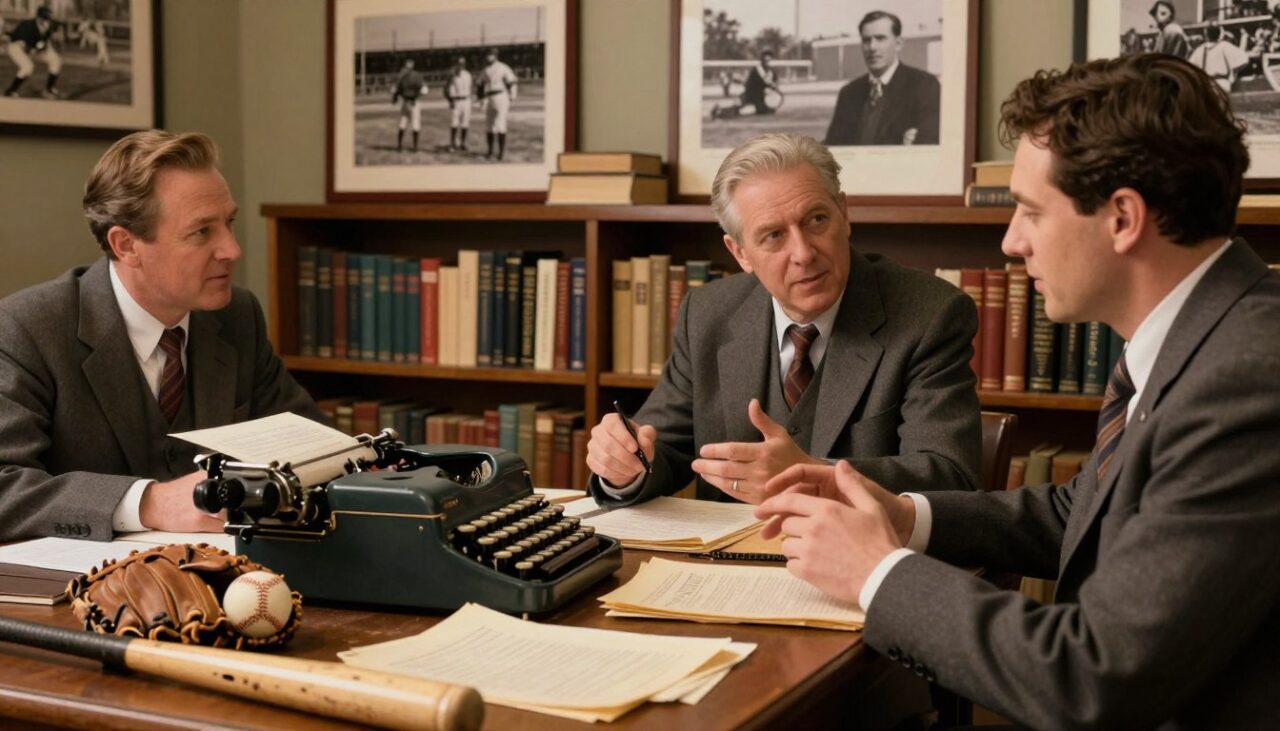
George Plimpton once said that sports writing quality is the opposite of the ball size. This is a funny idea, but it’s wrong. The amount of writing about baseball shows it’s more than just a game. It’s a place where our national story unfolds.
From the heroes of old dime novels to today’s detailed journalism, baseball has inspired a lot of writing. This isn’t just a sports tale. It’s a rich literary tradition.
The game’s pauses and rhythms make it perfect for stories. The sound of the bat isn’t just noise; it’s the start of a story. These writers don’t just report games. They tell us about America’s highs and lows, and our quest for perfection.
We’re not just talking about a game. We’re talking about the writers who saw beyond the stats. They found the soul of the sport. They turned it into a mirror for our identity, dreams, and the stories we tell ourselves.
Author backgrounds and influences
To understand the magic of baseball stories, we must look at the authors. The best baseball tales aren’t just about the game. They come from the author’s life, passions, and personal myths. The diamond is a stage for the author’s dreams and cultural stories, just as much as for the players.
The Kinsella Blueprint: Magic, Myth, and the Cornfield
W.P. Kinsella is a key figure in turning baseball into a myth. He built a baseball diamond in an Iowa cornfield. Kinsella didn’t just write about baseball; he used it to explore the past, magic, and ghosts.
He came from the Canadian prairies and started university in his 30s. This late start was key. He saw baseball as a place for redemption and second chances, not just a sport.

Kinsella’s life was full of contrasts, which showed in his writing. He wrote about First Nations life and created the mythic world of Shoeless Joe. His work was not just about baseball. It was about the magic and dreams that baseball can bring.
His masterpiece, Shoeless Joe, is a perfect example of this. The famous line—“If you build it, he will come”—is a leap of faith. The novel asks what we would build if we believed in the impossible.
Kinsella’s background gave the story its wisdom. It’s about regret, longing, and the act of faith in building a ballfield in a cornfield.
The controversy surrounding Kinsella is also part of his story. His use of J.D. Salinger in Shoeless Joe led to a legal battle. This mirrors the novel’s themes of the past and present colliding. Kinsella lived the intersection of the ordinary and magical.
For other baseball writers, Kinsella’s legacy is a blueprint. The game is a vessel for memory, magic, and the past. His work shows that the best baseball stories are the ones we build in the empty spaces.
Literary styles and approaches
In baseball literature, two voices stand out: the statistician and the poet. This isn’t just a style difference; it’s a deep split in understanding the game’s essence. Writers span a spectrum, from the data-driven statistician to the narrative poet. This contrast makes baseball literature rich and lasting. For more on this, check out this analysis of what makes a great baseball novel.

The Statistician vs. The Poet
The Statistician views the game as a complex equation. They believe the game’s truth lies in numbers like OPS and WAR. Their writing is clean and analytical, inspired by Bill James.
The Poet, like Roger Angell, focuses on the game’s human side. They write about the game’s texture and the players’ experiences. For them, the game’s beauty is in its human moments, not just statistics.
The table below shows the main differences between these two approaches:
| Aspect | The Statistician (The Analyst) | The Poet (The Narrator) |
|---|---|---|
| Primary Focus | Data, trends, probabilities, and objective metrics (WAR, OPS, FIP). | Human experience, emotion, narrative, and the ineffable “feel” of the game. |
| Narrative Voice | Objective, analytical, declarative. Seeks universal truths from data. | Subjective, descriptive, lyrical. Seeks universal truths from specific moments. |
| Ultimate Goal | To explain the “how” and “why” of the game through empirical evidence. | To capture the “why it matters” and the human experience within the game. |
| Iconic Example | Bill James, Rob Neyer, modern analytics departments. | Roger Angell, Roger Kahn, W.P. Kinsella. |
| Delivers | Insight, prediction, and a framework for understanding value. | Meaning, memory, and a connection to the game’s soul. |
This isn’t a fight for dominance, but a necessary balance. The Statistician gives us the game’s structure. The Poet adds the heart and soul. The best baseball writers blend these, using data to tell a deeper story or narrative to make numbers human. Roger Angell showed us that the game’s true picture is painted with both logic and emotion.
Fiction vs journalism crossover
Every great baseball writer knows a secret: the most exciting moments happen at the edges. It’s not just on the field’s foul lines but where fact and fiction meet. This is where baseball writers shine, blending Roger Angell’s sharp reporting with W.P. Kinsella’s fantasy, creating something more real than either could be alone.
W.P. Kinsella’s work, like Shoeless Joe and The Iowa Baseball Confederacy, is not just about baseball. It’s about the magic and human hopes the game embodies. His Iowa cornfield is a gateway, and the 1919 White Sox ghosts are about the game’s essence. It’s not just reporting; it’s turning fantasy into profound questions.
On the other side, we have Roger Angell, the journalist. He didn’t just cover baseball; he curated it. For years, Angell wrote about the game with a novelist’s eye and a poet’s precision. He chronicled the drama of the 1962 Mets and the 1975 World Series, revealing the human side of the game.
Angell’s work is a must-read for any serious baseball writer. He showed that fiction’s tools—character, setting, suspense—can be powerful in journalism. He reported the facts but wrote the truth.
This isn’t a rivalry; it’s a perfect partnership. Kinsella asks “what if,” while Angell tells us “what is.” One wonders about Shoeless Joe’s final at-bat. The other captures the essence of being a rookie in the 9th inning. They’re two sides of the same coin, one writing the game’s poetry, the other its biography.
The magic happens when a baseball writer blends journalism and fiction. Journalists learn to see the story in the game from novelists. Novelists, in turn, learn the power of specific details from journalists. Today’s best baseball writers work in this hybrid space. They know the game’s truth lies in the dirt, superstitions, and fan hopes.
The Kinsellas and Angells of the world play the same game. They use fiction and journalism to uncover baseball’s truth. They’re not just chroniclers but storytellers, myth-keepers, and passionate fans. Their work enriches us, whether from the press box or the cornfield.
Their legacy in sports literature
So, what’s the final score for these literary all-stars? The legacy of writers like W.P. Kinsella and Roger Angell is not just a record. They didn’t just report on the game; they brought its soul to life.
Kinsella’s “Shoeless Joe” did more than inspire a movie. It turned a baseball diamond in an Iowa cornfield into a symbol of faith and second chances. It showed that a box office hit and a literary masterpiece can share the same story. Roger Angell, with the J. G. Taylor Spink Award, did something just as groundbreaking. He found the epic poem in every box score.
These baseball writers did more than document the sport. They built a bridge between the dugout and the literary world. They showed that a box score can be as dramatic as a Shakespearean tragedy and a routine double play can hold a universal message.
Their true legacy is a field forever elevated. They proved the sound of a bat cracking can be as profound as any literary work. They didn’t just cover the game; they gave us the words to feel it. The best baseball writers, like Kinsella and Angell, didn’t just describe the action. They became part of the game’s timeless story, one perfect sentence at a time.