
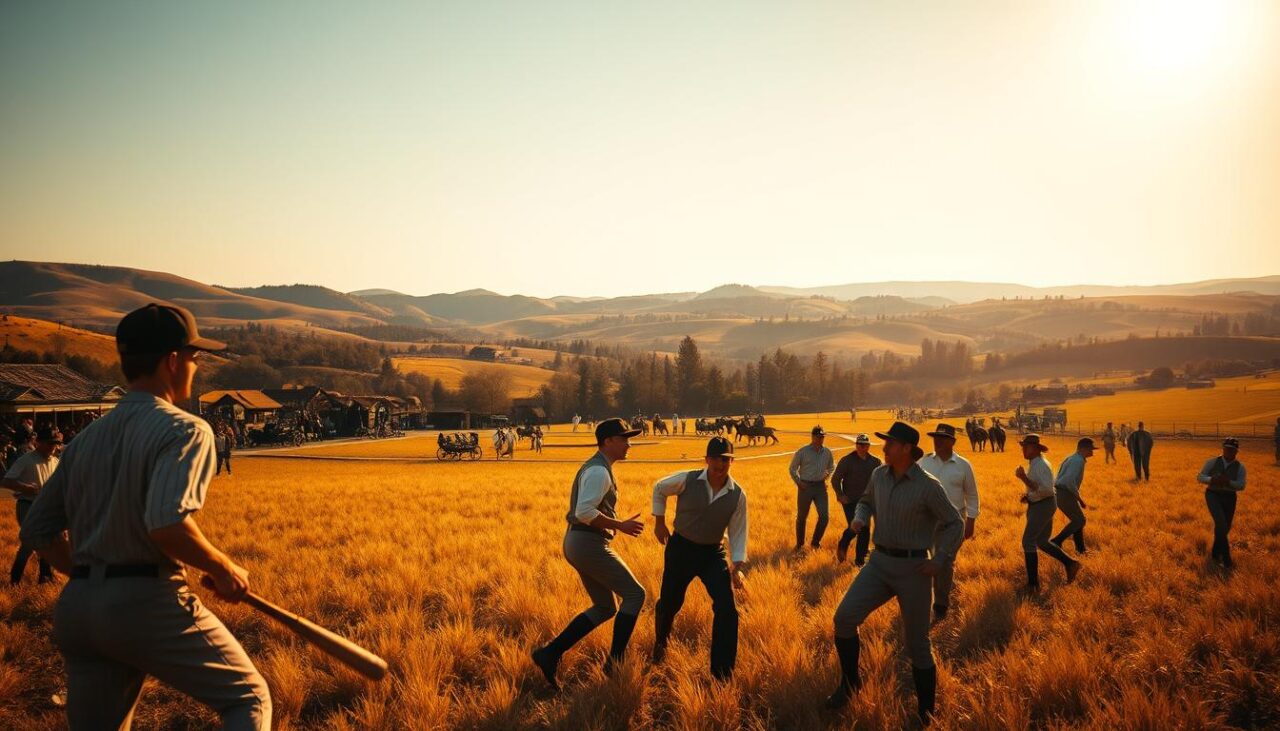
Think baseball just popped into existence like Athena from Zeus? Think again. It has roots as complex as a Brooklyn bodega’s WiFi password. Let’s explore its origins like a detective examining old chewing tobacco stains.
Our tale starts in 1744 England, where stoolball (a mix of cricket and Renaissance fun) set the stage. Then, in 1838, Canadian soldiers played “base” near frozen lakes. The New York Knickerbocker Club made rules that would make Rob Manfred raise an eyebrow. Doubleday’s “invention” is less believable than Shakespeare writing the King James Bible.
What we got was a mix of cultures. Stickball games from immigrants met industrialists’ love for order. This created a sport as American as speculative railroad bonds. The 1845 Knickerbocker Rules, baseball’s foundation, set bases 90 feet apart. This was to avoid chaos, like a Gilded Age stock market crash.
This messy start shows truth is stranger than myth. Baseball didn’t come from a perfect Eden. It was born in smoke-filled rooms and cultural theft. It’s perhaps the most American creation story of all.
The Amateur Era: Town Teams and Clubs
Imagine a world where baseball gloves were as rare as an honest politician – welcome to 1850s amateur ball. Before stadium nachos and $15 beers, the game thrived in vacant lots. Pharmacists, teachers, and merchants played with the intensity of Wall Street brokers… if Wall Street brokers wore lace-trimmed pantaloons.
New York’s baseball craze wasn’t just a sport – it was social alchemy. Teams like the Knickerbockers and Excelsiors functioned as Victorian-era LinkedIn groups. They mixed athletic competition with:
- Networking opportunities (business cards exchanged between innings)
- Fashion statements (wool uniforms that could double as winter survival gear)
- Class signaling (membership fees costing a worker’s weekly wage)
The real drama unfolded in the Massachusetts Game vs. New York Game rivalry. Picture Boston’s ruleset as the chaotic older sibling:
| Massachusetts Game | New York Game | |
|---|---|---|
| Players | 10-14 per side | 9 players (the “civilized” number) |
| Scoring | 100 runs to win | 21 aces, winner takes all |
| Tagging | “Soaking” – pelting runners with balls | Gentlemanly touches |
That soaking rule – baseball’s original extreme sport – would make modern agents weep. Imagine explaining to your boss that your star pitcher got sidelined by a walnut-sized hematoma from a “friendly” game at the town common.
These early baseball leagues weren’t just playing a game. They were crafting America’s first blueprint for organized sports fandom. They mixed heated regional pride with questionable fashion choices that haunt us today. The real victory? Transforming a patchwork of local rules into a national obsession, one absurdly overdressed game at a time.
The National Association and Professionalization
Imagine America’s favorite sport mixed with money. That’s what happened with baseball’s first professional league. The 1869 Cincinnati Red Stockings were pioneers, turning athletes into employees. They won 57 games, showing games could make money.
The National Association (NA) started in 1871, like a new, exciting service. But it was chaotic and short-lived. For five seasons, it showed how much baseball needed rules. Teams came and went, like startups in the Gilded Age.
Three big problems killed the NA:
- No salary caps – rich teams bought the best players
- Games were all over the place – teams played 14 to 66 games a year
- Gambling scandals were everywhere
But the NA laid the groundwork for modern baseball. They introduced player contracts and road games. When the National League started in 1876, it built on the NA’s ideas but added rules.
The Red Stockings’ undefeated season was more than just winning. It was the start of a new era. Factory work and profit became more important than community. Baseball had turned into a job, with disputes and player moves. Does that sound familiar?
Rule Evolution and Innovations
If baseball’s rulebook were a time machine, the 1845 Knickerbocker edition would take us back to a world where fielders played catch with gravity. Pitchers then lobbed underhand compliments. This wasn’t your grandfather’s America’s pastime – it was a Victorian tea party disguised as sport. The rules would make modern players cry into their elbow guards.
The Knickerbocker Rules banned “soaking” – the practice of pegging runners with live balls to record outs. This was to avoid concussions-as-strategy. Ty Cobb’s ghost might say, “Where’s the fun in that?”
Let’s look at three big changes that turned lawn games into Nolan Ryan’s fastball dreams:
| Year | Rule Change | Cultural Impact |
|---|---|---|
| 1845 | One-bounce catches count as outs | Outfielders perfected the art of lazy Sunday catches |
| 1858 | Called strikes introduced | Batters stopped treating plate appearances like open-mic poetry nights |
| 1884 | Overhand pitching legalized | Pitchers’ arms became both weapons and ticking time bombs |
The 1884 pitching revolution deserves its own Hall of Fame exhibit. Overnight, hurlers went from tossing underhanded lollipops to throwing gas. Batters suddenly needed reflexes sharper than a Gilded Age robber baron’s business tactics.
Want to trace how these evolution of baseball rules shaped modern play? Picture explaining the original “bound rule” to Aaron Judge. It’d be like teaching Shakespeare to compose TikTok captions – technically possible, but spiritually absurd.
Baseball’s early rulemakers were like mad scientists in cravats. They didn’t just adjust gameplay – they weaponized physics and redefined human limitations. The result? A sport that evolved from a pastoral novelty to America’s high-velocity Rorschach test.
Prominent Leagues: National League, American Association, Union Association
Baseball’s 19th-century league wars were intense. The National League, American Association, and Union Association were the main players. Each had its own style, from the National League’s strict rules to the American Association’s more relaxed vibe.
The National League started in 1876 and was very strict. They banned Sunday games and had rules like a school principal. Their goal was to keep the game classy, even if it meant fewer fans.
The American Association, starting in 1882, was the opposite. They welcomed fans with cheap tickets and beer. They knew that to grow, they needed to attract more people, not just the wealthy.
| League | Lifespan | Signature Move | Cultural Equivalent |
|---|---|---|---|
| National League | 1876-present | Banning alcohol & Sunday games | Ivory Tower Academia |
| American Association | 1882-1891 | 25¢ tickets & stadium beers | Blue Collar Comedy Tour |
| Union Association | One season (1884) | Signing anyone with a pulse | Cryptocurrency Startups |
The Union Association was short-lived but exciting. They grew fast but collapsed quickly. Their story shows how fast baseball leagues could grow and fail.
What drove this drama? America’s industrial growth and the desire for entertainment. Railroads, cities, and entrepreneurs all played a part.
- Railroads enabled coast-to-coast competition
- Urban populations craved entertainment
- Entrepreneurs saw dollar signs in dirt infields
By 1890, the National League had learned from its rivals. This set the stage for today’s MLB. The story of baseball teaches us that, in business and sports, success often comes after failure.
Key Teams and Legendary Players
Meet the original cast of baseball, a mix of Shakespeare-quoting sluggers and traveling vaudeville teams. The 19th century MLB was more than just games; it was a show. The 1887 Chicago White Stockings, for example, were known for their skills and racial exclusion.
The Providence Grays (1878-1885) were like the Google of their time. They had a secret weapon, pitcher Charles “Old Hoss” Radbourn, who won 59 games while possibly drunk. “Orator” Jim O’Rourke, a Yale Law grad, could recite Milton while stealing bases.
Teams had groundskeepers who also played outfield and umpires who called games after drinking. Imagine a manager saying, “No, Mr. Steinbrenner, the right fielder’s currently trimming the infield grass.”
| Team | Years Active | Signature Quirk | Lasting Impact |
|---|---|---|---|
| Providence Grays | 1878-1885 | Pitcher doubled as bartender | Invented the bullpen (literally) |
| Chicago White Stockings | 1870-1899 | Cap Anson’s racist policies | Accelerated segregation |
| New York Mutuals | 1871-1876 | Players owned team shares | Early player empowerment model |
Cap Anson’s story is complex. He was a batting genius but refused to play against Black athletes. His .334 career average makes us question our sports heroes.
These teams shaped baseball’s DNA with their mix of genius and prejudice. Their ballparks were filled with whiskey and dreams. To understand today’s MLB, we must face these historical ghosts.
Changes in Equipment and Stadiums
If 19th-century baseball were a survival show, players would’ve been voted off the island by episode two. Early equipment was not just simple; it was dangerous. Imagine batters swinging wagon tongues and catchers facing fastballs without protection. The game’s evolution from a backyard game to a scientific sport was a surprising accident.
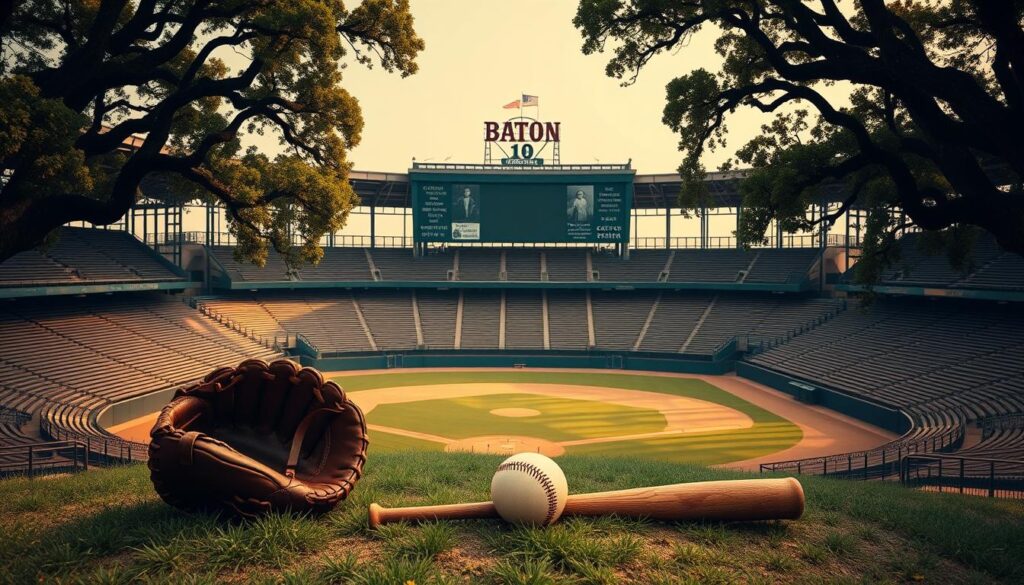
The 1870s marked the start of standardization. Hand-stitched balls were replaced by rubber-core spheres that could last through games. Bats evolved from heavy, splintered sticks to the famous Louisville Slugger. The 1880s brought catcher’s masks, showing even Victorians knew brain injuries weren’t good for business.
Stadiums also changed a lot. Early “ballparks” were dangerous:
- Wooden bleachers that creaked like pirate ships
- Oil lamps used as markers (and fire starters)
- Dirt infields that turned rainy games into mud wrestling matches
The 1890s saw the construction of steel-and-concrete coliseums. But first, many wooden parks burned down. Insurance adjusters might have invented the seventh-inning stretch to calm their nerves.
| Era | Equipment Features | Stadium Features | Safety Level (1-10) |
|---|---|---|---|
| 1860s | Hand-carved bats, rag-stuffed balls | Open fields with hay bale seating | 2.5 |
| 1880s | Standardized balls, catcher masks | Wooden grandstands with gas lighting | 4.7 |
| 1890s | Machined bats, padded gloves | Fireproof materials, defined dugouts | 7.1 |
This equipment evolution changed baseball in big ways. It made the game more possible. When balls were reliable, pitchers threw harder. When fields were safer, catches became more exciting. The game’s DNA was constantly changing with every broken bat and burned ballpark.
Social and Economic Contexts of 19th Century Baseball
Baseball was more than just a game in 19th-century America. It was a mirror of the era, showing off labor disputes, racial issues, and regional rivalries. The game spread quickly, carried by Civil War soldiers who played during breaks. But, baseball also created new barriers, excluding many people.
The 1887 National League salary cap was just $2,000, making players feel like indentured servants. Owners claimed they were keeping the game classy, but it was really about making money. They offered cheap beer and organ music to distract from the exploitation.
| Economic Factor | Baseball Impact | National Context |
|---|---|---|
| Industrial Labor Practices | Reserve Clause binds players to teams | Robber barons dominate railroads/steel |
| Westward Expansion | Teams follow rail lines to new markets | Manifest Destiny reaches Pacific |
| Class Divisions | Separate “ladies days” vs. working-class bleachers | Carnegie builds libraries while workers starve |
The sport reflected American values in complex ways. Northern industrialists backed teams to show off progress, while Southern clubs subtly supported racism. Even the baseball itself was made by underpaid immigrants in Massachusetts.
Despite its problems, baseball made leisure more accessible. By 1890, a factory worker could spend half a day’s wage to watch a game. It was like reality TV, with no commercials and exciting moments.
Race and Exclusion Before the Negro Leagues
Imagine a sport where your batting average didn’t matter as much as your skin tone. Welcome to 19th-century baseball. Before the Negro Leagues baseball era, pioneers like Moses Fleetwood Walker faced harsh realities. In 1884, Walker’s debut was seen as a circus act, with racial slurs passed off as “colorful commentary.”
The 1890s introduced baseball’s “gentleman’s agreement.” It was a term as contradictory as pineapple on pizza. Team owners banned Black players, calling it business etiquette. It was like a “Whites Only” sign, but with box scores instead of water fountains. By 1900, no Black athletes remained in the majors.
Walker’s career was filled with death threats, sabotage, and teammates who’d lose games to avoid him. Yet, his .263 batting average was better than many white catchers. Racism, not stats, was the real issue. Even The Sporting News said Black players “lacked the temperament” for the sport. It meant White fans couldn’t handle greatness in brown skin.
This wasn’t just exclusion—it was theft. The color line stole baseball of talent for 60 years. We’ll never know what Josh Gibson could have done against Babe Ruth. But here’s a fun fact: The Negro Leagues baseball scene thrived because of segregation. Sometimes, resilience means hitting home runs while facing spitballs.
Books and Resources: Great Encyclopedia of 19th Century MLB, “Baseball Before We Knew It”
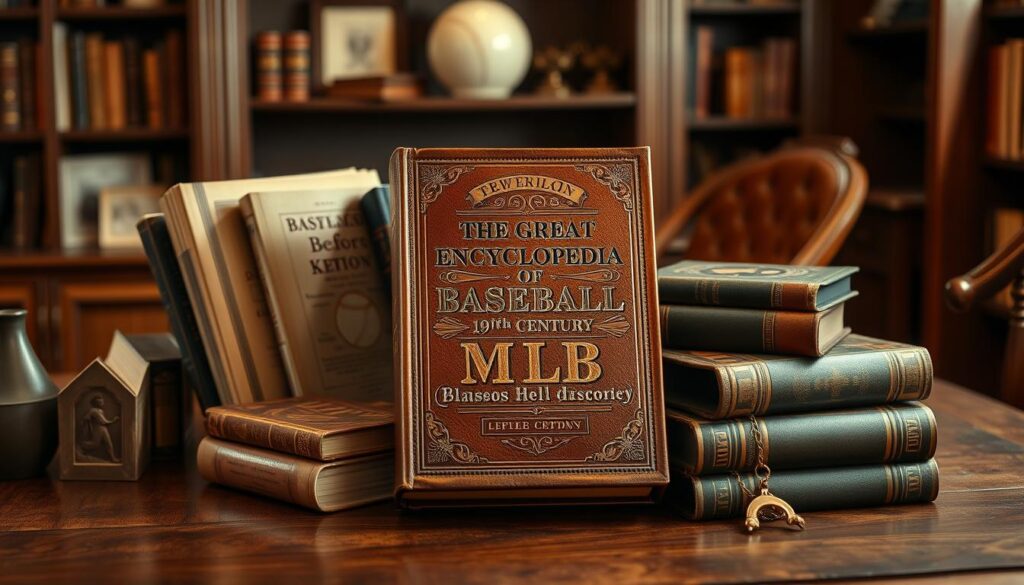
If you love Ken Burns’ baseball documentaries, you’ll adore Block’s Baseball Before We Knew It. It’s not just old stories from Cooperstown. It’s a deep dive into baseball’s true beginnings, with evidence from 1749 cricket matches in Surrey, England.
David Block’s research is like a myth-busting heist film. He takes away the Doubleday legend and gives the spotlight to real historical figures. He found a 1791 bylaw in Pittsfield, Massachusetts, banning baseball near windows. This shows Americans loved playing ball before steroids, and local governments have always disapproved of fun.
For those wanting more than just Wikipedia, here’s your reading list:
- Baseball Before We Knew It (Block) – The Moneyball of historical research, turning obscure British parish records into page-turners
- The Great Encyclopedia of 19th Century MLB – Think of it as baseball’s Oxford English Dictionary, but with more spitball recipes
- Past Time: Baseball as History (Tygiel) – Connects 19th-century on-field strategies to America’s industrial revolution
These works ask a big question: What if baseball’s real origin story is more complex and fascinating than we thought? Block’s discovery of “Base Ball” in a 1744 children’s book is a game-changer. It shows the game’s roots are older and more intriguing than we imagined.
Pro tip: Read these with a strong drink nearby. You’ll need it when you learn how many “firsts” in baseball history were actually seconds or third attempts at earlier games. Cooperstown is famous for one thing: making tourists richer.
Conclusion
Baseball’s roots in the 19th century are alive in every slider and replay challenge today. The 1903 World Series didn’t start the drama; it just made it official. The game has been full of chaos ever sense pitchers started using spitballs.
The foul-strike rule from 1887 is the ancestor of the designated hitter. It shows how MLB’s history is all about changing rules. This rulebook tinkering is what keeps the game exciting.
Imagine trying to explain defensive shifts to Cap Anson. He’d probably spit tobacco juice at your phone and argue about witchcraft. But these debates are what make baseball evolve. The game has been arguing with itself for 150 years.
At first, people banned curveballs because they thought they were unfair. Now, we have robot umps. Progress is messy, smelling like pine tar and hypocrisy.
Modern fans should thank the Knickerbockers for starting it all. Their crazy rules, like nine-inning games and stolen bases, shaped the game. Next time someone complains about pitch clocks, remind them: Baseball has always been a time traveler.
Want to get MLB today? Read David Block’s “Baseball Before We Knew It” sideways. The game’s heart is in those old dirt fields where $20 contracts started a billion-dollar journey. Old Hoss Radbourn is probably laughing with his walrus mustache, his complete-game records as legendary as his fastball.