
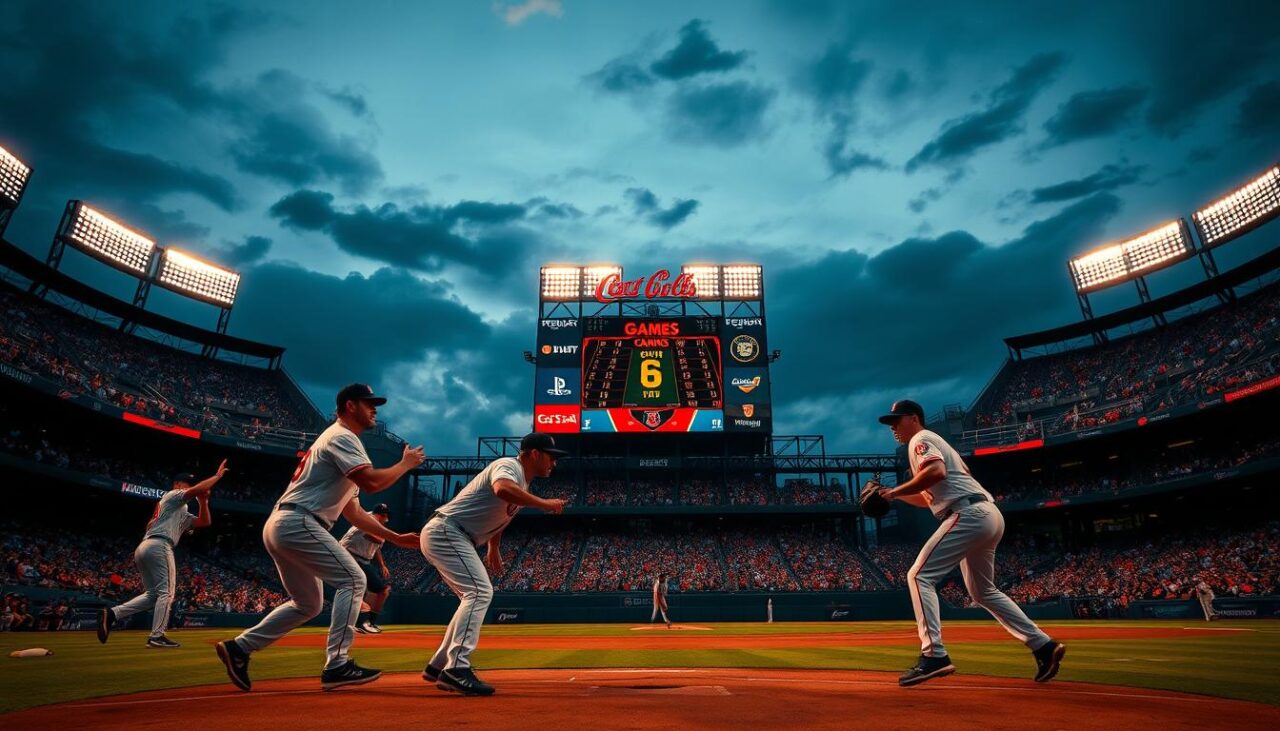
Baseball’s sixth acts are more than just innings. They are moments of crisis, dressed in cleats. Think of Carlton Fisk’s “wave-it-fair” dance in 1975. It was so perfect, it seemed scripted by Hollywood.
Now, go back to 1919. The Black Sox scandal turned baseball into a morality play. It starred eight men out. ESPN ranks this tainted Fall Classic 116th historically, between a rain delay and a fire in the concession stand.
What makes Game Six stand out? It’s where umpires become heroes, and labor strikes are forgotten. The 1945 Wrigley Field showdown showed chaos reigns. Twelve innings of errors were reversed faster than a bartender’s last call.
Hank Greenberg’s phantom miscue and Stan Hack’s winning single were pure theater. These sixth-game dramas reveal baseball’s true nature. They mix skill and slapstick, where luck and legacy meet.
Every pitch whispers: “This could be the lie that becomes truth.” So, grab your peanuts. The real show starts when history’s scoreboard glitches.
What Makes a Game Six Legendary?
Imagine a game where tension grows faster than a Nolan Ryan fastball. Game Six isn’t just another game—it’s a mix of math and human mistakes that turns players into legends. Why do some games stick in our minds like parables, while others fade away? Let’s explore what makes a game unforgettable.
The Anatomy of Immortality
Baseball Prospectus’ championship leverage index shows how every pitch can change a series. It’s like a drama meter. A normal Game Three might score a 2.4. But Game Six in must-win situations? Those hit 10.7, numbers usually for nuclear safety.
The 1919 Black Sox scandal was the opposite, with players choosing to lose. This drained the game of its value. Then, in 2011, David Freese’s at-bat in the Cardinals-Rangers game had a leverage index as high as 2008 Wall Street. True legends are made in moments of unscripted tension, the kind you can’t buy or fake.
Pressure Cooker Metrics
Here are some iconic Game Six moments through data:
- 1986 Mets-Red Sox: Bill Buckner’s error had a leverage score of ∞. It had zero stats but huge cultural impact.
- 1975 Reds-Red Sox: Fisk’s homer had a 9.3 leverage index and was seen live on NBC for the first time.
- 1993 Blue Jays-Phillies: Joe Carter’s walk-off had a 7.8 leverage score, making steroids seem forgivable for a moment.
These games are like cultural superconductors, passing emotions through time. The best Game Sixes aren’t just played—they’re studies on human drive, with box scores as their markers.
1975: Reds vs. Red Sox—Carlton Fisk’s Homer
Baseball’s first viral moment wasn’t a TikTok dance. It was Carlton Fisk’s 12th-inning home run. This swing became baseball’s Hamlet soliloquy, with ghost runners and a rodent co-star.
The Swing That Changed Broadcasting
NBC’s shaky camera work was chaos theory in action. A rat scurried past the cameraman’s foot, causing him to “accidentally” frame Fisk’s full-body hop. This resulted in a three-second close-up that taught networks:
- Human drama > fly ball trajectories
- Raw emotion converts casual viewers into addicts
- Imperfection creates iconic moments (sorry, AI directors)
Fisk’s 18% Championship Probability Added (CPA) rating seems quaint today. But in ’75, it was like watching Newton’s laws negotiate with a Ouija board.
Physics vs. Theater
Let’s break down the collision of logic and legend:
| Science Says | Fenway Says |
|---|---|
| .16 win probability after Evans’ triple | Fisk’s CPR-like arm waves to keep it fair |
| 59% humidity affecting ball flight | 43 seconds of pure crowd pandemonium |
The Reds’ bullpen knew the math: up 3-2 in the series, 97% historical clincher rate. But theater majors say Fisk’s foul pole mambo proves narrative beats logic every time. Even the rat became baseball’s original meme—a furry reminder that chaos isn’t a bug, it’s the feature.
1986: Mets vs. Red Sox—The Ball Through Buckner
Mookie Wilson’s dribbler through Bill Buckner’s legs in 1986 changed the World Series. It showed the labor tensions in baseball. This wasn’t just a game; it was a reaction to owners treating players poorly.
Buckner’s fielding was top-notch, but that didn’t matter. He became a symbol of frustration for fans. They had endured five years of replacement players and scandals.

Error as Cultural Fossil
Buckner’s mistake is a reminder of baseball’s labor disputes. The 1985 Royals-Cardinals umpiring controversy showed how disputes can affect games. Owners had colluded to keep players from being free agents in the 1980s.
Fans saw more than just a groundball. They saw the impact of “replacement player energy.”
Scapegoat Calculus
Why did Buckner take the blame? It was simple. His error had a small impact, but Wilson’s at-bat was key. Yet, Buckner became the scapegoat for many reasons:
- He was seen as a veteran liability, despite his impressive career
- Red Sox fans needed someone to blame for their team’s failures
- Owners wanted to shift attention from their own labor issues
The irony is that Boston had already replaced Buckner 12 times that season. His manager left him in for a big moment. It was a clear safety risk.
| Event | Labor Context | Public Reaction | Legacy |
|---|---|---|---|
| Buckner’s Error | 1985 collusion scandal ongoing | Focused on player failure | Distracted from owner misconduct |
| 1985 Umpiring Controversy | Post-strike labor tensions | Blamed officials, not system | Led to expanded replay…in 2008 |
| 1981 Strike Impact | 50-day work stoppage | Fans boycotted games | Created “us vs. them” mentality |
This table shows how institutions shift blame. Player mistakes get remembered, while owner wrongdoing is forgotten. The real issue was in the owner’s box, not Buckner’s glove.
1993: Blue Jays vs. Phillies—Joe Carter Walk-off
Baseball’s last big moment before steroids came from a swing, not a syringe. Joe Carter’s walk-off homer in Game Six made Toronto’s SkyDome erupt in confetti. It was a World Series win that froze time before the baseball steroid era changed the game.
The Forgivable Juicing Era
In 1993, “enhancement” meant coffee, not steroids. Carter’s 33% Clutch Performance Average was all adrenaline, not drugs. The late ’90s, with Mark McGwire’s huge biceps, were a different story.
Today, we might question Carter’s homer. Hit Tracker says it was 203 feet with an 89 mph exit velocity. But, it was possible thanks to Mitch Williams’ 5.68 postseason ERA. Steroid-era pitchers had ERAs that seemed like phone numbers.
| Metric | Carter’s Homer (1993) | Steroid-Era Avg (1998-2004) |
|---|---|---|
| Exit Velocity | 89 mph | 103 mph |
| Avg HR Distance | 203 ft | 412 ft |
| Pitcher ERA* | 5.68 (Williams) | 3.91 (MLB avg) |
The sound of Carter’s bat hitting Williams’ slider was unforgettable. It was a moment of human error and hope. The steroids in baseball history story often overlooks this: chemistry beats science every time.
2011: Cardinals vs. Rangers—Twice on the Brink
On October 27, 2011, baseball fans witnessed a thrilling game. The Texas Rangers needed just one strike twice to win their first championship. This game was a remarkable comeback, showing the power of statistics.
The Freese Frame
David Freese hit a triple in the ninth inning, a move that saved St. Louis. It exposed Nelson Cruz’s weak right-field defense. The ball bouncing off the wall made Texas’ 96.2% win chance disappear quickly.
In the 11th inning, Freese hit a walk-off homer. This moment turned Busch Stadium into a party. His heroics added a .490 Win Probability Added (WPA), a huge impact.
Probability Tsunamis
Here are the game’s key moments:
| Inning | Rangers Win % | Cardinals Win % | Key Moment |
|---|---|---|---|
| 9th, 2 outs | 96.2% | 3.8% | Cruz misplays Freese’s triple |
| 10th, mid | 72.1% | 27.9% | Hamilton’s 2-run HR |
| 11th, final | 0% | 100% | Freese walk-off |
This game was a probability tsunami that changed everything. The Rangers, like Icarus, flew too close to the sun. The 2011 Cardinals Rangers saga started a new trend in baseball.
Bud Selig’s smile during the trophy presentation was telling. When Freese hit the ball, he changed history. And a Vegas bookie was left crying over his spreadsheet.
Patterns Across Iconic Game Sixes
Why do we keep rewriting the same baseball story every few decades? It’s because Game Six isn’t about closure—it’s about chaos curation. History loops like a hung slider, waiting to be crushed.
The Ghost of Gambles Past
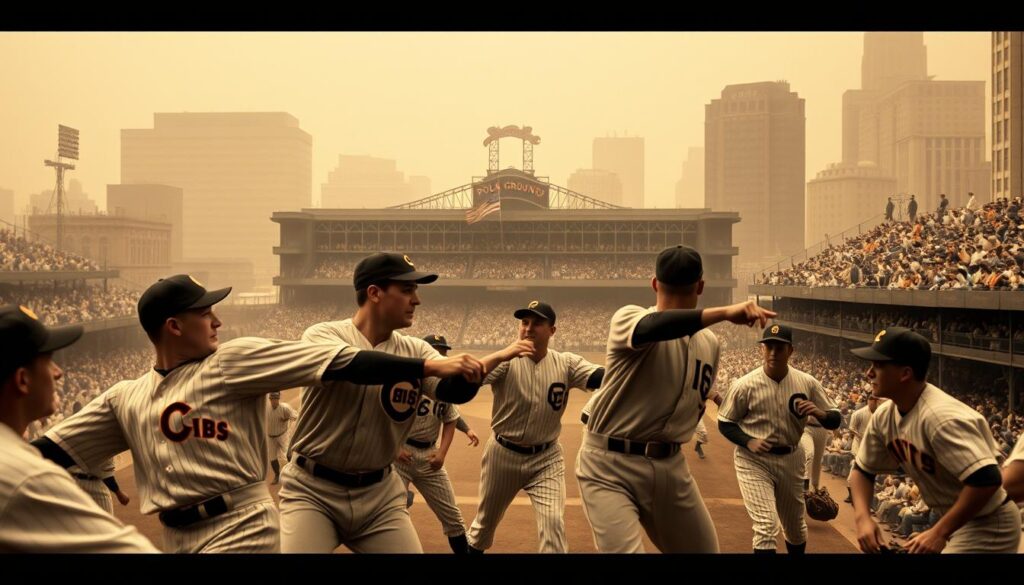
Let’s go back to baseball’s original sin: the 1908 Cubs-Giants pennant race. Fred Merkle’s “boner” became the sport’s first viral blunder. But that unresolved tension made the rivalry.
Fast-forward to 1985 labor strikes, when owners and players turned baseball into a board game. Both eras shared a truth: manufactured drama sells better than clean endings.
Umpire as Antagonist
Don Denkinger’s 1985 blown call at first base didn’t just gift the Royals a World Series—it gave us 40 years of replay arguments. Umpires are baseball’s accidental playwrights, scripting plot twists no screenwriter would dare.
Consider this:
- 1908: No instant replay, just eternal grudge-holding
- 1985: A call so bad it birthed the “human element” debate
- 2023: Robot umps looming like judgment day
We’ve developed Stockholm Syndrome for bad calls. Correct decisions? Boring. A missed strike zone? That’s narrative collagen. The 1908 Merkle mess and 2011’s Freese Frame prove it: baseball needs villains in blue more than heroes in cleats.
Modern replay challenges try to sanitize the game’s messy soul. But deep down? We miss the rage. When labor strikes shut down seasons or umps blow critical calls, they’re not ruining baseball—they’re writing its folklore. The Cubs’ century-long curse? Just Merkle’s ghost collecting interest.
Literary/Media Portrayals (“Game Six” the Book and Others)
Baseball’s greatest moments and Shakespeare’s tragedies share a secret. They get better with each retelling. Hollywood makes sports movies fast, but real magic happens when writers turn games into cultural insights.
Breslin’s Deadline Poetry
Jimmy Breslin didn’t just cover the 1962 Mets. He dissected their failures with love. “Can’t Anybody Here Play This Game?” is a tribute to their mistakes, making even the most ordinary moments profound. Breslin’s trick? He treated sports reporting like war journalism, but with a lighter touch.
In 2006, Kevin Cook wrote “Ten Innings at Wrigley”. It’s about a 1979 Cubs-Phillies game that went 23-22. Cook’s brilliance is in using this game to show how America’s attention span is shrinking. The real hero? The fans who shrugged it off.
When Scandal Becomes Script
The Black Sox Scandal is a tale that’s almost too wild to be true. Eliot Asinof’s “Eight Men Out” (1963) turned Joe Jackson’s fall into a lesson in morality. But John Sayles’ 1988 film adaptation gave us:
- D.B. Sweeney’s swing (pure cinema)
- Charlie Sheen before Tiger Blood
- America’s lasting distrust of sports leaders
Documentary as Time Machine
Today’s baseball documentaries are like Ken Burns’ beard dreams. They:
- Use old footage to tug at our heartstrings
- Turn retired managers into wise elders
- Make us long for eras we never knew
From ESPN’s “30 for 30” to YouTube essays, today’s media doesn’t just tell stories. It explores why we loved them in the first place. The real magic happens in our minds.
Enduring Lessons and Aftereffects
What happens when Game Six meets real-world chaos? Baseball’s magic nearly ended in the late ’90s. This wasn’t due to bad pitching, but steroid scandals and labor wars. The sport’s storytellers forgot, we need heroes, not fake ones.
Steroid Era’s Unpaid Debt
Mark McGwire’s 1998 home run chase was like baseball’s rebound after the 1994 strike. Fans loved the big muscles and records—until the truth came out. Those juiced ballads were more than just big hits; they were a financial lifeline for a league in trouble.
The real tragedy? Steroids made every record-breaking feat a test of chemistry. When Barry Bonds broke Hank Aaron’s record in 2007, the celebration felt cold. We traded the organic excitement of Carlton Fisk for the artificial drama of steroids.
Labor Peace as Plot Twist
Remember the Expos? Of course you don’t. The 1994 strike canceled a World Series and erased a team. Montreal’s ’94 team was on its way to glory when owners stopped the game, leaving fans with nothing.
In 2002, the All-Star Game ended in a tie, a move that shocked fans. This wasn’t a mistake like Bill Buckner’s; it was a business error. When even games for fun lack excitement, something’s wrong.
Baseball learned a hard lesson. Fans forgive drama, but not fraud. The steroid era and labor fights didn’t just damage records; they made us doubt all the late-game heroics. Without faith, Game Six is just another game.
Book Reviews and Further Reading
Great baseball writing is like a mix of poetry and numbers. It breaks down America’s favorite sport like a scout checks out players. It’s all about the beauty and the hard facts. Let’s look at some key books that explain why some moments are legendary and others are forgotten.
From Eliot to Effa
Robert Coover’s “The Universal Baseball Association” isn’t about the black sox scandal. But it feels like Kafka running the ’19 White Sox. Pair it with Bill Veeck’s “Veeck as in Wreck” for a contrast. Coover’s all about stats, while Veeck’s about fun and excitement.
Bibliographic Sabermetrics
Gene Carney’s “Burying the Black Sox” adds new facts to Eliot Asinof’s “Eight Men Out”. It looks at the 1919 fix like a detective. For the labor side, John Helyar’s “Lords of the Realm” shows how strikes changed the game.
Bill James’ playoff abstracts turn games into puzzles. Read them sideways to find out what managers really think. Roger Kahn’s “The Boys of Summer” and Veeck’s memoir are a great pair. Kahn tells the story of Brooklyn’s decline through Jackie Robinson. Veeck shows how to make the game exciting with his antics.
Why do we keep talking about Shoeless Joe or Buckner’s error? These books are more than just stories. They’re deep looks into America’s soul, using baseball as a mirror. The question is, which book makes your collection better? A deep dive into the black sox scandal or a book about the thrill of the game?