

MLB Labor Tensions became a central off-field issue around the 2026 World Series because the sport’s collective bargaining deadline sat just weeks away. The five-year Collective Bargaining Agreement was set to expire on December 1, 2026, and the discussion had narrowed around one of baseball’s most disputed labor ideas: a salary cap and floor system.
On October 24, 2026, before Game 1 of the World Series, MLBPA head Bruce Meyer described the owners’ salary-cap proposal as a “nuclear bomb,” according to the research record. That language mattered because it arrived during the sport’s highest-visibility event and because baseball has a recent memory of labor disputes disrupting the calendar. The 2026 World Series matched the Milwaukee Brewers and Tampa Bay Rays, two lower-spending clubs by luxury tax payroll rank, giving both sides a live case study for their arguments about competitive balance.
Why MLB Labor Tensions Reached October
How MLB Labor Tensions Reached October
The timing was not accidental. By late October 2026, the deadline for a new labor deal was close enough that bargaining positions carried immediate operational weight. If no agreement was reached by December 1, 2026, MLB was expected to impose a lockout shortly after the CBA expired. That would not mean games were lost immediately, but it would place trades, free-agent activity, and normal winter roster planning under pressure.
The June 2026 proposal from MLB reportedly included a salary cap near $245.3 million and a payroll floor around $171.2 million for 2027. That framework would have marked a major structural change for a league that has used luxury-tax thresholds rather than a hard cap. For a deeper related treatment of how the proposal fits with earlier baseball economics, the site’s analysis of the MLB salary cap proposal connects the 2026 debate to earlier bargaining patterns.
The Cap-Floor Split
The divide is easy to state but difficult to solve. Owners and former executives cited in the research, including Milwaukee’s Mark Attanasio, Yankees’ Hal Steinbrenner, and Bud Selig, publicly supported a cap-and-floor model as part of the next CBA. The union’s concern centered on lost guarantees, suppressed salary growth, and reduced free-agent bargaining power. Player-side estimates in the research placed the potential 2026 loss above $500 million if the proposed system had been applied that year.
The payroll data behind the dispute pushed both sides toward different interpretations. In 2024 and 2025, a record nine teams paid luxury tax penalties. In 2025, the Los Angeles Dodgers alone paid about $169.4 million in penalties. That gap supported the owner argument that the present system allowed wide spending separation. The union countered that spending separation had not prevented smaller-payroll teams from reaching the final stage in 2026.
Historical Labor Lessons From 1994 And 2021
The 1994 Strike Still Frames The Risk
Baseball’s labor history makes any December deadline more than an administrative date. The 1994-95 strike began on August 12, 1994, and led to the cancellation of the remainder of the 1994 regular season and the World Series, the first World Series cancellation since 1904, according to the U.S. Senate history. That remains the reference point for any labor dispute that threatens the competitive calendar.
The comparison is not perfect. The 1994 dispute had its own economic setting, legal posture, and public context. Still, it matters because it showed that labor conflict can interrupt not only roster building but the sport’s championship structure. The 2026 dispute had not caused that outcome as of October 30, 2026, but the historical reference gave the debate a sharper edge.
The 2021 Lockout Is The Recent Template
The more recent precedent came on December 2, 2021, when MLB entered a lockout, the sport’s first work stoppage since the 1994-95 strike, as reported by MLB.com. That lockout lasted 99 days, delayed parts of Spring Training and slowed free agency, but it did not erase regular-season games from the final schedule.
That experience shaped how clubs, agents, and players evaluated the 2026 deadline. A lockout can freeze transactions, limit communication between clubs and players, and compress the calendar once an agreement is reached. For player development departments, the issue is not only major-league free agency. It also affects 40-man roster planning, option decisions, depth acquisition, and the timing of minor-league assignments that depend on major-league roster movement.
Brewers-Rays World Series And The Payroll Argument
Small-Market Teams As Evidence
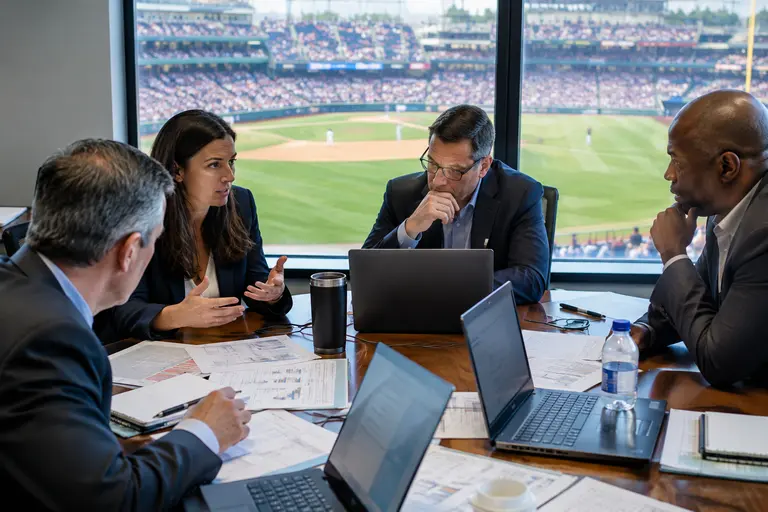
The Brewers-Rays matchup gave the labor debate a visible baseball example. The research identifies Milwaukee and Tampa Bay as lower-spending clubs, ranked No. 19 and No. 27 in luxury tax payroll. For the union, that pairing supported the argument that the present system can produce high-end competitive outcomes without a cap. Both organizations have long been associated with player development, roster churn, and value extraction from younger or less expensive talent, though the specific 2026 paths should be judged by confirmed roster and performance data rather than general reputation alone.
For owners, the same matchup did not settle the issue. Their counterargument was that isolated success by lower-spending clubs does not prove that the league’s economic structure is balanced across all markets. That is the core analytical tension: one World Series can show possibility, but it cannot alone measure the distribution of opportunities across several seasons.
What Payroll Rank Can And Cannot Prove
Payroll rank is useful, but it is not a complete measure of club strength. A lower-tax payroll team can win through pre-arbitration contributors, successful trades, defensive depth, bullpen development, or short-run performance spikes. A high-payroll team can miss expectations because of injuries, aging curves, roster fit, or poor run prevention. None of those baseball factors disappears from the labor debate.
That is why the 2026 World Series served more as evidence in a broader argument than as a final answer. The Brewers and Rays reaching the Series showed that lower-spending clubs could compete at the top in that season’s playoff structure. It did not, by itself, prove that every lower-revenue club had equal room to retain stars, absorb mistakes, or bid for free agents over multiple cycles. For readers interested in sports business stories beyond this specific event, Banat Zayed is a related site offering a wider coverage scope in the same network.
What MLB Labor Tensions Mean For 2027 Baseball
Calendar Pressure Before Spring Training
MLB Labor Tensions now sit directly on the 2027 planning calendar. Spring training typically begins in February, and Opening Day usually lands in late March. If a lockout began in early December 2026 and lasted deep into the winter, teams would face a compressed period for free-agent signings, arbitration planning, trade talks, and camp preparation once a deal was reached.
The player-development impact would be practical. Clubs build spring workloads around who is available, who is competing for roster spots, and which minor-league players may need major-league innings in camp. A transaction freeze can leave non-roster invite decisions, depth pitching plans, and option-path evaluations unresolved longer than usual. Those are not headline issues like a salary cap, but they affect how organizations prepare players.
The Stakes Beyond One World Series
The labor question after October 30, 2026, was not whether the Brewers-Rays World Series made either side correct. The stronger reading is that the matchup sharpened the evidence each side already wanted to use. Owners could point to payroll disparity and the luxury-tax surge. Players could point to competitive outcomes by lower-spending clubs and argue that a cap would reduce earnings without proving a better product.
The risk for the sport was calendar damage. The 1994-95 strike showed the cost of a dispute that reached the championship level. The 2021 lockout showed that even a stoppage without lost regular-season games can disrupt the offseason and spring schedule. The 2026 negotiations therefore carried two linked questions: whether MLB and the MLBPA could agree on an economic model, and whether they could do it without placing the 2027 season’s preparation under avoidable strain.