
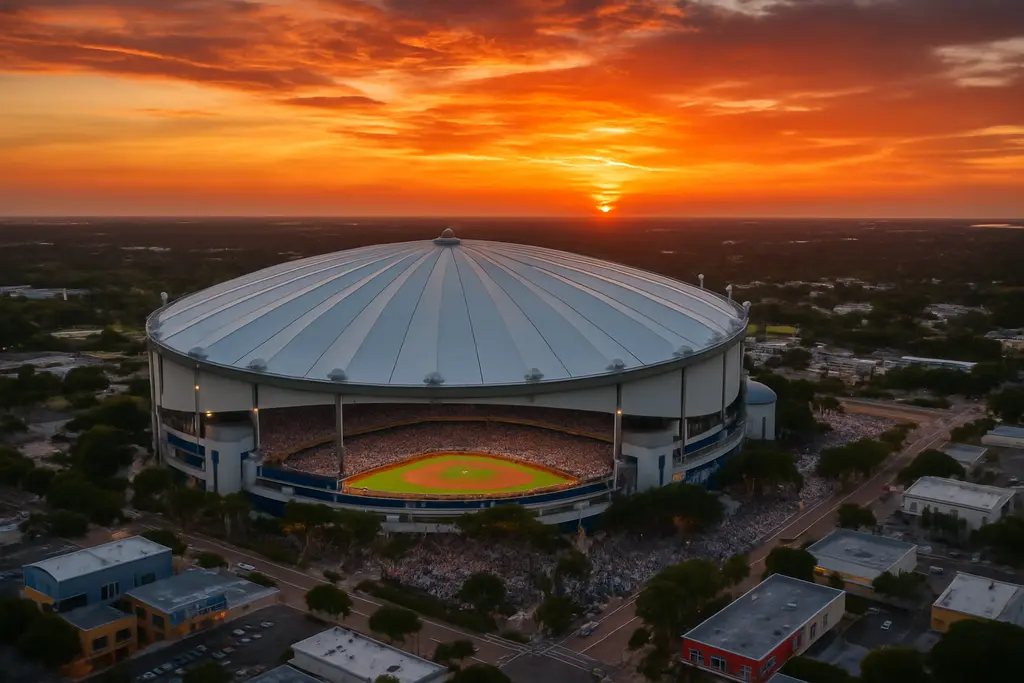
The Rays Forever Home proposal moved from broad concept to a documented civic and sports-business plan on August 22, 2026, when the Rays released definitive documents for an agreement with the City of Tampa and Hillsborough County. The plan centers on a $2.3 billion ballpark and mixed-use development at the Dale Mabry campus in Tampa, with financing roles assigned among the club, county, and city MLB reported.
For a franchise long tied to questions about venue location, attendance reach, and regional identity, the project is not only a stadium plan. It is an attempt to connect baseball operations, public infrastructure, and year-round foot traffic in one district. That makes the proposal a useful case study in how modern ballpark plans try to secure fan habits before the first pitch is thrown.
Rays Forever Home As Infrastructure Strategy
Why Rays Forever Home Is A Fan Test
The planned shift matters because the Rays’ use agreement at Tropicana Field in St. Petersburg expires after the 2028 season. The team has stated an intent to begin play in the new Tampa ballpark on Opening Day 2029. As of September 9, 2026, the supplied record does not confirm final approval outcomes; it shows that late-August votes by the Tampa City Council and Hillsborough County Commission were required to keep the timetable tied to construction beginning in September 2026 and completion by March 31, 2029.
That timing creates a narrow civic clock. A ballpark scheduled for Opening Day 2029 has to move through public approvals, construction, access planning, and district buildout while the major-league club continues operating through the end of its current Tropicana Field term. The fan-engagement question is not only whether a new building draws early curiosity. It is whether the project creates repeatable reasons for people across the Tampa Bay region to attach gamegoing to normal routines.
The funding outline gives the project its political weight. According to the released framework, the Rays would contribute about $1.37 billion, Hillsborough County about $796 million, and the City of Tampa $80 million, with the Rays responsible for cost overruns. The documents also state that portions of tax revenue generated by the surrounding mixed-use development would support public infrastructure, public-use areas, and debt service on privately placed debt through a Community Development District. The same framework says there would be no new taxes and that public safety funding would be protected.
What The Public Investment Is Designed To Support
Infrastructure investment in this plan is tied to more than the playing venue. The proposal treats the ballpark as the anchor of a district expected to generate activity beyond baseball dates. That approach fits a broader pattern in recent stadium planning: teams and local governments increasingly evaluate venues by their effect on daily movement, adjacent real estate, and non-game revenue. The Rays’ proposal puts that logic in plain terms through public-use areas, debt-service mechanisms, and mixed-use tax generation.
The project’s stated economic projections are large: $55.5 billion in economic impact over 35 years, about 11,900 new permanent jobs, and 10 million annual visitors to the district. Those figures should be read as projections, not completed outcomes. They indicate the scale of the public argument being made for the ballpark plan, but they do not prove that the final district will meet those targets. A cautious reading separates the documented proposal from future performance.
| Project Element | Documented Detail | Fan-Engagement Relevance |
|---|---|---|
| Total Project Cost | $2.3 billion | Shows the scale of the stadium and district commitment |
| Team Contribution | About $1.37 billion, plus cost overruns | Places a large share of financial risk with the club |
| County Contribution | About $796 million | Links the plan to regional public infrastructure |
| City Contribution | $80 million | Connects Tampa’s role to the proposed district |
| Target Opening | Opening Day 2029 | Sets the fan transition point after the 2028 Tropicana Field term |
Ballpark Design And Fan Engagement
Fixed Roof, Sightlines, And Social Space
The proposed ballpark is described as a fixed-roof, glass-wall venue with 30,000 seats, while some documents note 28,000 fixed spectator seats with expansion capacity for special events. Populous is listed as the designer. The site is roughly 130 acres in Tampa’s Westshore District on Hillsborough College’s Dale Mabry campus.
Design features released on July 9, 2026, point toward a venue built for both baseball viewing and social circulation. The Rays described two state-of-the-art video scoreboards, club spaces at varying price points, sky views from every seating location, a bar above the batter’s eye overlooking center field, and the return of the Rays Touch Tank aquarium feature. Those elements matter because fan engagement is not a single behavior. Some fans come for scorekeeping and defensive alignments; others come for gathering spaces, shade, food, or a family ritual. A modern venue has to serve those groups without making the game feel secondary.
The fixed roof is a practical design choice in Florida’s climate. The glass-wall concept, if built as described, would try to avoid the closed-in feel that can limit a domed ballpark’s civic presence. The promise of sky views from every seat is also notable because it signals an effort to combine climate control with visual openness. The actual fan response, however, cannot be verified until the building exists and operates through real games.
Price Points And Access Without Overclaiming
Club spaces at different price points may widen the ways fans experience a game, but the research supplied here does not provide ticket-price ranges, parking costs, transit schedules, or attendance survey data. Those omissions matter. Fan engagement depends heavily on affordability, travel time, and convenience. A 30,000-seat ballpark can feel intimate and active when demand is steady; it can also expose access problems quickly if travel and cost barriers remain high.
This is where the Rays Forever Home plan should be judged by evidence as it develops. Renderings and design lists show intent. Public approvals, construction progress, transportation planning, and eventual attendance patterns will show whether the infrastructure serves a broad regional audience. A related analysis of the Rays stadium plan tracks how cost, schedule, and fan behavior may interact as the 2029 target approaches.
Mixed-Use Development And Civic Reach
Four Districts Around The Ballpark
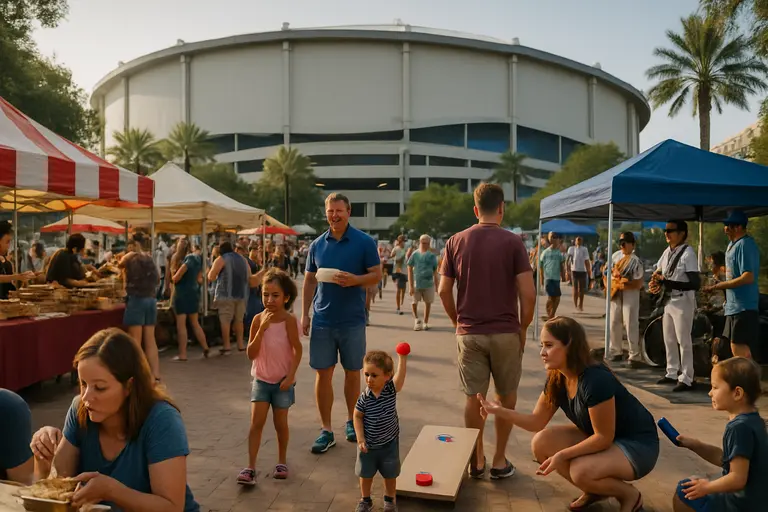
The surrounding development is central to the proposal’s fan-engagement case. Bay News 9 reported that the broader project would span more than 8 million square feet and be organized around four districts: Champions Quarter, Innovation Edge, The Canopy, and The Row Bay News 9 noted. Uses would include residential, office, retail, hospitality, and community spaces, with Innovation Edge including a reimagined Hillsborough College campus.
This is a different model from the stand-alone ballpark set apart by parking fields. The premise is that fans may enter the district before gates open, stay after the final out, or visit on non-game days. If that pattern develops, the ballpark becomes part of a larger civic routine rather than a destination used only 81 regular-season home dates plus other events. That is the strongest engagement theory in the proposal.
Still, the district concept carries an accountability question. The Community Benefits and Legacy Plan described in the research prioritizes affordable housing, anti-displacement, local hiring, small business opportunities, youth sports, literacy, public safety, long-term accountability, and transportation-related goals that require clearer public detail. Those commitments should be tracked against written benchmarks, because community benefit language is only meaningful when residents can see who is responsible, when deadlines arrive, and what remedies exist if targets are missed.
Baseball Memory And A New Tampa Address
Ballparks often become historical markers because fans attach personal calendars to them: first games, school nights, family seats, pennant-race noise, and summer routines. The Rays Forever Home proposal seeks to create that kind of attachment in Tampa after decades in which the franchise’s home identity has been tied to Tropicana Field in St. Petersburg. That shift is significant, but its cultural meaning cannot be declared in advance.
From a baseball-history view, the most durable parks tend to solve ordinary problems as much as symbolic ones. They make arrival easier, sightlines clear, weather manageable, and repeat visits plausible. The proposed Tampa ballpark addresses some of those concerns on paper through roof design, seating scale, district planning, and public-use infrastructure. Whether it succeeds will depend on execution, pricing, access, and how consistently the surrounding neighborhood functions outside marquee events.
Readers comparing venue debates across sports can also explore a range of similar topics at My All-Time Best, a related site that dives into ongoing narratives about place, memory, and attendance in various sports.
The Tampa Bay Rays’ Forever Home
The Tampa Bay Rays’ Forever Home is best understood as a proposed civic sports project, not only a ballpark rendering. The documents released in August 2026 set out a financing framework, a target opening, a fixed-roof design, and a mixed-use district meant to connect baseball to daily life in Tampa’s Westshore area. Those are concrete details. The harder questions remain open because the final approvals and long-term public outcomes were not established in the supplied record as of September 9, 2026.
The most defensible reading is cautious. The proposal gives the Rays a path toward a Tampa address after the 2028 Tropicana Field term, and it offers a fan-engagement model based on comfort, proximity, social space, and district activity. It also places public infrastructure, tax-revenue mechanisms, and community benefits under public scrutiny. If built on the stated schedule, the project would be judged first by whether it opens for Opening Day 2029, then by whether fans make it part of ordinary baseball life.