
By Terra Kelly | June 18, 2026
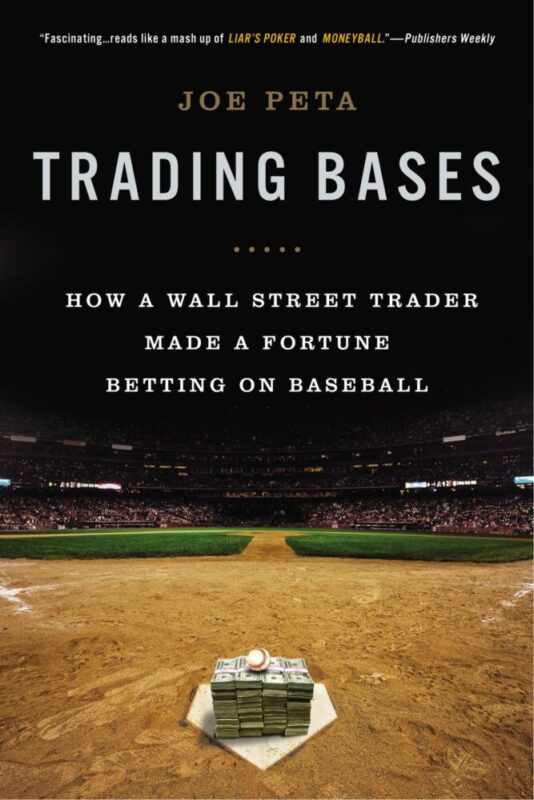
In 2026, legalized sports gambling dominates the broadcast experience. Fans wager on individual pitch outcomes directly from their phones. Joe Peta’s 2013 book Trading Bases reads like the origin story of this hyper-commodified era. After losing his job at Lehman Brothers and surviving a brutal pedestrian accident, Peta applied high-level financial modeling to the Las Vegas sportsbooks. He viewed the 30 Major League franchises not as athletic teams, but as individual equities presenting mispriced valuations.
Treating the Diamond Like the Trading Floor
The narrative succeeds as Peta refuses to rely on traditional scouting. He applies a Wall Street mindset to a sport still clinging to narrative momentum at the time. The text breaks down how oddsmakers construct their lines based on public perception and recent performance. Peta exploited this by focusing on underlying metrics rather than raw win-loss records.
He stripped the emotion from his wagers. If a team lost a heartbreaking extra-inning game, the betting public often faded them the next day. Peta ignored the heartbreak and trusted the run differential. Tracking this mathematical approach shows how early sharp bettors found an edge before automated platforms and modern sportsbook algorithms tightened the daily lines.
| Financial Concept | Baseball Equivalent | Application |
| Market Inefficiency | Mispriced Vegas Lines | Betting against public sentiment and narrative bias. |
| Return on Equity | Run Differential | Predicting future win probability based on raw production. |
| Volatility | Cluster Luck | Identifying unsustainable offensive or defensive sequencing. |
The Theory of Cluster Luck
The smartest analytical contribution in the text centers on a concept he popularized: cluster luck. Peta proved that hitting sequencing creates massive illusions in team quality. A lineup that scatters ten hits across nine innings might score zero runs. A lineup that bunches three hits into a single inning scores multiple runs. The traditional standings reward the clustered hits, yet the underlying data proves the scattered hits carry identical future value.
Oddsmakers consistently overvalued teams benefiting from positive cluster luck in previous games. Peta systematically bet against them. This exact strategy places the text firmly among the most analytical Classic Baseball Books. He proved that predicting baseball outcomes requires separating actual skill from random sequencing variance.
A Personal Narrative Disguised as Data
Books focused purely on gambling statistics often read like dry textbooks. Trading Bases avoids this fate by running the financial analysis parallel to a gripping personal recovery story. An ambulance ran a red light and crushed Peta’s legs, ending his lucrative Wall Street career. His decision to build a baseball hedge fund from a wheelchair acts as an intense psychological coping mechanism.
He uses the daily rhythm of the 162-game season to structure his physical rehabilitation. Modern financial analysts and readers studying the evolution of predictive analytics will appreciate the rigid discipline required to execute his model. He isolates himself from the romanticism of the sport, treating every player as a volatile asset requiring strict risk management. The resulting story acts as a fascinating bridge between sports finance and raw human resilience.
Grade: B+ (Highly Engaging)
Best For: Analytical fans, readers interested in the math behind sports betting, and anyone looking for a unique survivor story centered around the 162-game grind.