

Tarik Skubal’s trade from the Detroit Tigers to the Los Angeles Dodgers is already one of the defining baseball stories of 2026. The Dodgers did not add a useful starter at the edge of the roster. They acquired a back-to-back American League Cy Young Award winner, a left-handed ace, and one of the rare pitchers whose name can make a trade deadline feel like a baseball history chapter before he throws a pitch for his new club. Detroit sent Skubal to Los Angeles on Aug. 2, 2026, for outfielder Zyhir Hope and right-handers River Ryan and Brady Smith, according to MLB.com’s Tarik Skubal trade report. That makes this more than a contender’s upgrade. It places Skubal beside the sport’s classic deadline-ace dramas, where one pitcher becomes the center of a franchise’s present, future, and memory all at once.
Why This Trade Became A Baseball History Story Immediately
Some trade-deadline moves need October before they reveal their meaning. Skubal’s Dodgers trade did not. The scale was clear as soon as the names were known. Detroit moved a two-time reigning Cy Young winner before the 2026 deadline. Los Angeles added an ace to a roster already measured against championship standards. The prospect return gave Detroit a future-centered explanation, but the emotional weight of the deal belongs to the pitcher leaving town.
That is what separates an ace trade from a normal deadline deal. A bench bat can help a lineup. A reliever can shorten a postseason game. An ace changes the way a series is imagined. Skubal’s arrival in Los Angeles gives the Dodgers a pitcher whose résumé already carries historical gravity. MLB’s official Tigers coverage framed the deal as the end of the Skubal era in Detroit, a phrase that matters because it treats his departure as the close of a chapter rather than a roster adjustment.
The deadline calendar sharpened the feeling. MLB set the 2026 Trade Deadline for Monday, Aug. 3, at 6 p.m. ET, which meant the Skubal deal landed just before the market’s final hours. A move that big before the last day changes the whole trade environment. Every other contender had to respond to the Dodgers’ new rotation reality. Every Tigers fan had to process the loss of the franchise’s most valuable pitcher before the season itself had finished making its argument.
That is the heart of the deadline-ace story. It is never only about wins above replacement, prospect rankings, or salary. It is about the moment a team decides that the pitcher who defines one era can be traded into another.
How Skubal Fits The Great Deadline-Ace Tradition

The reason Skubal’s move feels so large is that baseball already has a tradition for this kind of transaction. When a dominant starter changes teams at the deadline, the trade becomes a test of ambition. Randy Johnson going from Seattle to Houston in 1998 remains one of the cleanest examples. The Hall of Fame’s account of the Randy Johnson deadline trade notes that Houston acquired Johnson on July 31, 1998, for Freddy García, Carlos Guillén, and John Halama, adding a Hall of Fame left-hander to a club already leading the National League Central.
That template is easy to see in the Skubal deal. A powerful contender gets more dangerous. A selling or retooling club accepts young talent. Fans instantly start measuring the deal in October terms. Johnson became a Houston legend in a short window because he dominated so completely after the trade. Skubal now steps into a similar kind of pressure, though with his own setting, contract context, and Dodgers’ expectations.
The CC Sabathia comparison also belongs in the conversation. Milwaukee’s 2008 acquisition of Sabathia became a deadline story because he gave the Brewers more than innings. He gave them force, urgency, and the feeling that a franchise could ride one starter through the final stretch. SABR’s account of Sabathia’s 2008 Brewers run captures that period as a defining workload and pennant-race push.
Skubal enters that lineage with a modern twist. He joins a Dodgers club already known for star accumulation, roster depth, and financial reach. That changes the mood. Johnson to Houston and Sabathia to Milwaukee felt like a single ace transforming a contender’s identity. Skubal to Los Angeles feels like a powerhouse adding a historic weapon and daring the rest of the league to keep up.
Detroit’s Return Turns The Deal Into A Future Argument
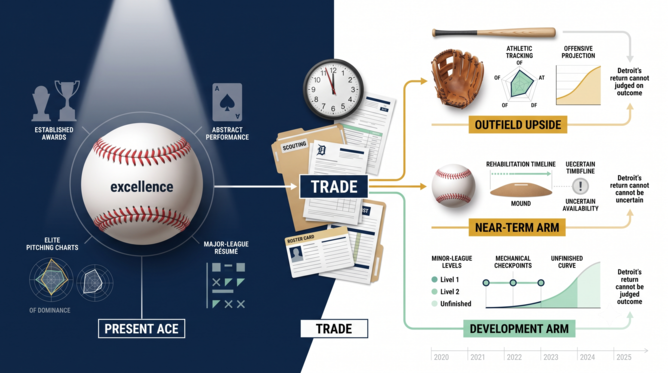
Every great deadline-ace trade creates two stories. The first belongs to the acquiring team. The second belongs to the team that let the ace go. Detroit’s side now rests on Hope, Ryan, and Smith.
Zyhir Hope is the most obvious name in the return because he gives the Tigers a high-ceiling outfield prospect. River Ryan brings major-league proximity and pitching talent, though his injury history and age will shape how evaluators judge the return. Brady Smith adds another right-handed pitching piece to Detroit’s development system. The package gives the Tigers multiple ways to defend the trade, but it also creates years of public accounting.
That accounting is unavoidable. Baseball fans remember deadline trades through the players who leave and the players who arrive later. The Tigers know this better than most franchises. Their 1987 trade for Doyle Alexander helped a playoff push, but the prospect sent to Atlanta was John Smoltz. The Hall of Fame’s look at the John Smoltz trade keeps that deal alive because it shows how a short-term pitching answer can become a long-term historical regret.
That shadow does not mean the Skubal trade will fail Detroit. It means Detroit’s grade will remain open. Hope could become a star. Ryan could still deliver real innings. Smith could develop into a useful pitcher. The Tigers could turn three young players into the next stage of their roster. Yet the public memory will always begin with the ace who left.
This is why the trade belongs beside baseball’s classic pitcher dramas. The Dodgers’ side is immediate. Detroit’s side will take years. The story has two clocks, and both started the moment the deal was reported.
Why Dodgers Context Makes The Trade Feel Different
Los Angeles changes the meaning of this deal. If Skubal had gone to a mid-tier contender chasing its first deep October run in years, the story would read as a desperate swing. With the Dodgers, it reads as an escalation. The club already carries the public image of a franchise that can absorb stars, remake expectations, and treat the deadline as another stage for roster dominance.
That does not reduce Skubal’s value. It sharpens the debate around it. A team with fewer resources might have been celebrated for one bold strike. The Dodgers are judged against a different standard because fans expect them to chase elite talent. Skubal’s arrival feeds the modern baseball argument over whether the sport’s strongest organizations can keep turning depth and money into the league’s most dramatic additions.
The baseball-book angle is rich here. Skubal’s move is not only about one pitcher changing uniforms. It is about the way modern baseball writes power. The Dodgers can turn a deadline into a statement of empire. The Tigers can turn an ace into a prospect package. The rest of the league must decide whether the gap is a scouting problem, a payroll problem, a development problem, or simply the cost of doing business against Los Angeles.
Booksonbaseball.com recently looked at how young players become myth before they become major leaguers through Hunter Dietz and the Yankees’ 2026 draft class. The Skubal deal is the opposite side of that same baseball imagination. Prospects are future belief. An ace is present certainty. Deadline trades force clubs to decide how much future belief they will surrender for present certainty.
The Dodgers chose the surest kind of present-tense baseball: a Cy Young left-hander at the front of a pennant race.
How Skubal Changes The October Imagination

A great deadline ace changes the way fans picture October before the bracket even exists. That is why Skubal’s trade feels bigger than most roster additions. He gives the Dodgers a different kind of first-game image, a different kind of short-series calculation, and a different kind of burden on every opponent.
In a postseason series, an ace can alter the entire emotional schedule. A team facing Skubal has to think about lineup construction, left-handed matchups, bullpen conservation, and the chance that one game may be reduced to a few scoring chances. A club that already had Dodgers-level depth now adds a pitcher capable of making a good lineup look passive.
That is the old ace mythology, updated for 2026. Modern teams track pitch shape, release traits, matchup data, fatigue indicators, defensive alignment, and recovery models. Fans see a simpler thing: the ball in the hand of the pitcher who can make a season feel different. That gap between analytical detail and public feeling is where ace stories live.
Skubal also carries the personal pressure of being the acquired ace. If he dominates in October, the trade becomes part of Dodgers lore. If Los Angeles falls short, the move becomes part of the club’s larger debate over star collection and postseason payoff. If Hope, Ryan, or Smith breaks out in Detroit, the trade grows a second life. None of those possibilities cancels the others. They stack on top of each other.
That is why deadline-ace trades remain so durable in baseball memory. The first reaction is never the last reaction. The same deal can look brilliant in August, incomplete in October, and different again five years later.
Why This Deal Will Stay On Baseball’s Bookshelf
Skubal’s Dodgers trade belongs beside baseball’s great deadline-ace stories because it has every ingredient that makes those stories last. It has a star pitcher, a powerful contender, a painful seller’s choice, a prospect package, a hard deadline, and a public argument over what a season is worth.
The deal also has a clean literary shape. Detroit developed the ace. Los Angeles acquired the ace. Hope, Ryan, and Smith became the future cost. Skubal became the present weapon. Fans now get to watch two versions of the same trade unfold: one at Dodger Stadium and one across Detroit’s player-development system.
That is why this story fits booksonbaseball.com better than a standard deadline recap. Baseball history is filled with transactions that became chapters because they revealed something larger than roster construction. Johnson to Houston revealed how quickly a dominant arm could reshape a contender. Sabathia to Milwaukee showed how one pitcher could carry a franchise’s urgency. Smoltz leaving Detroit showed how deadline logic can age in unexpected ways.
Skubal to the Dodgers now joins that shelf. It is a story about talent, timing, ambition, loss, and the strange baseball habit of judging one deal across multiple eras. The trade happened in 2026, but the argument around it is much older. Baseball has always treated the ace as the player who can make a season feel fated. The Dodgers just bought that feeling. Detroit just sold it for the future. The rest of the story will take years to finish.