

Ty Cobb was born on December 18, 1886, in Georgia. He is one of baseball’s most remarkable players. His career batting average of .366 and 4,191 hits make his legacy unforgettable.
Tragedy struck early in his life. His father, a state senator, was killed by his mother, Amanda. She thought he was an intruder. This event shaped Cobb’s fierce determination and intense personality.
He made his debut with the Detroit Tigers at 18. He quickly became a dominant force in the American League. By 1907, he led the league in hits and batting average, helping the Tigers succeed.
His aggressive base-running and hitting skills made him a fan favorite. Over his career, Cobb retired in 1928 with over ninety all-time records. His lifetime batting average remains unmatched.
After baseball, he found success in stock-market investing and philanthropy. He founded the Ty Cobb Educational Foundation to support students in Georgia. Cobb passed away on June 17, 1961, leaving a complex legacy.
Analyzing Myths vs. Facts
The story of Ty Cobb has been filled with myths and exaggerations. After he died, Al Stump wrote a 1961 article in True magazine. It called Cobb “the meanest man in baseball.” Stump claimed Cobb sharpened his spikes to hurt others and was a racist.
But, research has shown Stump’s claims were false. He made up documents and fake memorabilia to tell his stories. The 1994 movie “Cobb” starring Tommy Lee Jones also spread these lies, making them seem true to many.
Charles Leerhsen, a modern biographer, has worked to clear up these myths. In his 2015 book, Ty Cobb: A Terrible Beauty, Leerhsen used real documents and accounts. He showed Cobb was not just angry but also smart and kind.
New evidence has come to light. It shows Cobb supported baseball integration and praised Jackie Robinson in the 1950s. He even said he would “pay to watch” Willie Mays play. This new information shows Cobb was ahead of his time, unlike the racist image Stump painted.
The Society for American Baseball Research (SABR) has been key in reevaluating Cobb’s legacy. They look at original sources like letters and game reports. This work is important because it helps us see the truth behind myths and reminds us to question sensational stories.
| Myth | Fact |
|---|---|
| Cobb was the meanest man in baseball. | He was complex, showing both temperamental and charitable traits. |
| Cobb sharpened his spikes to injure players. | No evidence supports this claim; it was a fabrication by Stump. |
| Cobb was violently racist. | He supported integration and praised players like Jackie Robinson. |
Key Achievements and Controversies
In the world of baseball legends, Ty Cobb is a standout. He won 12 batting titles and had a batting average over .400 in three seasons. His lifetime average of .366 and 4,191 hits make him one of the greatest.
Cobb didn’t just play; he also managed the Detroit Tigers from 1921 to 1926. Even in his forties, he played at a high level. He joined the Philadelphia Athletics later and hit over 4,000 times.

His skills in bunts, hit-and-runs, and steals earned him respect and fear. But his aggressive play sparked many controversies. The early 1900s were violent, and Cobb’s toughness was a survival tactic.
People close to him saw him as demanding but loyal. Stars like Babe Ruth and Tris Speaker respected him. Cobb was complex, driven, and sometimes hostile, but also kind and generous.
Influence on the Game
Ty Cobb changed baseball forever. He brought new ways to run the bases and read pitchers. His drive for small wins raised the bar for all players.
He was a master of bunts, hit-and-runs, and steals. His smart tactics turned baseball into a thinking game. Even now, his records, like 12 batting titles, are goals for hitters.
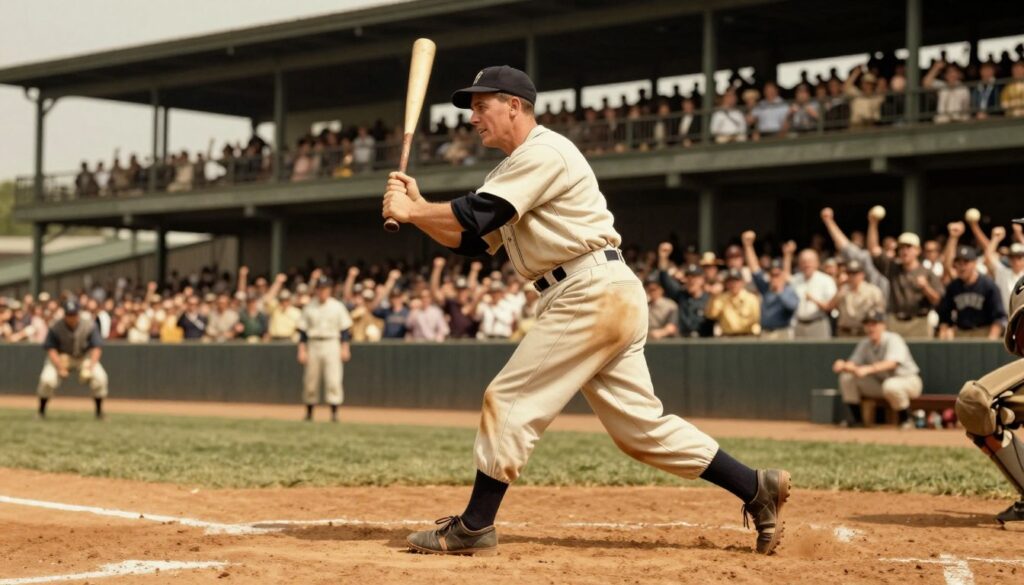
Cobb’s speed, precision, and strategy made him a legend. His hard work inspired many players after him.
His story shows how baseball evolved. From a wild game to a polished sport, Cobb’s legacy is a lesson in greatness.
Now, experts are re-examining Cobb’s life. They find that greatness is full of contradictions. This teaches us that winning and legacy are closely linked.
Legacy and Modern Perspectives
Ty Cobb’s legacy has changed a lot in recent years. He was once seen as a villain in baseball stories. But now, scholars see him in a more complex light.
Cobb did more than play baseball. He also helped others through his Ty Cobb Educational Foundation. This foundation gives scholarships to students in Georgia. It shows a kind side of Cobb that was often ignored.
It’s important to understand Cobb’s views on race. He supported baseball integration and admired Jackie Robinson and Willie Mays. This is a big change from the racist image once given to him.
Historians from SABR are digging deeper into Cobb’s life. They find both the harsh and beautiful sides of early baseball. Cobb’s stats, like a .367 batting average and 892 stolen bases, make him a baseball legend.
But it’s his evolving story that really grabs our attention today. It shows us that history is always changing. We need to keep looking and learning about it.
Cobb represents the mix of good and bad in people. He was not perfect, but he was a complex, talented person. By looking at figures like Cobb, we learn more about history and the stories that shape our view of the past.