
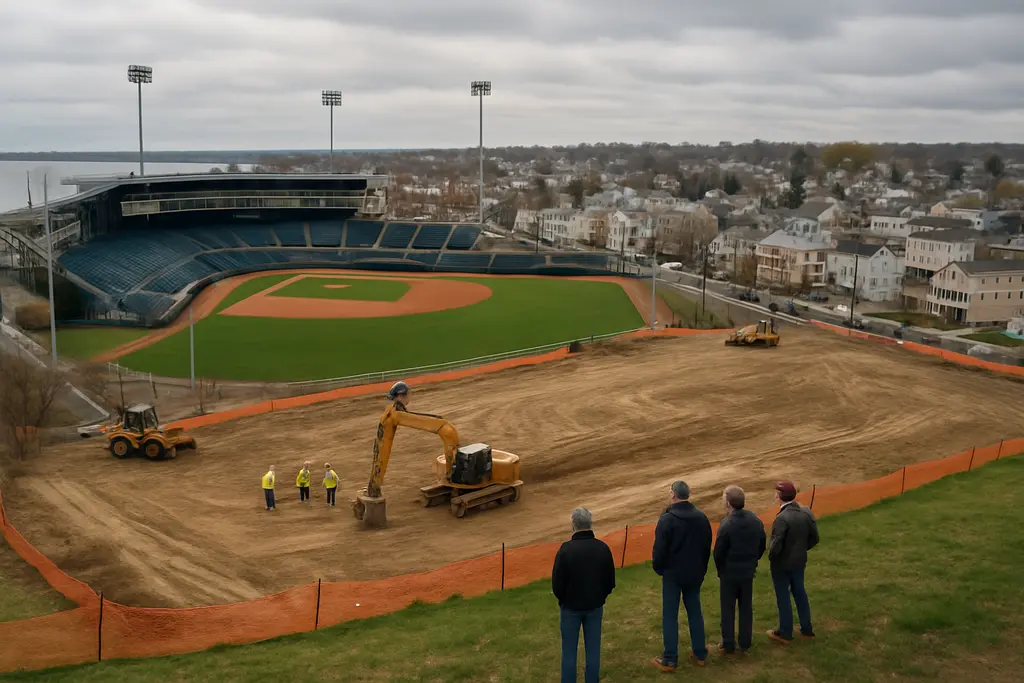
Bridgeport Stadium Concerns sit at the center of the White Sox stadium debate because the baseball project is tied to a major rail-yard move, not just a new ballpark question. As of September 14, 2026, the proposal described in public reporting involved relocating Amtrak’s maintenance facility from its South Loop location near 14th Street to a 47-acre Bridgeport site along Canal Street between 33rd and 35th Streets, just west of Rate Field. That makes the analysis different from a narrow discussion about premium seating, team branding, or neighborhood retail. The key issue is whether the intended stadium plan shifts costs, disruption, and environmental risk onto residents near the proposed maintenance facility.
Bridgeport Stadium Concerns And Site Tradeoffs
Why The Amtrak Move Matters
The central planning tradeoff starts with the project map. NBC Chicago reported that the proposed Amtrak relocation would move the maintenance facility from the South Loop to the Canal Street corridor in Bridgeport, near the White Sox’s existing ballpark, and that the combined plan was estimated at about $900 million, with Amtrak having secured more than $600 million in federal funding for the relocation project NBC Chicago reported. That funding fact matters because it gives the rail component a degree of momentum separate from the baseball club’s on-field performance or attendance outlook.
For a baseball operations lens, venue certainty has value. A club with a lease question can make longer-range plans around fan access, sponsorship inventory, premium seating, player facilities, and regional identity. Yet the community question is not answered by proving that a new or relocated venue could help the franchise. A project can make business sense for a club and still raise valid siting questions for people living beside the infrastructure that makes the project possible.
Bridgeport Stadium Concerns By The Rail Yard
Bridgeport Stadium Concerns sharpen because the proposed rail facility has been described as a 24-hour operation, four stories tall and five tracks wide, with nearby homes, schools, senior housing, and a historic park close to the site. CBS Chicago also reported that the White Sox have played at their current stadium, Rate Field, formerly Guaranteed Rate Field, since it opened in 1991, and that the lease there is set to expire in 2029 CBS Chicago reported. Those details explain why residents treated the rail-yard component as a neighborhood issue, not as a routine supporting piece of a sports-development package.
The reported concerns include diesel exhaust, fine and ultrafine particulates, black carbon emissions, noise, vibration, soot, grime, runoff, and spill exposure. The public record provided in the research notes does not include pollution modeling, traffic counts, or property-value estimates, so those effects should be treated as reported concerns rather than quantified outcomes. That distinction is essential. In stadium analysis, the absence of a number is not proof that a risk is small; it means the public debate still lacks the measurements needed for a firmer comparison.
Financing, Process, And Public Trust
Federal Funding Changes The Pace
The financial structure adds pressure to the public process. A project with more than $600 million in federal funding tied to the Amtrak relocation is not a casual concept plan. The research notes also identify Justin Ishbia’s company, Canal Edge LLC, as involved in the development and state that Ishbia has contributed more than $125 million of his own money toward the projected project. Those stakes help explain why critics focused on speed, transparency, and public input. The larger the committed funding pool, the more residents tend to ask whether alternatives were fully tested before the plan hardened.
From an analytics standpoint, this is a constraint problem. The White Sox have a lease date in 2029. The rail facility has an identified relocation site. Public funds and private money have been described. Residents have raised health, noise, vibration, displacement, and property-value concerns. None of those variables can be treated as secondary if the project is evaluated honestly. Bridgeport Stadium Concerns do not erase the team’s need to plan beyond Rate Field; they test whether the plan distributes burdens in a defensible way.
Community Input As A Planning Metric
Community process is harder to measure than revenue, acreage, or lease term, but it is still part of stadium feasibility. The research notes state that critics, including Alderman Nicole Lee of the 11th Ward, residents, and community leaders, argued that the proposal moved too quickly and with limited transparency or meaningful input. The notes also state that hundreds of residents from Bridgeport, Chinatown, Armour Square, and nearby communities protested outside Rate Field on September 8, 2026, and that petitions against the rail yard had gathered more than 1,000 signatures.
Those figures should not be stretched into claims about the view of every resident. They do show organized resistance across several nearby communities. For team executives and public agencies, that matters because stadium projects often depend on legitimacy as much as engineering. A plan that clears financing checkpoints can still lose public confidence if the affected neighborhoods believe the burdens were assigned before the review process was fully aired.
Ballpark Strategy In A Chicago Context

Venue Value Beyond Seating
Baseball teams increasingly evaluate ballparks as operating platforms rather than simple seating bowls. That does not mean a new stadium guarantees a better roster, a stronger farm system, or higher win totals. It means stadium control, lease length, development rights, and fan access can influence the revenue base that ownership groups use to plan. For related historical context on how ballpark projects have been tied to public financing and team strategy, BooksonBaseball has examined MLB infrastructure investment through prior venue projects.
The White Sox case is narrower and more local. Rate Field has been the club’s home since 1991, and the lease expiring in 2029 creates a defined planning horizon. That date does not prove a South Loop stadium is the right answer. It does make clear why the franchise and development partners have sought a path before the lease deadline. Bridgeport Stadium Concerns enter the analysis because the proposed solution for one site creates a separate set of impacts at another site.
What The Lease Date Does And Does Not Say
The 2029 lease expiration is a real deadline, but it should be read carefully. It explains urgency. It does not settle environmental review, neighborhood compatibility, public funding priorities, or the acceptability of a 24-hour maintenance operation beside residential and civic uses. Baseball history offers many examples of stadium debates being framed around competitiveness and civic identity, but this case turns heavily on infrastructure placement.
For broader sports-business coverage within the same network, Sports Wire News provides insights into how venue debates align with public priorities across various leagues. The White Sox proposal belongs in that category because the baseball outcome cannot be separated from transit infrastructure, neighborhood exposure, and political process. Any sound evaluation has to keep those pieces together rather than treating the stadium and the rail facility as unrelated decisions.
White Sox Bridgeport Stadium Concerns
The Decision Standard
The fairest standard is not whether the White Sox benefit from a new stadium plan, or whether Amtrak benefits from a relocated maintenance facility. The fairer standard is whether the combined project shows that community burdens were identified, measured where possible, and compared with less disruptive alternatives. The research available here supports the existence of serious resident objections, a large public funding component, a private development stake, a lease deadline, and a proposed Bridgeport rail site near sensitive neighborhood uses.
Bridgeport Stadium Concerns should be analyzed as part of the project’s core design, not as public-relations friction. If decision-makers can produce credible environmental, operational, and neighborhood-impact evidence, the debate can move from broad fear to testable claims. Without that evidence, the White Sox stadium proposal remains tied to an unresolved question: whether a baseball-centered development plan is asking Bridgeport residents to absorb too much of the cost that does not appear on the stadium budget.