
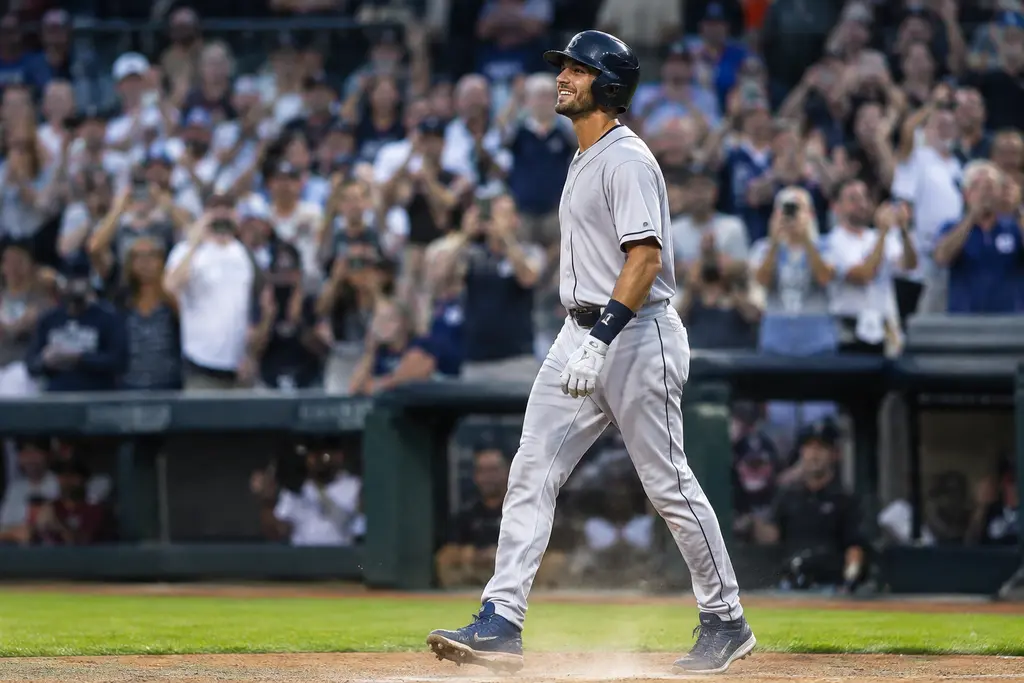
By October 31, 2026, the 2026 MLB postseason had already supplied enough evidence to make home run trot culture a measurable part of October conversation. The discussion was not limited to style points. It centered on trackable time, player expression, and the way postseason moments are now archived through Statcast-era data.
The clearest examples came in the League Championship Series. Junior Caminero’s October 19, 2026 home run trot in Game 6 of the American League Championship Series lasted 38.66 seconds after he hit a two-run homer off Guardians closer Cade Smith. The trot included chest pounding, a point toward the dugout, and an imitation of Randy Arozarena. It was reported as the longest uninterrupted postseason home run trot since Statcast began tracking that category in 2015, according to The Washington Post.
That moment followed William Contreras’ October 12, 2026 Game 2 NLCS home run trot, which was reported at approximately 35.77 seconds after a 436-foot home run. By the end of the postseason, Contreras’ trot stood behind Caminero’s in the Statcast-era postseason record discussion. The point is not that every long trot carried the same tone or context. The point is that the postseason supplied multiple record-level examples within a narrow October window.
How Home Run Trot Culture Changed In October
Measuring Home Run Trot Culture With A Clock
The most meaningful shift was the conversion of celebration into a comparable data point. Baseball has always contained unwritten expectations around pace after a home run, but the 2026 postseason put timestamps on those expectations. A 38.66-second trip around the bases is not just a visual memory; it is a number that can be compared with other postseason homers since 2015.
That matters because Statcast did not simply capture exit velocity, launch angle, or distance. In these cases, it gave analysts and viewers a shared reference for celebration length. The same technology-centered October also shaped other baseball arguments, including strike-zone process and review strategy, as covered in our analysis of ABS playoff dynamics.
Why Two Trots Changed The Tone
One slow trot can be treated as an isolated player choice. Two record-level trots in the same postseason create a pattern worth studying. Caminero and Contreras did not produce identical celebrations, but their timing placed them in the same public debate. Slow trots were no longer just a matter of dugout reaction or opposing-player frustration. They became part of the postseason record file.
That does not prove a leaguewide cultural reset by itself. It does show that October 2026 offered unusually visible examples of players extending their home run celebrations. For home run trot culture, the analytic value sits in the repeatability of the measurement. The emotional interpretation remains less precise.
| Player | Date | Postseason Context | Reported Trot Time |
|---|---|---|---|
| Junior Caminero | October 19, 2026 | Game 6, ALCS | 38.66 seconds |
| William Contreras | October 12, 2026 | Game 2, NLCS | About 35.77 seconds |
Statcast Turned Celebration Into Comparable Data
Postseason Records Need Era Context
The phrase “postseason record” needs a clear boundary here. The relevant record set begins with Statcast tracking in 2015, not with the start of Major League Baseball postseason play. That distinction matters. Baseball’s pre-Statcast archives include famous celebrations, but they cannot be ranked with the same precision if uninterrupted trot timing was not captured in the same way.
Caminero’s October 19 trot also fit a broader personal pattern. His September 2026 regular-season trot was clocked at 40.65 seconds, a longer mark than his ALCS trot when regular-season plays are included, as noted in a Vancouver Television Sports recap of MLB’s top Statcast moments from the 2026 postseason.
This is where caution helps. A slow trot is not a hitting skill in the way bat speed or swing decision quality is. It does not add run value after the ball clears the fence. Still, it can indicate how players frame high-leverage moments, especially when the celebration follows a swing that already changed the score or advanced a club’s postseason position.
What The Data Can And Cannot Say
The data can tell us that Caminero’s 38.66-second trot exceeded Contreras’ reported postseason mark. It can tell us that both occurred during the League Championship Series. It can tell us that Statcast-era postseason comparison now includes celebration time as a logged artifact.
The data cannot tell us intent with certainty. It cannot prove whether a player meant to send a message, energize teammates, respond to criticism, or simply enjoy the moment. Those interpretations require caution, especially in an environment where a short video clip can gain a meaning larger than the game situation that produced it.
Performance Context Without Overreading Intent
Celebration Follows Production
The 2026 examples gained attention because they followed actual offensive events. Caminero hit a two-run home run in Game 6 of the ALCS. Contreras hit a 436-foot home run in Game 2 of the NLCS. Without the baseball result, the celebration does not exist. That ordering should stay central in any analysis.
For analysts, the right frame is not whether long trots are good or bad in a moral sense. The better question is how the sport now records and discusses them. A player’s extended pace around the bases can be debated culturally, but it should not be confused with the swing decision, pitch selection, or contact quality that created the home run.
- Use trot time as a descriptive measure, not a substitute for performance analysis.
- Separate verified timing from inferred motivation.
- Compare only within the measured Statcast-era sample unless older timing is documented on the same basis.
That approach keeps the discussion grounded. It recognizes that home run trot culture became more visible in October 2026 without turning celebration into a standalone performance metric.
Home Run Trot Culture After October 2026
The 2026 postseason showed that slow trots had moved from argument fodder into baseball’s measurement file. Caminero’s 38.66 seconds and Contreras’ approximately 35.77 seconds now give future postseason moments a benchmark. If later players take longer trips around the bases, the comparison will be immediate.
There is also a historical angle. Baseball’s public code around celebration has changed over time, and the 2026 postseason supplied a clean Statcast-era snapshot of that change. Earlier debates often leaned on memory, etiquette, or generational preference. The October 2026 record now gives analysts a firmer starting point: dates, games, players, and times.
For readers interested in the intersection of baseball and lifestyle, including travel and dining experiences, Bass Lake Roadhouse offers related content within the same network. While this off-field context does not affect the Statcast record directly, it highlights how postseason conversations often extend beyond traditional statistics.
The safest reading is also the most useful one: home run trot culture did not replace performance analysis in 2026, but it became easier to measure. The record slow trots by Caminero and Contreras gave baseball a clearer way to discuss celebration without relying only on opinion. That is a real analytical shift, even if the meaning of each individual trot still depends on game context.