
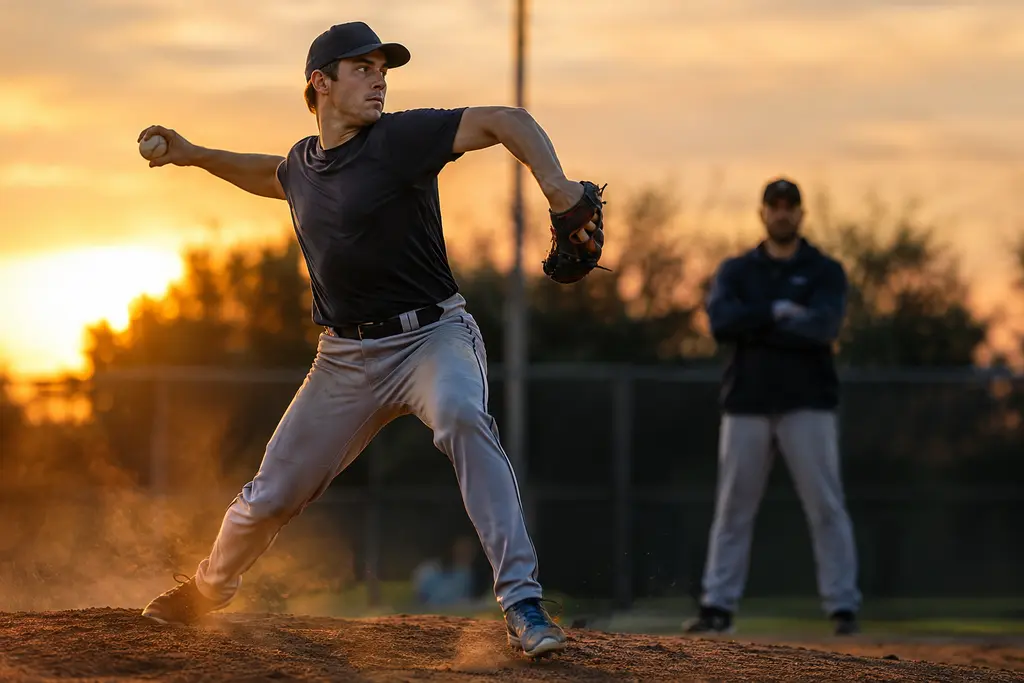
Nationals Pitching Prospects became a more concrete development story by the end of August 2026, not because of one radar-gun reading or one award, but because several measurable signals pointed in the same direction. Washington had a 19-year-old starter producing extreme swing-and-miss numbers, and its farm system had documented velocity growth across a broad group of arms. That combination does not guarantee major league rotation depth, but it gave the Nationals a clearer pitching-development case than they had entering the year.
The cleanest way to read Washington’s 2026 pitching progress is to separate outcomes, traits, and translation risk. Outcomes include ERA, strikeouts, innings, and opponent batting average. Traits include fastball velocity and the ability to miss bats. Translation risk covers what the public numbers cannot fully answer, especially command, durability, and how hitters at higher levels respond over longer samples. For the Nationals, the available record was strongest on the first two categories and less complete on the third.
What Nationals Pitching Prospects Showed In 2026
Miguel Sime Jr. As The Headline Arm
On August 31, 2026, Washington named 19-year-old right-hander Miguel Sime Jr. its Minor League Pitcher of the Year. Through that announcement, he led the Nationals’ minor league system with 130 strikeouts across 23 starts and 72 1/3 innings. He also led all minor leaguers with at least 65 innings in strikeouts per nine innings, at 16.18, and in hits allowed per nine innings, at 4.73, while holding opponents to a .153 batting average, according to the Nationals’ announcement.
Those figures matter because they describe more than a hot month. Sime finished the cited period with a 2.99 ERA, and the strikeout rate was not merely above average for his club; it sat at the top of the minor league sample specified by MLB.com. In player-development terms, that is the kind of performance that earns internal attention because it combines run prevention with a bat-missing foundation.
Nationals Pitching Prospects And Level Context
For Nationals Pitching Prospects, level context is essential. Sime’s 2026 line covered work between Low-A Fredericksburg and High-A Wilmington. The research record supplied a 4.44 ERA over 26 1/3 innings in Low-A and a sharper 2.15 ERA over 46 innings in High-A. That split should be read cautiously, since both samples were limited, but the direction is still notable: the stronger run prevention came after the promotion.
The home-run prevention also added to the profile. Sime allowed only three home runs across those 72 1/3 innings. For a young pitcher with a high strikeout total, that combination suggests hitters were not consistently converting contact into damaging outcomes during the measured stretch. What the public data did not provide in the same detail was walk rate by level or pitch-by-pitch command information, so any evaluation should stop short of declaring him a finished product.
The System Gains Behind Nationals Pitching Prospects
Velocity Growth Across Multiple Affiliates
The broader organizational marker came from velocity. On May 10, 2026, The Washington Post reported that, as part of Washington’s minor league changes, more than 30 minor league pitchers had increased their fastball velocity by at least three mph since spring training 2026. The report identified Erik Tolman at Triple-A, Brady Hill at Triple-A, and Landon Harmon at Low-A among pitchers who made notable jumps, according to The Washington Post.
That fact is important because velocity gains spread across more than 30 pitchers are harder to dismiss as one prospect’s personal improvement. They suggest an organizational process had produced measurable changes, at least in fastball speed. Still, velocity alone is not pitching performance. A harder fastball has to be paired with strikes, usable secondary pitches, and workload management. The available public record supported the velocity-growth claim; it did not fully prove that every velocity gain produced better game results.
Separating Stuff From Results
Washington’s 2026 pitching story is best read as a two-column report. In one column, Sime’s strikeouts, opponent batting average, and run prevention supplied game-level evidence. In the other, the system-wide velocity gains supplied trait-level evidence. The overlap between those columns is where the Nationals had reason to view their farm pitching more seriously by late August.
That distinction also protects the analysis from overreach. A pitcher can gain velocity and still struggle to locate. A prospect can dominate Low-A or High-A and still need to prove that the same approach works against advanced hitters. For readers tracking Washington’s broader minor league process, our earlier review of Nationals velocity gains treated those changes as a development marker rather than a completed verdict.
Why The Performance Record Needs Caution
Strikeouts Are A Signal, Not A Full Report
Strikeouts are among the strongest public indicators for young pitchers because they show a pitcher can end plate appearances without relying on defenders. Sime’s 130 strikeouts in 72 1/3 innings were the central statistic in his 2026 case. Yet strikeout totals do not answer every roster question. They do not fully measure strike-throwing efficiency, sequencing, recovery between starts, or how a pitcher responds when hitters stop chasing.
That is why the 23-start workload matters almost as much as the strikeout total. Sime was 19 during the 2026 season, and his workload gave Washington repeated looks at how his stuff held up across a longer assignment than a short relief sample. The public facts supported a strong performance evaluation. They did not support a precise major league timetable, and no responsible reading should create one without more verified information.
Historical Comparisons Require Matching The Context
Minor league history is full of pitchers whose strikeout numbers hinted at major league value, but the useful comparison is not simply “high strikeouts equals future starter.” The better comparison asks whether the pitcher’s age, level, workload, contact suppression, and command trend line fit together. In Sime’s case, age and bat-missing ability were clear positives in the available record. The command side remained less public, so the safest historical framing is that his 2026 season moved him into a more serious evaluation group rather than into a settled major league role.
For a front office, that kind of pitcher changes planning without ending the search for arms. Teams still need depth because pitching attrition is constant across a full system. The Nationals’ encouraging sign was not that one teenager solved a future rotation. It was that a high-strikeout starter and a broader velocity program appeared in the same development cycle.
Nationals Pitching Prospects And The 2026 Development Signal
Nationals Pitching Prospects had a stronger public case after the 2026 minor league awards than they did before the season. Sime gave Washington a standout individual line: 23 starts, 72 1/3 innings, 130 strikeouts, a 2.99 ERA, three home runs allowed, and a .153 opponent batting average in the cited record. The organization also had a separate system marker, with more than 30 pitchers reported to have added at least three mph to their fastballs since spring training.
The careful reading is that Washington improved the quality of its pitching indicators, not that every question was answered. The next evaluative layer would require more verified detail on walks, pitch usage, health, and performance against more advanced lineups. For a related view of how measurement and technical process can shape performance fields outside baseball, CAD/CAM Network offers insights within the same network. However, the baseball takeaway here remains specific: measured change is valuable only when it connects to repeatable results.
By October 31, 2026, the supported record showed a farm system with a clearer pitching-development identity. Sime was the central name because his statistical performance earned the award and matched the strikeout profile. The velocity gains gave the story organizational weight. Together, they made Washington’s minor league pitching one of the more evidence-backed parts of the club’s 2026 player-development discussion.