

The Carter Jensen Rookie Season ended as one of the clearest rookie breakout cases in Kansas City Royals history. By October 20, 2026, the key records were no longer projections or late-season possibilities. Jensen had already set new franchise rookie marks, passed a major catcher benchmark tied to Mike Piazza, and paired an unusual offensive role with more than 100 games behind the plate.
For a rookie catcher, the weight of that workload matters. Catching is not a light defensive assignment, and the Royals also used Jensen in a demanding lineup spot. The evidence from 2026 shows a player asked to handle pitchers, control the running game, absorb the daily physical toll of the position, and still serve as a power source. That combination gives his season its historical weight.
Why Carter Jensen Rookie Season Stood Apart
Carter Jensen Rookie Season In Context
Jensen reached 58 extra-base hits on September 16, 2026, setting a new Royals rookie record for most extra-base hits in a season. MLB’s report on Jensen’s role noted the rare combination of catching and leading off for Kansas City, placing that record within the broader context of his offensive usage MLB’s Jensen report. By September 26, 2026, the record had grown more meaningful: Jensen reached 62 extra-base hits, passing Mike Piazza’s mark of 61 for the most extra-base hits in a rookie season by a catcher since at least 1947.
That comparison does not require overstating the case. Piazza became one of the defining offensive catchers of the modern era, while Jensen had completed only one major league season as of October 20, 2026. Still, single-season rookie records have value because they identify performance at a specific developmental stage. Jensen did not merely post a promising partial season. He carried production across 149 games, including 105 games at catcher, while finishing with 81 RBIs.
The Power Profile Behind The Records
The Carter Jensen Rookie Season also reset the Royals’ rookie home run standard. Jensen had 27 home runs as of September 26, 2026, passing Bob Hamelin’s previous franchise rookie mark of 24, set in 1994. That record is central to understanding the scale of Jensen’s year because it links him to a small group of Kansas City rookies whose first seasons became reference points for later comparisons.
His broader line added useful balance to the record chase. Jensen’s full-season slash line was .239 batting average, .323 on-base percentage, .467 slugging percentage, and .790 OPS across 527 at-bats in 149 games. Those numbers show that the year was built more on impact contact and extra-base production than on batting average. Among American League rookies in 2026, he ranked first in extra-base hits and doubles, with 33 doubles, second in RBIs, and third in total bases with 242 and in home runs.
| Category | Jensen’s 2026 Mark | Historical Meaning |
|---|---|---|
| Extra-base hits | 62 | Passed Mike Piazza for rookie catchers since at least 1947 |
| Home runs | 27 | Set the Royals rookie record, passing Bob Hamelin |
| Games | 149 | Showed season-long availability and lineup trust |
| Games catching | 105 | Added positional strain to the offensive profile |
| RBIs | 81 | Led Kansas City and ranked near notable Royals rookie seasons |
Historical Comparisons With Royals Rookies
Bob Hamelin, Carlos Beltran, And Kevin Seitzer
Within Royals history, Jensen’s season sits beside the franchise’s most productive rookie hitting years. Passing Hamelin in home runs gave Jensen a clean, measurable franchise record. His RBI total also placed him near the rookie production associated with Carlos Beltran in 1999 and Kevin Seitzer in 1987, though the available research here does not provide their exact RBI totals for direct ranking.
That caution is necessary. Rookie comparisons can flatten differences in eras, ballparks, lineup roles, and defensive demands. Jensen’s case stands out because he was a catcher and a leadoff hitter, not simply because he accumulated power numbers. As a leadoff hitter, he recorded 20 home runs while batting first and playing catcher, eight more such home runs than any catcher before him in MLB history. That fact separates the profile from the usual power-hitting catcher model, which is more often tied to middle-of-the-order run production.
Why The Catcher Comparison Is Different
The Piazza comparison is the headline because it crosses franchise boundaries. Passing Piazza’s rookie catcher extra-base hit mark since at least 1947 placed Jensen in a category that is both position-specific and historically narrow. Catchers are rarely asked to combine heavy defensive volume with leadoff plate appearances and middle-order-type power. Jensen did so in his first full major league season.
September sharpened the perception of his year. Over the final month of September 2026, Jensen was named both American League Player of the Month and Rookie of the Month after hitting .338 with 19 extra-base hits, including eight home runs, and producing a 1.194 OPS, according to his Baseball Reference Bullpen page. That finish did not create the entire season, but it did push several records into place and gave the Royals a clearer picture of what his peak production looked like over a month.
Development Signals And Future Outlook
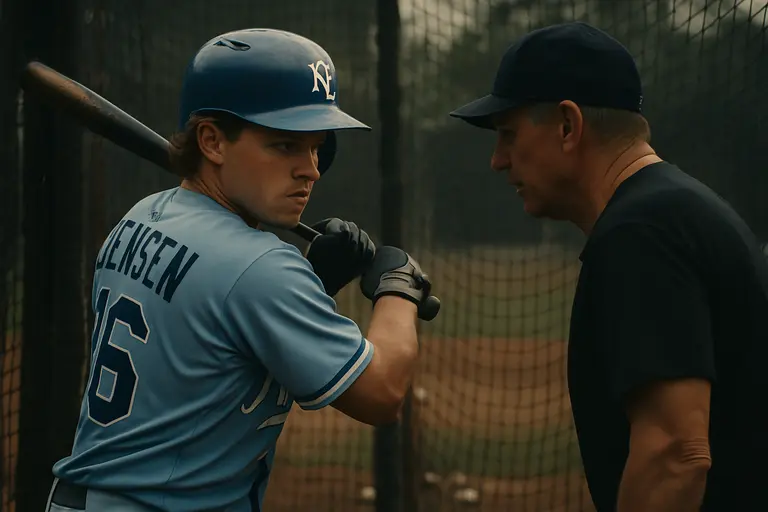
What The 2026 Workload Shows
The Carter Jensen Rookie Season offered evidence in three areas: power, durability, and role flexibility. The power evidence is direct: 62 extra-base hits, 27 home runs, 33 doubles, and a .467 slugging percentage. The durability evidence is also direct: 149 games played and 105 games caught. Role flexibility came through his use as a leadoff hitter while still handling a position that usually limits offensive expectations.
For Kansas City, that type of season affects roster planning. A catcher who can bat near the top of the order changes how a club can arrange the rest of its lineup. It can allow the Royals to separate similar hitter types, protect younger bats from immediate lineup pressure, or use another power bat lower in the order. Those are roster effects supported by Jensen’s 2026 usage, not guarantees about how future lineups will operate.
What Should Be Treated Carefully
The future outlook should stay tied to the record rather than jump beyond it. Jensen’s rookie year was exceptional, but one season does not establish a career path. Catchers face unusual physical demands, and offensive performance can shift as pitchers build scouting plans. The stronger conclusion is that Jensen gave Kansas City a rare foundation: a 23-year-old catcher with verified rookie power records, month-end award recognition, and a season-long workload.
The Carter Jensen Rookie Season also gives historians a firm comparison point. Future Royals catchers and power-hitting rookies will be measured against the 58 extra-base hits reached on September 16, the 62 reached after September 26, and the 27 home runs that passed Hamelin. Those numbers are specific enough to avoid vague praise and strong enough to explain why the season quickly entered franchise lore.
Carter Jensen’s Record Setting Place With Kansas City
Jensen’s 2026 campaign belongs in Kansas City’s rookie record discussion because it combined franchise marks with a broader MLB catcher milestone. His .790 OPS, 81 RBIs, and AL rookie rankings help define the production, but the more distinctive point is structural: he produced as a catcher and leadoff hitter at a level not previously seen in the same form.
That is the careful way to frame the Carter Jensen Rookie Season. It was not a promise of specific awards in later years, and it should not be treated as proof that he will follow Piazza’s career arc. It was, on its own terms, a record-setting rookie year for a demanding position, one that gave the Royals a young player whose first full season already carries historical weight. Readers interested in exploring similar sports content can check out a related site on the network at FSGolf, but Jensen’s achievements remain squarely within the baseball world.