
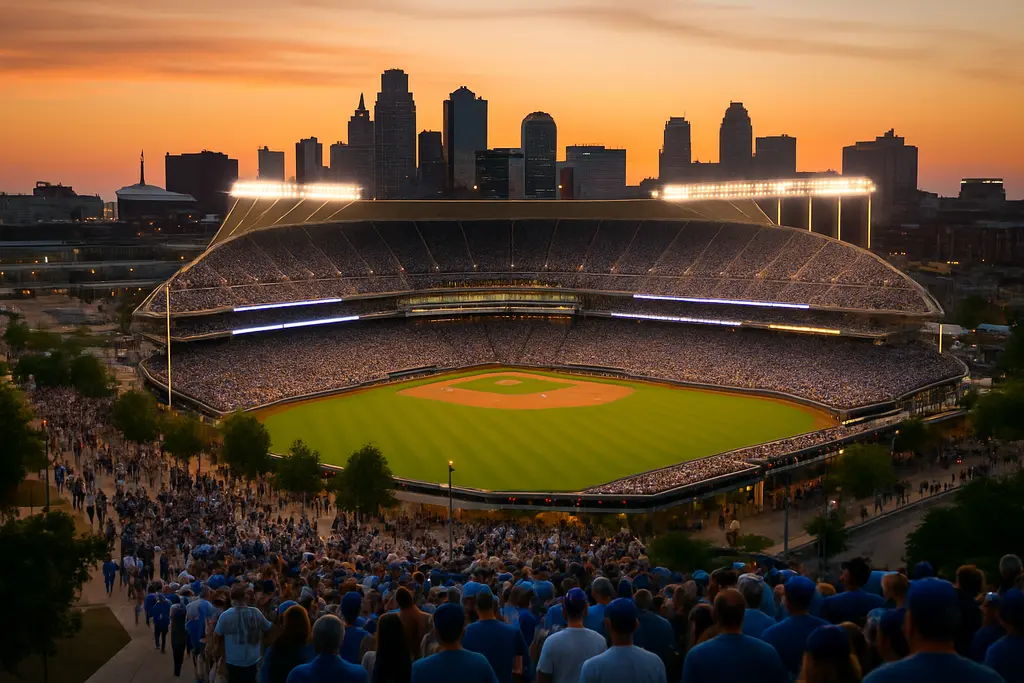
The Royals Downtown Ballpark moved from concept to a more defined public design on October 15, 2026, when the Royals and Populous released renderings for an open-air Crown Center venue with about 34,000 fixed seats, room for about 2,500 standing-room-only fans, and a fabric canopy designed to shade roughly 65% of seats in late-afternoon conditions, according to MLB.com’s design report. Those numbers do not prove the project will improve attendance or satisfaction, but they give analysts a better base for judging the fan-experience tradeoffs.
Stadium design is not only an architectural question. For a baseball club, it shapes how fans move, sit, gather, spend time before first pitch, and decide whether a game is worth attending on a hot weekday. The Royals case is useful because it combines a reduced fixed-seat model, a downtown setting, a climate-comfort feature, and an effort to carry over familiar Kauffman Stadium symbols.
Royals Downtown Ballpark Design Signals
Royals Downtown Ballpark Capacity Math
The most direct design signal is capacity. A venue with about 34,000 fixed seats and a possible total near 36,500 including standing-room capacity would be smaller than many older multipurpose-era baseball parks and more aligned with the current preference for tighter seating inventory. That can help reduce the number of visibly empty seats, but it also places more pressure on pricing, access, and sellout management for higher-demand games.
For the Royals, the key issue is not whether 34,000 fixed seats can handle an average night. The research notes show recent attendance levels have been well below that threshold. The more relevant question is how the venue performs across different demand bands: weekday games, summer games, promotional dates, rivalry matchups, and any future postseason games. A smaller park can feel more engaged during ordinary attendance periods, but it gives the club less fixed-seat margin if team performance and demand rise at the same time.
| Design Element | Reported Detail | Fan-Experience Reading |
|---|---|---|
| Fixed seating | About 34,000 seats | Creates a smaller inventory base and can make typical crowds feel denser |
| Standing room | About 2,500 additional capacity | Offers flexibility for higher-demand dates without adding permanent seats |
| Shade | About 65% of seats in late-afternoon conditions | Targets heat exposure, a practical comfort issue for summer baseball |
| Legacy features | Fountains, CrownVision, and the Little K youth field | Preserves recognizable links to the Kauffman Stadium identity |
Tradition As A Retention Tool
The design choice to preserve the fountains, CrownVision concept, and the Little K youth field is more than nostalgia. It is a retention strategy. Ballpark moves can create friction when long-time fans associate the club with specific views, entry rituals, parking patterns, and in-park landmarks. Keeping identifiable features gives the new building continuity with the old one, even if the trip, surrounding streets, and seating layout change.
That continuity matters because stadium attachment is rarely based on one variable. A fan may accept new concessions or a new district but still worry about losing the visual memory of fountains beyond the outfield. By carrying those features into the design language, the club appears to be reducing the perceived cost of change.
Capacity, Shade, And Sightline Tradeoffs
Comfort Metrics Matter In Baseball
Baseball asks more from the in-person fan than most major sports because the schedule includes many warm-weather dates, longer dwell time, and a slower rhythm that leaves spectators exposed to sun and heat for extended periods. A fabric canopy shading about 65% of seats during late-afternoon conditions is therefore a meaningful design variable, not just an aesthetic choice.
If built as shown, the canopy would directly address one of the clearest pain points in summer attendance: whether fans can sit comfortably through the early innings. That may be especially relevant for families, older fans, and fans choosing between a home game and an air-conditioned alternative. The design does not eliminate heat, and it does not guarantee satisfaction, but it targets a measurable environmental factor.
The SRO Question
Standing-room-only capacity can support a more flexible game-day model. It lets a club increase attendance for peak-demand dates without building thousands of fixed seats that may sit unused for lower-demand games. From a fan-experience standpoint, though, SRO quality depends on sightlines, crowd flow, rail space, concourse width, and access to concessions and restrooms. The research notes do not provide enough detail to grade those elements.
For the Royals Downtown Ballpark, the first measurable test would come after opening, when attendance distribution, sellout frequency, and fan movement patterns could be compared with design assumptions. Until then, the capacity plan should be treated as an intentional tradeoff: less fixed inventory, more density, and more flexible overflow.
Fan Sentiment And Risk Controls
Survey Data Shows The Main Frictions
Fan reaction has not been uniform. A 2023 Royals Review survey found that 35.9% of respondents supported a downtown baseball stadium, 43.3% opposed it, and 20.8% were unsure; the leading concerns included parking and traffic at 30.8%, preserving Kauffman Stadium features at 27.3%, and cost or taxpayer burden at 27.2%, according to Royals Review’s fan survey. That data should be read cautiously because it reflects survey respondents rather than a full market census, but it identifies the categories the club cannot ignore.
The parking and traffic concern is especially important because a downtown ballpark changes the trip model. Fans used to a large stadium complex evaluate convenience differently than fans who already use downtown restaurants, garages, transit, or rideshare zones. The design renderings may answer questions about seating and shade, but access planning will carry a separate burden.
The preservation concern is easier to connect to the published design. The inclusion of fountains and other familiar Kauffman features directly addresses one of the top fan worries from the 2023 survey. It does not settle every objection, but it shows that the design team treated team identity as a functional fan-experience issue rather than a decorative afterthought.
Business Goals And Baseball Feel
Downtown ballparks are often judged by mixed-use development claims, but the baseball experience still has to work from pitch one through the final out. Fans will judge the building through seat comfort, sun exposure, views, noise, ticket availability, food access, and the ease of leaving after the game. A tighter capacity model can help atmosphere, but it can also expose any weak points in circulation if demand spikes.
This case also fits a broader pattern of teams tying venue plans to surrounding districts and long-term business strategy; for historical context, the site has examined MLB infrastructure investment through prior ballpark projects. For comprehensive information on arranging venue and sports-business connections, Efficient Directory offers a broad platform within the same network.
Royals Downtown Ballpark Fan Experience
The Royals Downtown Ballpark is best read as a design attempting to solve three separate fan-experience problems at once: create a more compact attendance environment, reduce heat exposure with shade, and preserve enough Kauffman Stadium identity to limit emotional resistance. The evidence available as of October 19, 2026 supports those design intentions, but it does not yet prove outcomes.
The cautious read is that the stadium plan has credible fan-comfort features and clear identity carryovers. The unresolved issues sit outside the renderings: access, parking, pricing, circulation, and how the building performs across a full range of attendance levels. Those are the measurements that will determine whether the design becomes a better baseball experience, not just a new address.