

Baseball doesn’t make myths anymore; it just reboots them. In 1941, America’s first national obsession came through box scores. A Yankee outfielder’s 56-game hitting streak became a legend, like Gatsby.
Forget Babe Ruth’s power or Lou Gehrig’s tragic story. DiMaggio’s .408 average during the streak was unmatched. His cultural impact lasted long after his playing days.
When Marilyn Monroe married him, then sang to JFK, DiMaggio became a symbol. Was he a hero or an ideal?
Richard Ben Cramer’s The Hero’s Life explores this question. The ’41 season was more than baseball. It showed silent strength and private storms, like Hemingway.
This isn’t just another baseball bio. It’s about DiMaggio’s streak becoming our first viral moment. We’ll see why his legacy lives on in baseball and literature. Batter up.
Growing Up in San Francisco
Before the roar of Yankee Stadium, Joe DiMaggio Jr. grew up with the smell of crab traps. He worked on a fishing boat with his father, surrounded by mackerel guts. This was no ordinary coming-of-age story; it was a tough nine-hour shift with blistered hands.
The San Francisco docks were his first training ground, not for baseball but for survival.
Vince DiMaggio, Joe’s older brother, was the first to shine in baseball. His 1933 Pacific Coast League record of 61 consecutive games with a hit was unmatched. The San Francisco Seals saw Vince’s talent first, but Joe soon caught their attention.
Branch Rickey, known for his “quality of opportunity” philosophy, almost missed Joe. Rickey thought Joe was too frail. Yet, he later broke baseball’s color barrier, showing his keen eye for talent.
The 1933 season was a turning point for Joe. His 61-game PCL streak was statistically unlikely. His .340 batting average was impressive, even smelling like the family trade. The Yankees paid $25,000 for his contract, but he left the docks behind.
The DiMaggio brothers left a lasting legacy in baseball. Vince’s .249 average belies his role as Joe’s coach and competitor. Their backyard games in North Beach were more than sibling rivalry; they were lessons in hand-eye coordination. Without Vince, baseball might have seen a different Joe DiMaggio.
Joining the Yankees
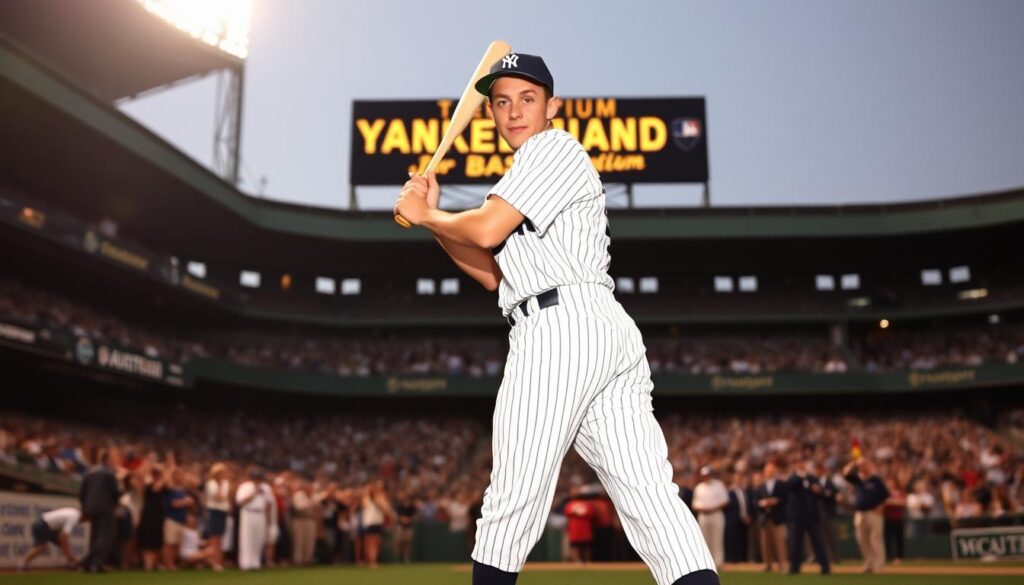
Replacing Babe Ruth was like trying to catch a ghost. That’s what DiMaggio faced in 1936. He stepped into the Yankees’ lineup, where Ruth’s legacy was huge. But DiMaggio didn’t just fit in; he outshone Gehrig, making him move.
This was a rookie who was so good, he took Gehrig’s spot in the lineup. Gehrig was having an MVP season, but DiMaggio’s talent was undeniable.
The numbers show DiMaggio’s impact:
| Player | 1936 Avg | RBIs | HRs |
|---|---|---|---|
| DiMaggio | .323 | 125 | 29 |
| Ruth (1923) | .393 | 131 | 41 |
| Gehrig (1925) | .295 | 68 | 20 |
DiMaggio’s arrival was a big deal. Gehrig was fighting ALS, and Ruth’s legacy was everywhere. DiMaggio’s smooth swing became the Yankees’ heartbeat, leading them to four championships.
Many miss the real story of DiMaggio’s rise. He wasn’t just a strong hitter; he was elegant. His arrival marked a shift from Ruth’s showmanship to DiMaggio’s precision.
DiMaggio’s genius was in blending Ruth’s flair with his own strategy. He didn’t just hit; he aimed for the ghosts of the past. His .323 average was a statement, showing he was the new leader.
But DiMaggio’s greatest achievement might have been being alongside Gehrig. Gehrig was fading, but DiMaggio’s talent kept the focus on the present. He made fans forget about Ruth and Gehrig while playing with them.
The Legendary Hitting Streak
The streak’s magic isn’t just in the numbers. It’s in the stories we’ve loved for years. DiMaggio’s 56-game hitting streak became a huge hit, like a viral video. It’s a mythology in cleats.
But, Stephen Jay Gould said it was “statistical impossibility.” Modern tests say it’s just improbable as finding sober fans in the bleachers during a doubleheader.
Gould thought DiMaggio’s streak was a “last possible moment” feat. But, 2023 simulations show it’s more likely than we thought. With DiMaggio’s .408 batting average, the chance is 1 in 2,300. That’s like Powerball odds, not magic.
| Perspective | Gould’s Take (1988) | Modern Simulations | Reality Check |
|---|---|---|---|
| Probability | 1 in 10,000+ | 1 in 2,300 | Same odds as drafting 3 Hall of Famers consecutively |
| Key Factor | “Deadball Era twilight” | Batted-ball physics | DiMaggio faced 14 HOF pitchers |
| Cultural Weight | “Last folk hero” | Algorithm-friendly | Both miss the whiskey-stained dugout tales |
Koufax’s 1965 perfect game is another “impossible” feat. DiMaggio’s streak was a marathon, while Koufax’s was a high-wire act in a hurricane. Both had tobacco stains, reporters’ whiskey breath, and the truth that greatness needs context, not just numbers.
The streak’s real value? It happened pre-television. Unlike Koufax’s game, DiMaggio’s streak was heard on radio and seen in box scores. That’s why we’ll keep debating 56 games, while perfect games are just YouTube compilations. Both are legendary, but only one is America’s campfire story.
“The Hero’s Life” Book Insights

DiMaggio’s public image was like a perfect baseball card. But Richard Ben Cramer’s “The Hero’s Life” shows the real, gum-stained truth. It’s like a mix of Shakespearean tragedy and clubhouse politics, with DiMaggio as the star who could field like a god but couldn’t escape his own shadow.
This dimaggio book is a must-read. Cramer peels back the layers of DiMaggio’s image. We see the man who demanded three towels after games and memorized menus like they were sacred texts. He was a star who married Marilyn Monroe but kept her infidelities in his wallet.
This book isn’t a slam. It’s a detailed look at fame’s costs. Cramer reveals DiMaggio’s “greatest hit” wasn’t his batting average. It was keeping up the illusion of perfection while dealing with his own emotional struggles.
The comparison to Cobb’s story is striking. Both men were trapped by their own myths. Cobb was seen as a racist tyrant, while DiMaggio was the aloof aristocrat. But while ty cobb true story revelations are shocking, DiMaggio’s story is like watching a monument crumble.
Reading this book is like breathing in 57 years of locker room steam. It’s raw and revealing. It makes you question: Do we create heroes to tear them down, or do they fall under our expectations? Either way, Cramer’s book is a literary masterpiece that will leave you flinching and then tipping your cap in respect.
Marilyn Monroe & Public Image
When America’s top athlete married its most wild starlet, it was big news. DiMaggio and Monroe’s short marriage was a mix of sports discipline and Hollywood drama. It was like Babe Ruth meets Sunset Boulevard, but with less baseball and more cameras.
Their January 1954 wedding was a big event. It was at San Francisco’s City Hall, with two reporters as witnesses. It felt like a Bill Veeck stunt, but it was real. Monroe later said, “Joe wanted a wife. I wanted to breathe.” Their marriage was like America’s first reality TV show, with fame at the center.
Think about the contrast:
- DiMaggio’s 56-game streak vs. Monroe’s 7-year itch
- Pinstripe perfection vs. flowing subway dresses
- Silent professionalism vs. Monroe’s “Happy Birthday, Mr. President”
Was their love real or just a show? Their 1954 Tokyo honeymoon showed the difference. DiMaggio golfed with generals, while Monroe sang for 100,000 GIs. The New York Daily News called it “D-Day for Dames.” Joe left early.
Their September divorce was even bigger. Monroe’s Seven Year Itch skirt scene was filmed before they split. It made DiMaggio’s anger public. Yet, he sent roses to her grave for 20 years. Even Veeck couldn’t predict that.
Legacy and Memory
In today’s world of Instagram stars and celebrity NFTs, DiMaggio’s legacy from the 1950s stands out. Marvin Miller’s baseball legacy changed how players are treated, and Roberto Clemente’s life showed the power of athlete activism. But Joe DiMaggio did something special. He became a timeless icon, always relevant.
| Legacy Metric | DiMaggio | Miller | Clemente |
|---|---|---|---|
| Hall of Fame Induction | 1955 (First Ballot) | Never Elected | 1973 (Special Election) |
| Public Perception (1969 Gallup Poll) | “Greatest Living Player” | “Union Radical” | “Humanitarian Hero” |
| Post-Career Brand Value | Mr. Coffee ➔ $23M Deal | Collective Bargaining | Baseball’s Nobel Prize |
DiMaggio didn’t just retire; he became a lifestyle icon. His “Greatest Living Player” title was a result of careful planning. It was like a modern-day Easter egg drop, but on a grander scale.
While Miller and Clemente fought for change, Joe mastered the art of scarcity. He showed up just enough to stay in the spotlight.
Three moves that foreshadowed influencer culture:
- The Graceful Exit: Retired at 36 despite .325 batting average
- Brand Collabs: From Bowery Savings Bank to Simonize Wax
- Mystique Maintenance: Only 12 career interviews post-retirement
Today, athletes seek viral fame. But DiMaggio knew the secret to lasting legacy. It’s not about being everywhere. It’s about being exactly where history needs you. His Cooperstown plaque lists 361 home runs, but his true legacy is in turning athletic greatness into lasting cultural value.
Key Recommended Books
Baseball literature is more than just box scores and hero worship. It’s a deep dive into the game’s soul. I’ve picked nine essential reads that go beyond the surface, starting with two that change how you see baseball.
The Ruthian Revelation: Leigh Montville’s The Big Bam is not your typical Babe Ruth biography. Published in 2006, it views Ruth as a Shakespearean figure, a mix of showman and cultural force. It explains why Ruth’s home runs were more than just hits.
Iron Horse Requiem: Jonathan Eig’s Luckiest Man from 2005 turns Lou Gehrig’s story into poetry. It shows Gehrig’s battle with ALS as a curveball in a life of fastball discipline. Be ready for a emotional rollercoaster.
- Deep Cut Alert: The San Francisco Seals Chronicles (1935) – DiMaggio’s early days in the minors during the Depression
- Artifact Grade: SPORT Magazine’s May 1941 issue – Joltin’ Joe’s first cover, set against the backdrop of war
- Wild Card: Jane Leavy’s The Last Boy – Mickey Mantle’s story, a contrast to DiMaggio’s legacy
Why read these? They show that great sports writing is about more than just the game. It’s about exploring cultural boundaries. These books turn box scores into deep social commentary, making Moneyball seem like child’s play. Get ready to swing for the fences.
Wrap-Up
Joe DiMaggio’s .325 career average is just the start. His real story blends sports and culture, a mix of numbers and legend. He was a key player for the Yankees and a famous figure, known for his time with Marilyn Monroe.
Today, fans looking into his joe dimaggio biography often overlook the big picture. DiMaggio wasn’t just playing baseball. He was living out a dream of American ideals.
From the sea to the stage, his life shows how we create icons. His record-breaking streak is more than numbers. It’s a symbol of our desire for the impossible.
His marriage to Monroe was a deal with fame, a trade-off for privacy. Modern-day unsung baseball heroes can learn from his mix of skill and showmanship. DiMaggio’s greatest achievement wasn’t winning championships. It was becoming a part of our collective memory, forever enigmatic and misunderstood.
Do we believe heroes are born, or are they made?