
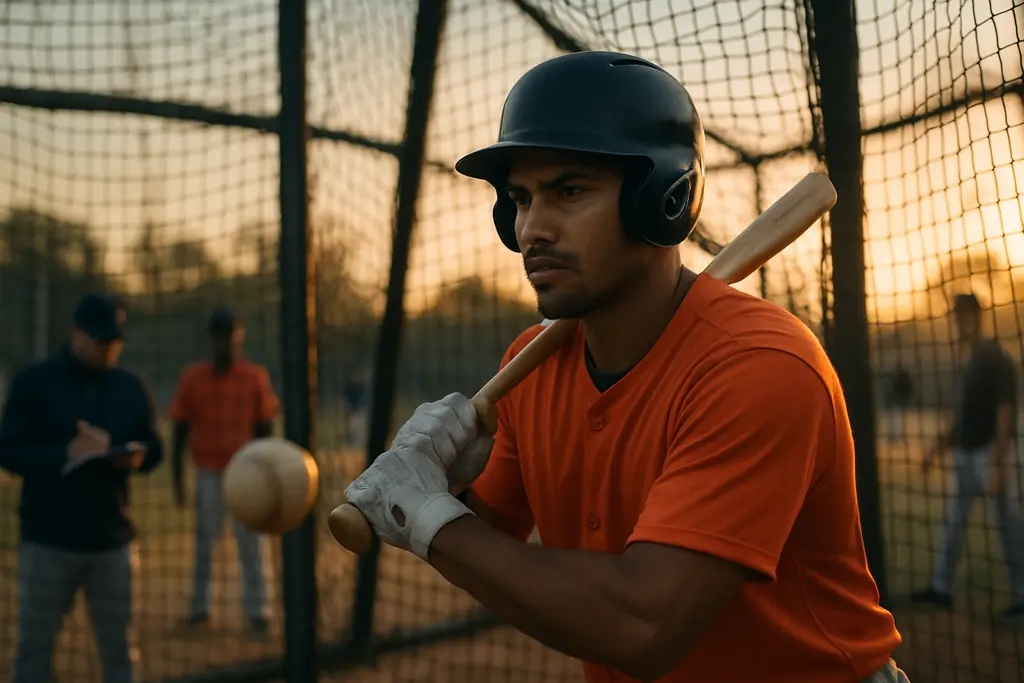
Rainiel Rodriguez development has moved quickly enough to change how the St. Louis Cardinals’ catching pipeline is discussed, but the most useful reading of his rise is still grounded in what has been verified: age, production, promotions, defensive usage, and the way he responded after his first Double-A slowdown.
Rodriguez was born on January 4, 2007, in Pimentel, Dominican Republic. He bats and throws right-handed, and his listed frame is 5-foot-10 and 197 pounds. The Cardinals signed him as an international free agent in April 2024 for $300,000. That entry point matters because his first two professional seasons did not follow a slow, low-impact track. He produced immediately in the Dominican Summer League, carried power into full-season ball, and reached Double-A Springfield as an 18-year-old in 2026.
As a biographical subject, Rodriguez is still closer to the beginning than the finished portrait. The record through September 14, 2026, gives enough detail to explain why he has become a breakout prospect, while still leaving room for caution about the normal risks attached to young catchers and teenage power hitters.
Rainiel Rodriguez Development In Context
From Pimentel To The Cardinals
Rodriguez’s professional record begins with a Dominican-born catcher entering the Cardinals’ system in 2024. The signing bonus, while substantial, was not the kind of figure that automatically places a player among the most publicized names in an international class. His rise has been driven less by pre-signing attention and more by what he did after entering organized ball.
At age 17 in the 2024 Dominican Summer League, Rodriguez played 41 games and made 184 plate appearances. He hit .345 with a .462 on-base percentage and a .683 slugging percentage, producing 10 home runs, 38 RBIs, and a 1.145 OPS. Those numbers describe more than a hot opening month. They show a young hitter who was already doing damage while reaching base at a high rate.
Why Rainiel Rodriguez Development Accelerated
The reason his prospect status moved so quickly is not one statistic alone. It is the combination of age, position, and power. Catchers who produce offense at a young age draw attention because the position carries defensive demands that can slow a hitter’s offensive progress. Rodriguez’s case is different so far: his bat has pushed the timeline forward while his defensive profile has remained part of the evaluation.
That is the central marker in Rainiel Rodriguez development. His bat has not had to wait for years of defensive sorting before becoming relevant. Still, a catcher’s path is rarely measured only by home runs. The Cardinals have used him behind the plate, at first base, and as a designated hitter, which shows both the value of keeping his bat active and the ongoing work tied to his defensive home.
A Bat That Forced Faster Tests
DSL Power And Plate Production
The 2024 DSL line gave Rodriguez a high starting point. A .345/.462/.683 slash line from a 17-year-old catcher is the type of performance that demands stronger competition. It did not prove that he was close to the majors, but it did show that rookie-level pitching had not exposed the kind of offensive weakness that often slows teenage hitters.
His home run total in that setting is also central to the profile. Ten home runs in 41 games gave the Cardinals reason to test whether the power would hold against pitchers with better command and more advanced secondary offerings. The answer in 2025 was encouraging.
The 2025 Teenage Home Run Marker
In 2025, at age 18, Rodriguez played across the Florida Complex League, Single-A Palm Beach, and High-A Peoria. Across 84 games, he hit .276 with a .399 on-base percentage and a .555 slugging percentage, adding 20 home runs. He was one of only two teenagers in the minor leagues to reach at least 20 home runs during 2025.
That year matters because it separated his first professional outburst from a one-level story. The batting average declined from the DSL mark, as expected against better competition, but the on-base percentage remained strong and the slugging percentage stayed well above ordinary. The key developmental signal was that the power traveled.
By September 14, 2026, his combined 2026 minor league line across High-A and Double-A included roughly 451 at-bats, a .324 batting average, 27 home runs, 87 RBIs, 11 stolen bases, and a .987 OPS. His career minor league line at that point stood at a .311 batting average, 57 home runs, 188 RBIs, and a 1.002 OPS. Those figures support the view that his offensive production has been sustained, not isolated to one park or one short assignment.
Catching Profile And Positional Demands

Arm Strength Shows Up Early
Rodriguez’s defensive record is part of the story because he has not been treated solely as a bat-first corner player. In the 2024 Dominican Summer League, he caught 26 games and logged 218.2 innings behind the plate. During that time, he was credited with 30 runners caught stealing and a .988 fielding percentage.
In 2026, his usage reflected a broader developmental plan. He had started 55 games at catcher, 21 at first base, and 20 as the designated hitter. Public defensive notes credited him with arm strength and a strong ability to throw out baserunners, with at least a 30 percent caught-stealing rate in his first two full seasons. His framing and blocking were still described as developing areas, according to Baseball Savant.
Why First Base And DH Matter
Those first-base and designated-hitter starts should not be read as a confirmed position change. The verified usage shows a club keeping his bat in the lineup while still giving him catcher work. For an 18- or 19-year-old catcher, that balance is not unusual. Catching requires game-calling, receiving, blocking, throwing, pitcher preparation, and physical recovery. The bat can move faster than those skills.
The Cardinals’ challenge is to protect the offensive growth without losing defensive information. If Rodriguez stays behind the plate, the value of his bat increases because power-hitting catchers are harder to find. If he moves more often to first base or designated hitter, the offensive standard rises. That distinction is why his defensive progress remains central, not secondary.
Followers interested in diverse athletic development can discover similar topics at Triple T Powersports, a related network site.
Rainiel Rodriguez Development After Double-A
The Springfield Adjustment
Rodriguez was promoted to Double-A Springfield in mid-May 2026. His opening stretch there was difficult: over his first 21 games with Springfield, he produced a .527 OPS. That is an important detail because prospect evaluation is often shaped by how quickly a player adjusts after a league finds something that works against him.
After the All-Star break, which followed July 17, 2026, Rodriguez’s Double-A results improved. Over 16 Double-A games after that break, he hit .338 with six home runs and posted a 1.088 OPS, as reported by MLB.com. He had already been named to the National League roster for the 2026 All-Star Futures Game, which was played on July 12, 2026.
The Biographical Read
For now, Rainiel Rodriguez development is best read as a story of rapid offensive proof paired with unfinished defensive definition. The production is loud: power in the DSL, 20 home runs as a teenager in 2025, and a strong 2026 line through September 14. The positional question is just as real: he has the arm and throwing results to remain a catcher in the conversation, but framing and blocking remain part of the work.
That combination makes Rodriguez one of the more interesting young players in the Cardinals’ system. His career has not yet reached the major leagues, and no verified timeline should be treated as certain. What can be said is narrower and stronger: through the available record, he has repeatedly earned harder assignments, struggled briefly at Double-A, and then responded with production that restored the momentum of his breakout profile.