
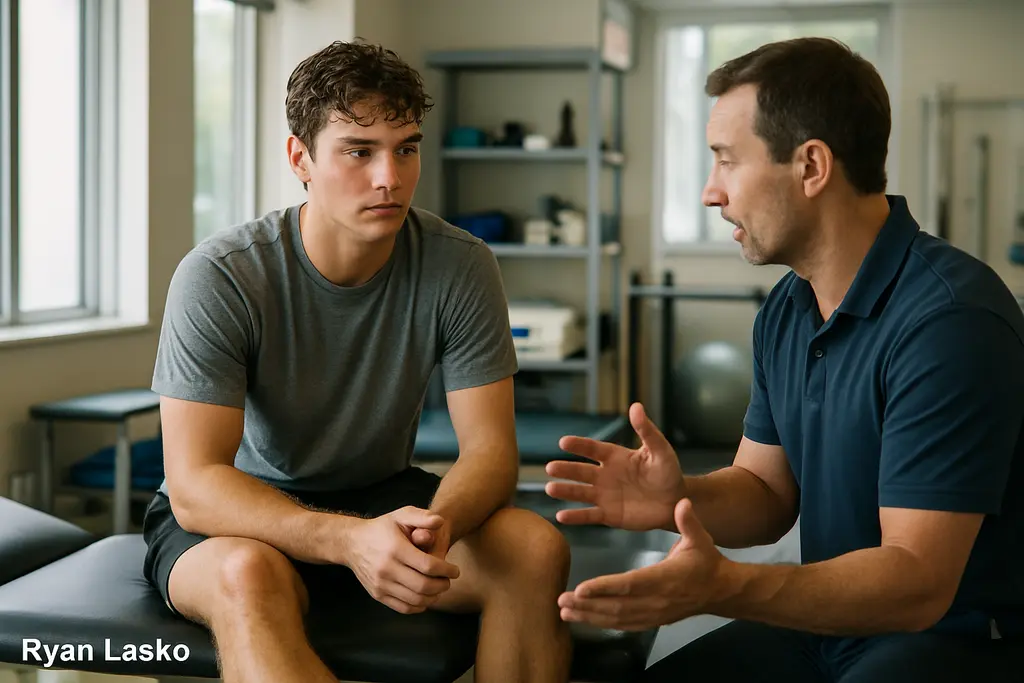
Ryan Lasko Rehabilitation has become one of the most closely followed player-development stories in baseball because it began with a severe on-field injury and then moved into the slower, less public work of inpatient and outpatient therapy. Lasko, an Oakland A’s prospect playing center field for Double-A Midland, was injured on June 30, 2026, in a road game at Frisco, Texas. The verified record supports a careful reading: this is not a story for broad medical prediction, but it is a clear case study in emergency response, rehabilitation structure, family support, and how a club system responds when a prospect faces a life-changing injury.
Biographical writing about players often focuses on draft status, tools, and performance arc. Lasko’s 2026 story requires a different frame. The key measures were not batting lines or defensive range. They were sensation, functional movement, transfer skills, occupational therapy gains, and the ability to regain independence in basic daily tasks. For those who follow the development of baseball players across the minor leagues, checking out related insights at Sports Wire News can provide valuable context by placing individual player stories within the broader sports landscape.
Ryan Lasko Rehabilitation Timeline
The Frisco Collision
On June 30, 2026, Lasko collided with teammate Devin Taylor while attempting a diving catch in center field. According to ABC News, the collision left him immediately unable to move, and tests revealed fractures in the C6 and C7 vertebrae in his neck ABC News reported. He underwent emergency spinal decompression and stabilization surgery after the injury. The same reporting described him as tetraplegic, meaning loss of motor or sensory function in the lower body and partial loss in the arms.
For a baseball biographer, that date matters because it marks a sharp break in the normal prospect timeline. A center fielder’s development usually gets judged by reads off the bat, route efficiency, arm accuracy, plate discipline, and adjustment to upper-level pitching. After June 30, those baseball measures became secondary to medical stabilization and rehabilitation. The available reporting does not support firm claims about a playing future, and any serious account should avoid treating recovery as a predictable straight line.
Transfer To Kessler
Lasko remained hospitalized for more than two weeks after the collision. He was then flown from Texas to New Jersey, his home state, while still on a stretcher. On July 16, 2026, he arrived at the Kessler Institute for Rehabilitation to begin inpatient therapy. That move from emergency care to structured rehabilitation was a major change in setting, but not a simple endpoint. In spinal cord injury cases, the shift to a rehabilitation hospital often begins the most repetitive and demanding phase of recovery.
By July 28, 2026, Lasko had reported regaining sensation from his feet up to his knees, along with involuntary leg movements and some feeling in the sides of his thighs, hamstrings, and back, according to MLB.com. Those details are important because they describe specific gains without overstating what they mean. Sensation and involuntary movement can be encouraging markers, but the public record does not permit a definitive forecast of long-term function.
Daily Work At Kessler
Ryan Lasko Rehabilitation At Kessler
Ryan Lasko Rehabilitation at Kessler centered on daily physical and occupational therapy. Research notes from the reporting indicate that sessions lasted about three hours each day, a length comparable to a typical baseball game. That comparison is useful, but the nature of the work was entirely different. Instead of reaction, sprint speed, and defensive instinct, the emphasis moved to repetition, assisted movement, fine motor work, and practical independence.
The task list showed how much of life had to be rebuilt. Lasko described relearning how to transfer between a bed and a wheelchair, open water bottles, put on socks and shoes, and sit himself up using reaching motions. None of those actions would have appeared in a scouting report, yet each became a measurable step. Baseball often celebrates visible performance under lights. Rehabilitation, by contrast, can hinge on movements that are small, private, and difficult to repeat when fatigue sets in.
Basic Skills Became Measurable Wins
After roughly two months of inpatient rehabilitation, Lasko was released from Kessler Institute on September 16, 2026. Staff gave him a send-off described in reporting as a “clap out,” and he transitioned to outpatient therapy while returning home. That date should be understood as a change in care setting, not the end of recovery. Outpatient rehabilitation still requires planning, transportation, stamina, and support from caregivers.
Lasko later said that virtually every activity he initially believed he could not do, he had found a way to do, including opening a water bottle. Some tasks remained particularly difficult. That balance is central to evaluating the story responsibly: there were gains, but the reporting also makes clear that daily life still involved hard work. Ryan Lasko Rehabilitation therefore fits best as a record of documented progress and adaptation, rather than a simplified comeback narrative.
Support System And Baseball Context
Family Teammates And Care Training
Lasko’s rehabilitation was not an individual effort in isolation. His parents were present throughout the process, including at the game when he was injured. His girlfriend, Alli Graff, took part in care-partner training at Kessler. Friends, teammates, coaches, and fans also sent messages of support that were reported as part of his daily environment.
Those details matter in baseball biography because player development is often described as a club-and-player equation. In an injury as severe as this one, the circle becomes wider. Family presence, care-partner preparation, facility staff, and organizational resources all shape the day-to-day conditions around the athlete. The A’s system could not convert the injury into a normal player-development problem, but the case shows how baseball infrastructure can still support a player after performance goals are displaced by health and independence goals.
What Clubs Can Learn
The most practical baseball lesson is that emergency preparedness and long-term care planning are part of prospect management. Minor league players travel often, play in varied ballparks, and depend on coordinated medical systems when serious injuries occur away from home. Lasko was injured in Texas, hospitalized there, and then moved to New Jersey for inpatient care. Each stage required coordination beyond the diamond.
MLB’s insurance program was reported to cover all medical and related costs for Lasko’s work-related injury for the rest of his life. That fact is central to the institutional side of the story. A severe injury can create medical, logistical, and financial demands that extend far beyond a season. In that sense, Ryan Lasko Rehabilitation is not only a personal account. It is also a reminder that player welfare systems must be built for rare but serious outcomes.
Ryan Lasko Rehabilitation And Prospect Support
A Cautious Model For Future Cases
Calling this case a model for future prospects requires care. It should not be used to predict another player’s medical outcome, and it should not be treated as a template that guarantees recovery benchmarks. What can be modeled is the response structure: immediate medical care, specialized inpatient rehabilitation, family and care-partner training, outpatient transition, insurance coverage, and communication from the baseball community.
Ryan Lasko Rehabilitation also asks observers to rethink what progress means for an injured player. For a prospect, development usually points toward promotion, major league readiness, and roster value. After a spinal cord injury, progress can mean transferring more independently, completing a daily task, building endurance for therapy, or adapting to a new routine at home. Those gains deserve the same factual care that analysts bring to statistics.
The record available as of October 10, 2026, supports a grounded account: Lasko was severely injured on June 30, underwent emergency surgery, entered inpatient rehabilitation on July 16, reported specific sensory gains by July 28, left Kessler on September 16, and continued into outpatient work. His story remains part of baseball because his identity as a player did not vanish with the injury. It changed the terms by which his strength, support, and progress were measured.