
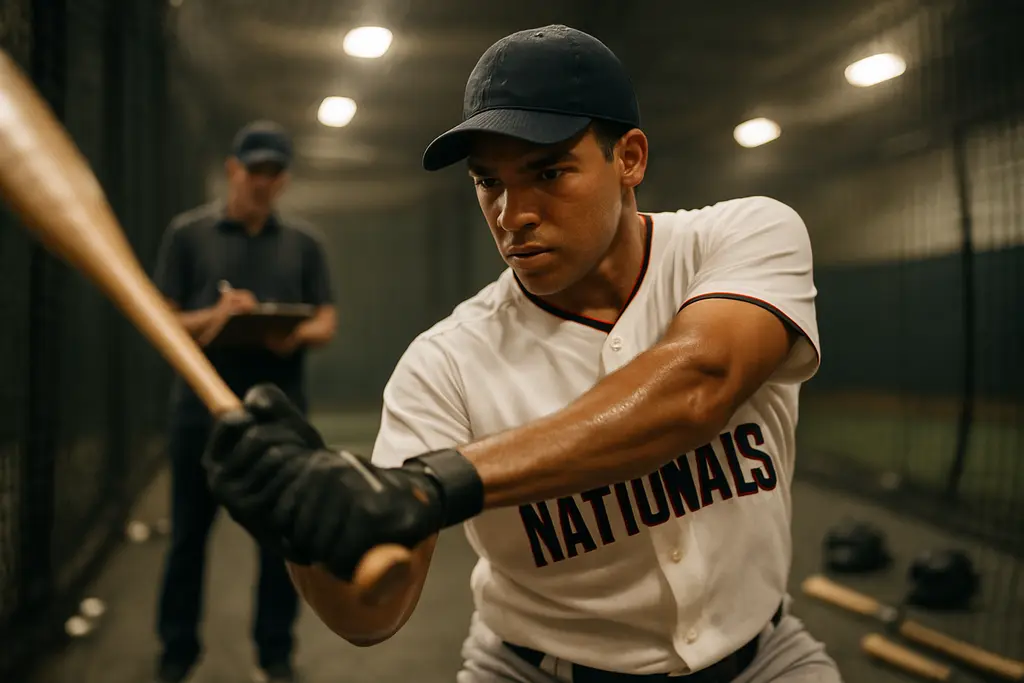
Nationals Player Development entered 2026 with a larger staff structure, clearer affiliate support, and several measurable gains across the minor league system. The safest reading is not that Washington solved player development in one season. It is that the organization produced year-over-year indicators that moved in the right direction after a major process change.
The data in the research set was strongest at the system level: affiliate winning percentage, home run output, slugging percentage, strikeout rate, run prevention, and plate-discipline markers all improved from 2025 to 2026. Some numbers were reported as late-season snapshots rather than fully audited end-of-year public leaderboards, so they should be treated as directional evidence rather than a complete verdict. Even with that caution, the pattern is hard to ignore.
Player development gains can be noisy in the minors because age, level, park effects, roster movement, and rehab assignments all shape the numbers. That is why the Nationals’ 2026 case is most useful when the indicators are grouped together. Better results from the upper affiliates, more power across the system, improved strikeout rates on the mound, and added coaching coverage all point toward a farm system that became more coordinated than it had been in 2025.
Nationals Player Development Gains In 2026
Nationals Player Development Metrics That Moved
The broadest result was the farm system’s combined record. Across six affiliates, the Nationals’ minor league clubs were reported at 305-282 in 2026, a .520 winning percentage. A winning record alone does not prove prospect quality, but it is useful context when paired with skill-based gains. Development systems are not judged by standings first, yet losing environments can make evaluation harder when rosters lack depth. Washington’s 2026 affiliates gave the organization more competitive innings and more meaningful late-game reps for young players.
The power growth was the most visible offensive signal. By September 8, 2026, Washington’s six affiliates were reported with 681 home runs, up from 409 in all of 2025. That was close to a 67 percent increase. System slugging percentage also rose from .349 in 2025 to about .410 in 2026. Home run totals can rise for reasons beyond teaching, including personnel changes and league environment, but the scale of the increase suggests the organization had more hitters doing damage more often.
Plate discipline also improved in the research set. In 2025, only two Nationals minor league hitters were reported with a walk-to-strikeout ratio above 0.50 while producing at least league-average offense. By mid-2026, that count had risen to 13 among hitters with a wRC+ of at least 100. Another early-2026 measure showed 22 Nationals minor leaguers with a wRC+ of at least 100, compared with 11 in 2025, and 16 at 120 or higher compared with four in 2025. Those numbers matter because power gains are more convincing when they are not paired with unchecked swing-and-miss.
Affiliate Results And Upper-Level Signal
The upper minors provided a useful signal because Triple-A and Double-A production is closer to major league decision-making than rookie-level performance. Triple-A Rochester’s winning percentage reportedly improved from .401 in 2025 to .606 in 2026. Across the four highest affiliates — Single-A Fredericksburg, High-A Wilmington, Double-A Harrisburg, and Triple-A Rochester — winning percentage moved from .452 in 2025 to .560 through September 8, 2026.
Those records should not be read as direct forecasts for the major league club. Minor league teams can improve because older players repeat levels, because prospects arrive together, or because pitching depth covers innings more effectively. Still, a gain across multiple full-season affiliates is more persuasive than one breakout club. It suggests that the changes were not isolated to a single coaching staff or one prospect cluster.
Pitching indicators also moved. The research set reported that Washington’s minor league strikeout rate rose from 21.7 percent in 2025, ranked 28th among 30 organizations, to 24.1 percent in 2026, ranked seventh. The system ERA was reported at 4.58 in 2026, the best among all 30 organizations. ERA in the minors is not a clean development stat because defense, parks, and scoring environments vary, but pairing better run prevention with a higher strikeout rate gives the pitching gains more weight.
Staff Structure And Process Changes
More Coaches At The Affiliate Level
Washington’s staffing change was documented before the season. On January 29, 2026, the club announced minor league coaches, coordinators, and staff, including assistant hitting and pitching coaches at each affiliate and expanded support at Triple-A Rochester, such as a quality control coach, defensive coach, added strength staff, a trainer, and a technology technician tied to tools such as a Trajekt machine, according to the Nationals’ Minor League staff release.
The staff expansion is relevant because player development is not only about identifying talent. It is also about giving players repeatable feedback. More coaches can allow for smaller player-to-instructor ratios, more specialized work, and better tracking of daily goals. The key question is whether the added roles led to better instruction or simply more information. The 2026 performance gains suggest the new setup coincided with improvement, but public data cannot prove causation by itself.
The Washington Post reported on May 10, 2026, that more than 30 pitchers had velocity increases of at least 3 mph during spring training and described a more cohesive organizational process under president of baseball operations Paul Toboni, including consistent feedback, postgame reports, and technology use across levels in its system changes report.
Why Process Matters More Than One-Year Records
A farm system can have a strong season without producing enough major league contributors. The more meaningful test is whether the process creates repeatable improvements for different types of players. Washington’s 2026 data was encouraging because the gains appeared in several areas: power, plate discipline, strikeout rate, affiliate record, and run prevention. That mix is more useful than a single spike in one category.
For a related earlier framework on how to judge staff additions, technology use, and timing markers, the Nationals minor-league overhaul analysis offers a useful companion point. The 2026 results made some of those markers easier to evaluate, especially at the upper levels where player movement and role changes tend to reveal organizational priorities.
There is also a broader sports-development lesson. Teams that add technology without clear coaching translation can overwhelm players. Teams that add coaches without consistent data can miss measurable adjustments. The Nationals’ reported 2026 model combined both pieces. For readers interested in similar topics across different regions, Texas Sportsmen provides insights into regional sports development as part of the same network.
What The 2026 Numbers Can And Cannot Say

Signs Of Real Growth
The clearest case for progress starts with breadth. Washington did not only show a better record at one affiliate. The research set showed higher home run volume, a major slugging increase, more hitters with league-average or better production, stronger walk-to-strikeout profiles, a higher pitching strikeout rate, and better run prevention. That is the type of multi-category movement analysts want to see when evaluating a development overhaul.
There was also an early major league process signal. After about the first 10 games of 2026, the Nationals’ big league offense was reported with a walk rate near 9.7 percent, up from 7.4 percent in 2025, while the strikeout rate fell from 22.6 percent to about 20.9 percent. The BB/K ratio rose from .33 to roughly .46. Ten games is far too small to define a season, but it fit the broader organizational theme: better strike-zone control and fewer empty plate appearances.
Prospect depth is another encouraging marker. The research set identified lower-level names such as Eli Willits at Single-A Fredericksburg and hitters such as Gavin Fien, Devin Fitz-Gerald, Angel Feliz, and Ronny Cruz as part of the developing group. The presence of many productive hitters matters because farm systems are healthier when they are not dependent on one top prospect carrying the narrative.
Limits Of The Evidence
The biggest caution is translation. Minor league dominance does not automatically become major league production. A hitter can post strong power numbers in the minors and still face adjustment problems against major league velocity, breaking-ball command, and defensive positioning. A pitcher can add velocity and strikeouts while still needing to prove durability, command, and workload stability over multiple seasons.
Injury prevention is another unresolved area. The research set reported more than 30 pitchers with velocity jumps of at least 3 mph during spring training. Velocity growth can raise a pitcher’s ceiling, but the next analytical question is whether those gains held through full-season workloads without sacrificing health or command. Publicly available results can show strikeouts and ERA; they cannot fully show workload planning, recovery quality, or mechanical risk.
Age and level also matter. A 22-year-old succeeding in Single-A is not the same signal as a 21-year-old holding his own in Double-A. Without full age-to-level and batted-ball context for every player, the safest conclusion is that Washington improved system performance in 2026, not that every prospect’s true talent level changed by the same amount.
Nationals Player Development Measurement After 2026
The next test for Nationals Player Development is not whether the 2026 farm system looked better. It did, based on the reported year-over-year indicators. The next test is whether those gains persist when players are promoted, exposed to tougher pitching or hitting, and asked to help the major league roster.
Three measures should carry the most weight after October 10, 2026. First, track whether the improved strikeout rate on the pitching side survives promotions to Double-A, Triple-A, and the majors. Second, watch whether the power gains remain attached to acceptable walk and strikeout profiles. Third, separate affiliate winning from individual advancement, because the Nationals need players who can move levels without losing the underlying skills that drove the 2026 surge.
The historical lesson from farm-system turnarounds is simple: one strong minor league season is evidence, not proof. Washington’s 2026 season provided evidence across enough categories to deserve attention. It also left open the harder question that every rebuilding club faces. Can the organization turn better instruction, more staff, and stronger minor league performance into durable major league value? The answer will come from promotions, role stability, and production against higher-level competition, not from 2026 totals alone.