
By Books On Baseball | June 17, 2026
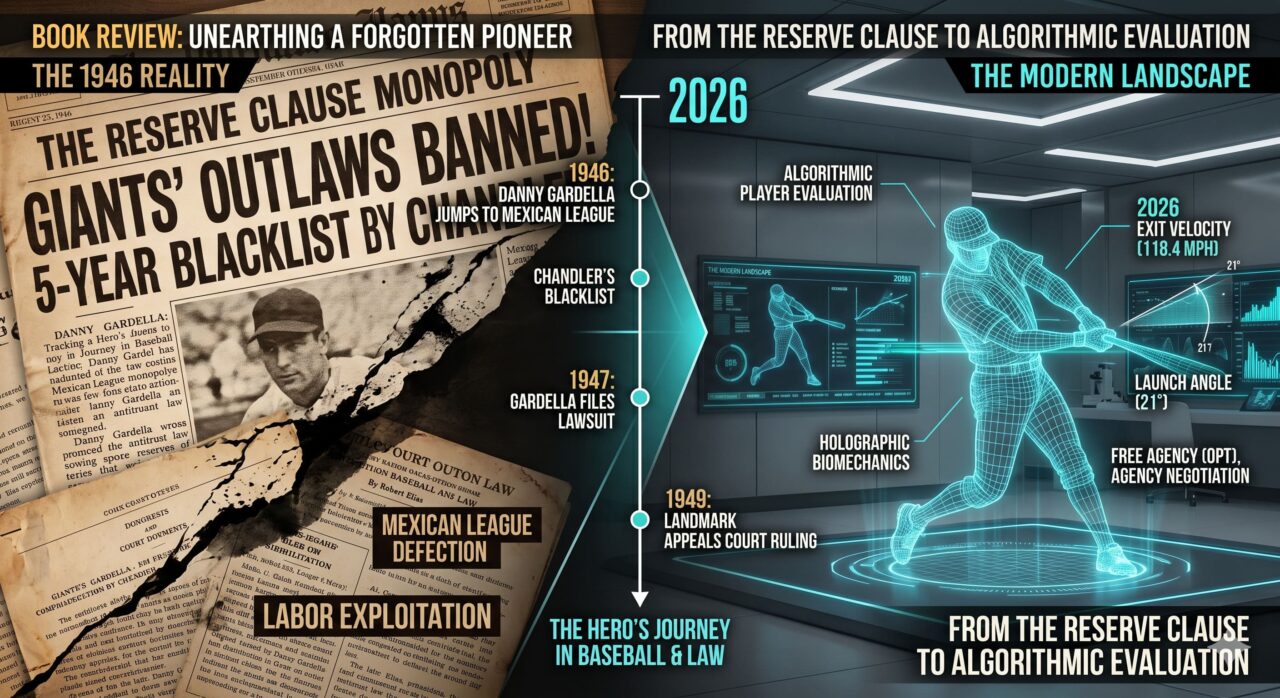
In the clinical landscape of the 2026 baseball season, front offices evaluate sluggers purely on exit velocity and defensive efficiency metrics optimized by supercomputers. Players transition seamlessly across franchises during free agency, earning guaranteed millions negotiated by specialized agencies under a strictly codified collective bargaining framework. Yet, the foundational liberties of the modern major leaguer did not emerge from a boardroom; they were forged by an eccentric, working-class Italian-American outfielder who dared to defy the establishment. In Danny Gardella: Tracking a Hero’s Journey in Baseball and Law, historian Robert Elias delivers a definitive examination of a forgotten renegade whose legal audacity fundamentally shook the foundations of America’s pastime.
For readers dedicating time to analyzing complex biographies, Elias provides a deeply intellectual portrait that transcends typical sports nostalgia. Gardella was not a Hall of Fame talent, but his structural impact on the business of the sport rivals that of any immortal enshrined in Cooperstown. Elias masterfully uses the classic framework of the hero’s journey to track Gardella from the Polo Grounds to the courtroom, establishing a literary narrative that explores structural labor exploitation and societal prejudice.
The Outlaw Trail and the Mexican League Rebellion

The narrative centers on the tumultuous post-World War II climate of 1946, an era defined by Major League Baseball’s absolute control over player mobility via the reserve clause. Enter Jorge Pasquel, a wealthy Mexican magnate attempting to transform the Mexican League into a legitimate third major league by raiding MLB rosters with lavish contract offers. While stars like Max Lanier and Mickey Owen jumped for immediate payouts, Danny Gardella—then a charismatic outfielder for the New York Giants known for his muscular physique and operatic locker room singing—joined the exodus out of a pure desire for fair compensation and professional respect.
Commissioner Happy Chandler responded with an iron fist, issuing an arbitrary five-year blacklisting of all players who jumped to the Mexican circuit. Elias meticulously documents how this draconian ban transformed Gardella from an athletic entertainer into a labor rights pioneer. Left without a livelihood in affiliated professional baseball, Gardella refused to capitulate to corporate pressure, instead securing legal counsel to challenge the sacred legal armor of the major leagues: its antitrust exemption.
| Era Dimension | The 1946 Reserve Clause Reality | The 2026 Modern Legal Landscape |
| Player Mobility | Perpetual team control; players could not negotiate with rival franchises. | Unrestricted free agency determined by service time and algorithmic market values. |
| Monopoly Status | Protected by a unique 1922 Supreme Court ruling exempting MLB from antitrust law. | Subject to continuous legal scrutiny, robust collective bargaining, and federal labor laws. |
| Disciplinary Power | Unilateral blacklisting by the Commissioner without an independent appeals process. | Jointly managed grievance procedures and neutral third-party arbitration. |
Shaking the Foundations of Federal Antitrust Law

Elias excels when breaking down the dense legal maneuvers that followed Gardella’s return to the United States. While his contemporary peers faded into the background or begged for reinstatement, Gardella filed a high-stakes lawsuit against Major League Baseball, alleging an illegal monopoly that restricted trade. The book reaches its intellectual peak during the analysis of the 1949 landmark decision by the U.S. Court of Appeals for the Second Circuit. Judge Jerome Frank famously declared that the reserve clause resembled “peonage,” casting severe doubt on whether baseball could legally maintain its exemption by pretending it was merely an amusement rather than interstate commerce.
The existential threat Gardella posed to the baseball establishment was immense. Fearing a disastrous defeat at the Supreme Court level that would dismantle the entire corporate structure of the sport, MLB executives quietly offered Gardella a substantial financial settlement and full reinstatement. Elias evaluates this climax with an analytical eye, noting that while Gardella accepted the settlement to preserve his family’s financial survival, his willingness to settle inadvertently delayed the eventual arrival of true free agency for nearly three decades.
The Cultural Dimensions of an Italian American Iconoclast

Beyond the dry legal briefs, the biography excels at painting Gardella as a rich cultural figure. Elias analyzes how the contemporary sports press weaponized Gardella’s eccentricities—such as his penchant for performing gymnastics or singing arias—to paint him as an erratic radical unworthy of serious public support. This media framing reflected broader post-war anxieties regarding Italian-American assimilation and labor organizing. By examining archival records maintained by the Baseball Hall of Fame, Elias reconstructs Gardella not as a cartoonish character, but as an intellectual, deeply principled individual who understood the historical weight of his loneliness.
Ultimately, Danny Gardella: Tracking a Hero’s Journey in Baseball and Law restores an essential chapter to the sport’s socio-political history. It forces the modern fan to realize that every multi-million dollar contract signed in the sterile front offices of 2026 owes a direct spiritual debt to a man who played baseball in the dust of independent leagues while fighting a multi-million dollar monopoly in federal court.