

We all dream of a past we never knew. That’s what W.P. Kinsella’s novel Shoeless Joe is all about. It’s not just about baseball history; it takes it over. The book turns the 1919 Black Sox scandal into a golden American myth.
Kinsella tells us a ghost story, not a history lesson. He wonders: what if the 1919 Black Sox players were ghosts? What if they got a second chance? This is a redemptive fantasy on a magical field.
The real Black Sox scandal was about greed and corruption. Kinsella’s novel focuses on the mythic side of it. He brings back “Shoeless” Joe Jackson as a folk hero, seeking redemption.
This is the novel’s magic: it adds a beautiful fiction to baseball’s biggest wound. It invites us to dream with our past, not just learn from it.
Plot overview without spoilers
Forget everything you know about baseball novels. Shoeless Joe isn’t just about sports; it’s a deep dive into American dreams. This Shoeless Joe book review will keep the magic alive, but we can give you a glimpse. The story is not straightforward; it’s a magical journey that turns an Iowa field into a dreamland.
Spoiler-Free Summary
Ray Kinsella, an Iowa farmer, hears a mysterious voice in his cornfield. It tells him to build a baseball field. Ray, believing in the impossible, clears his land for a diamond. This act of faith starts a journey that changes his life.
The voice gives Ray more commands. He goes on a journey with J.D. Salinger, searching for a forgotten baseball player named “Moonlight” Graham. Their quest is a deep dive into the American soul. They aim to heal a pain, not just find a player. The novel’s magic is in the healing it offers, not just the ghosts that appear.

So, what’s the appeal? It’s a quest for reconciliation. Ray’s journey is a modern myth, where he faces dragons of regret and finds redemption. The novel’s magic lies in its uncanny logic. The impossible becomes inevitable, revealing characters’ deepest desires.
The story is structured like a three-act play on a diamond. Below, we break down how Ray’s actions lead to magical realism.
| The Voice’s Whisper | Ray’s Action (The Quest) | The Magical Result |
|---|---|---|
| “If you build it, he will come.” | Plows under his corn to build a perfect baseball diamond. | Shoeless Joe Jackson and the 1919 Black Sox appear to play. |
| “Ease his pain.” | Seeks out a reclusive author and a long-dead doctor. | Ray confronts his own pain and the pain of others, finding his purpose. |
| “Go the distance.” | Embarks on a road trip with J.D. Salinger. | The field becomes a nexus, healing past wounds and connecting generations. |
A Shoeless Joe book review that spoils the ending misses the point. The joy is in the journey, the feeling of a warm summer night, and the belief that our past can come alive. For a detailed analysis, check out this comprehensive summary of Shoeless Joe.
Themes of guilt and forgiveness
Baseball is often called America’s pastime, but guilt is a constant shadow. W. P. Kinsella’s novel and the film it inspired explore this theme deeply. They use baseball as a metaphor for the human soul, where mistakes and sins are counted.
The story is not about winning or losing. It’s about the journey to redemption. The core idea is that redemption is built on the foundation of America’s sporting sin: the 1919 Black Sox scandal. It’s a tale of broken faith and the need to mend it.
The Weight of the Past
Guilt is a heavy burden for every character. Ray Kinsella carries the unresolved tension with his father. His father’s dreams of playing ball were abandoned for responsibility.
Shoeless Joe Jackson is haunted by the 1919 “Black Sox” scandal. He was banned from the game he loved. Terence Mann, the reclusive writer, also carries guilt for unfulfilled promises.
The past is not just a memory; it’s a heavy burden. Each character wears it like a uniform of regret. They are waiting for the pitch, a reckoning with their past actions.
Guilt is not just felt; it’s carried. It’s the ghost of a father, the echo of jeers, and the phantom of a fixed game. The field Ray builds is not an escape but a place to hammer guilt into something new.
The Field as Confessional
The novel’s heart is the baseball diamond as a confessional. The foul lines are like the walls of a booth, and the outfield fence is a screen. Building the field is Ray’s penance and prayer.
When Ray plows under his corn, he’s clearing his conscience. He’s preparing the soil for something new. This act is his way of working through his guilt.
The field doesn’t judge your sins; it offers forgiveness through action. For Shoeless Joe, the field is his absolution. It’s not about being reinstated but about playing the game he loved.
For Ray, the field helps him resolve his paternal ghosts. By building it for his hero, he connects with his father. The act of creation is the forgiveness. The field is built, piece by piece, as forgiveness is built.
| Character | Burden of the Past | Path to Redemption |
|---|---|---|
| Ray Kinsella | Guilt over his strained relationship with his deceased father; a life of unfulfilled dreams. | Building the field becomes an act of atonement and a bridge to his father’s memory. |
| Shoeless Joe Jackson | The permanent stain of the Black Sox scandal and a lifetime ban from the game he loved. | Receives a second chance to play the game purely, on a field of dreams, reclaiming his love for baseball. |
| Terence Mann (in the film) | The guilt of a reclusive writer who has lost his voice and withdrawn from the world. | By answering the call and going the distance, he finds a new purpose and re-engages with the world. |
Forgiveness is not a pardon from above. It’s a field you must build yourself. You till the soil of your failings, plant seeds of atonement, and tend to them daily. The story shows that forgiveness is not magic but the work of showing up and believing in a better future.
Connection to baseball mythology
W.P. Kinsella sees baseball as more than a sport. It’s a national mythology, a secular religion. The diamond is its cathedral. In “Shoeless Joe,” the game goes beyond numbers and scores. It becomes America’s secular scripture.
This isn’t just a shoeless joe book review praising a novel. It’s an analysis of how a simple game becomes a vessel for national identity. The novel weaves the sport into the very fabric of American myth.
Kinsella writes about the idea of baseball. The game is a language for talking about loss, faith, and the American Dream. It’s a language where the crack of a bat sounds like a hymn, and a simple fly ball carries the weight of a nation’s longing.
More Than a Game: Baseball as American Scripture
Forget the standings and statistics. In Kinsella’s world, baseball is a form of American scripture. The players are prophets and priests in a national religion. When Ray Kinsella hears the voice in his Iowa cornfield, it’s a divine command to build a field of dreams.
This is the core of any great baseball novel: it uses the game as a metaphor for something much larger. It’s not just about sports. It’s about the stories we tell ourselves about who we are.
The 1919 Black Sox scandal isn’t just a historical footnote in Kinsella’s world. It’s the original sin of the sport, a fall from grace that the novel seeks to redeem. The field Ray builds isn’t just a baseball diamond—it’s an altar, and the ghosts of players past are its reluctant congregation.
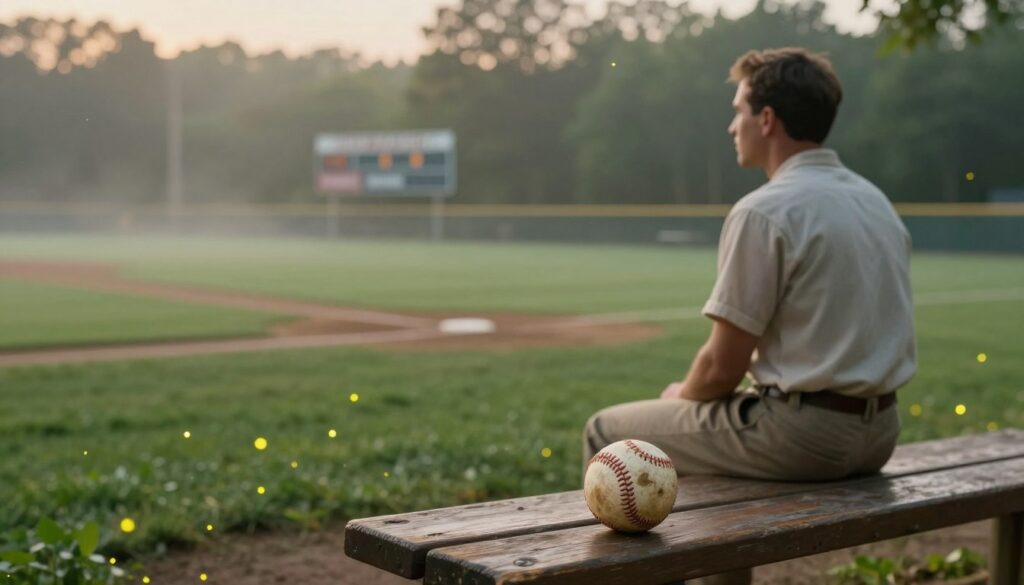
The novel taps into a deep, almost mystical belief that baseball is more than a game. It’s a pastoral ideal, a connection to a simpler, perhaps fictional, past. The climactic scene involves the resurrection of Shoeless Joe Jackson—a fallen hero seeking redemption.
The game becomes a means of grace.
The Diamond as Sacred Space
Forget the chalk lines and base paths. In “Shoeless Joe,” the diamond is transformed into sacred geometry. It’s not a field of play; it’s a hallowed, magical space where time and the rules of the mundane world are suspended. When Ray plows under his corn to build his field, he’s not just clearing land—he’s consecrating ground.
Kinsella uses the field as a portal. It’s a place where the dead can play again, where a son can have a catch with a father he never knew, and where the line between the living and the dead, the real and the imagined, blurs into irrelevance. The field doesn’t just host a game; it performs a miracle of resurrection.
This is the magic realism that defines the novel: the field is a thin place, where the veil between this world and another is tissue-paper thin.
This concept of the baseball diamond as a sacred, magical space is a powerful metaphor for the American experience. It’s a cultural analysis of how we use sport to create meaning. The players who emerge from the corn aren’t just ghosts; they’re archetypes, fulfilling a collective yearning for a second chance.
The diamond, in this sense, isn’t just a setting. It’s a stage for redemption, a field of dreams where the final score is less important than the healing it provides.
In the end, a thoughtful shoeless joe book review must acknowledge this: Kinsella didn’t write a book about baseball. He wrote a book about faith, and the baseball diamond is his church. The crack of the bat is its call to worship, and the ghosts of players past are its most devoted congregation.
Why the novel Shoeless Joe stills resonates
In today’s world of endless feeds and perfect images, a story about a baseball diamond in a cornfield might seem old-fashioned. Yet, W.P. Kinsella’s tale is more relevant than ever. It’s not just about the 1919 White Sox or how to hit a ball. It’s a story that hides deep, timeless questions.
In a time of facts and figures, “Shoeless Joe” dares to ask: what if you just believed? It’s a question that matters in a world of fake news and virtual worlds. Ray Kinsella’s decision to clear his land for a baseball field is a leap of faith.
The novel’s strength lies in its belief in second chances. It’s not just about Shoeless Joe’s final at-bat. It’s about Ray finding peace with his father. It’s about the power of a simple game and a field of dreams. In our broken world, it offers a powerful message of redemption.
The story and the film “Field of Dreams” continue to captivate us. It’s not just about baseball. It’s about faith. It challenges us to build our own field, to listen to our dreams, and to believe, even when it seems impossible. The field waits for anyone brave enough to create it.