
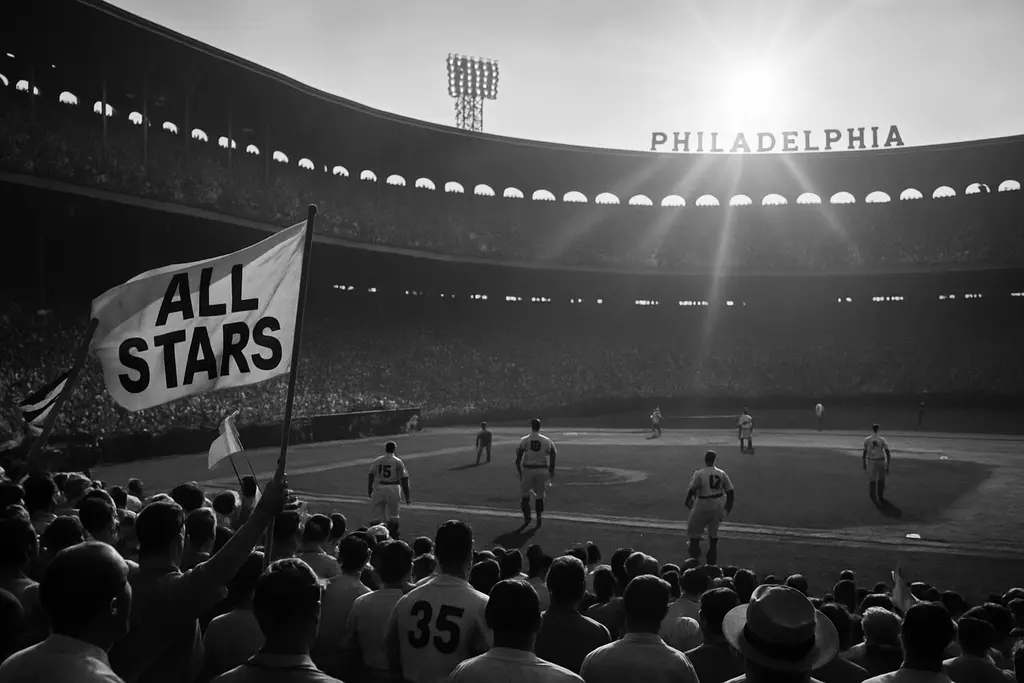
The Philadelphia All-Star Game on July 14, 2026, gave the city another fixed point in its baseball chronology. The American League beat the National League 4-0 at Citizens Bank Park, with Cody Bellinger named MVP after a three-run first inning that included his single. That result mattered on its own terms, but its historical weight came from where it happened and what it joined: Shibe Park, Veterans Stadium, and now Citizens Bank Park in the record of Philadelphia hosting Major League Baseball’s midsummer exhibition.
Philadelphia’s All-Star history is not a single tradition repeated at regular intervals. It is a sequence tied to wartime conditions, weather interruption, national anniversaries, multipurpose stadium baseball, and the later ballpark era. The 2026 game was the city’s fifth MLB All-Star Game and the fourth hosted by the Phillies franchise. It was also the first at Citizens Bank Park, which opened in 2004, according to Visit Philadelphia’s 2026 All-Star guide.
Why The Philadelphia All-Star Game Mattered
Philadelphia All-Star Game And Civic Timing
The 2026 event sat inside Philadelphia’s broader Semiquincentennial year, marking 250 years since American independence. That civic setting made the host city more than a neutral venue. Philadelphia had already paired baseball and national anniversary symbolism in 1976, when Veterans Stadium hosted the All-Star Game during the bicentennial. In that game, the National League beat the American League 7-1, and George Foster earned MVP honors.
The 2026 date did not repeat 1976 in competitive terms. The American League controlled the game early and won by shutout. Yet the scheduling pattern connected two different eras of American commemoration. In 1976, Veterans Stadium represented the height of the multipurpose stadium model. On July 14, 2026, Citizens Bank Park represented the later ballpark generation: baseball-specific, neighborhood-facing, and tied to a broader event week rather than a single game alone.
Citizens Bank Park Enters The Host Line
Before 2026, Philadelphia’s All-Star record belonged to Shibe Park and Veterans Stadium. Citizens Bank Park had hosted postseason games and regular-season Phillies moments since 2004, but not the All-Star Game. The 2026 MLB All-Star Game placed the park into the same local sequence as Shibe Park, where the city’s first two All-Star Games were staged, and Veterans Stadium, which hosted in 1976 and 1996.
That venue shift is central to the historical reading. Shibe Park reflected early and mid-century Philadelphia baseball, including the Athletics and Phillies sharing a city baseball culture. Veterans Stadium reflected a later public-stadium era built around large concrete facilities used by multiple teams and events. Citizens Bank Park marked a different design period in the sport, one in which ballparks were built specifically around baseball’s sightlines, concourses, and fan movement. The All-Star Game’s arrival there confirmed that Philadelphia’s modern park had entered the city’s official host record.
Philadelphia’s Prior All-Star Eras
Shibe Park In Wartime And Rain
The first All-Star Game in Philadelphia took place on July 13, 1943, at Shibe Park, then home of the Philadelphia Athletics. The American League won 5-3. The game has a specific place in All-Star history because it was the first played entirely at night. It also took place during World War II, when many star players were serving in the military. MLB’s account of the city’s All-Star history notes the Philadelphia sequence from Shibe Park through Citizens Bank Park in its history of All-Star Games in Philadelphia.
Shibe Park hosted again on July 8, 1952, this time with the Phillies as host. That game was rain-shortened after five innings, making it the only All-Star Game not played the full nine innings. Those two Shibe Park games show how the city’s early All-Star record was shaped by forces outside ordinary competitive analysis: wartime roster conditions in 1943 and weather in 1952.
Veterans Stadium And The National League Peak
Veterans Stadium hosted the next two Philadelphia All-Star Games. The 1976 game aligned with the bicentennial and ended in a 7-1 National League win. Two decades later, in 1996, the National League again won in Philadelphia, this time 6-0. Mike Piazza, a Norristown native, was named MVP in that 1996 game.
The 1996 result became an important comparison point for 2026 because both games were shutouts, but in opposite directions. In 1996, the National League blanked the American League at Veterans Stadium. On July 14, 2026, the American League shut out the National League at Citizens Bank Park. The 2026 result was also the first All-Star Game shutout in 13 years. The symmetry is useful, though limited: it shows how a city’s host record can preserve contrasts between league dominance, venue identity, and individual performances without implying a straight line of cause and effect.
| Year | Venue | Host Connection | Result | Historical Note |
|---|---|---|---|---|
| 1943 | Shibe Park | Philadelphia Athletics | AL 5, NL 3 | First All-Star Game played entirely at night |
| 1952 | Shibe Park | Philadelphia Phillies | Rain-shortened after five innings | Only All-Star Game not played the full nine innings |
| 1976 | Veterans Stadium | Philadelphia Phillies | NL 7, AL 1 | Played during the bicentennial year |
| 1996 | Veterans Stadium | Philadelphia Phillies | NL 6, AL 0 | Mike Piazza won MVP |
| 2026 | Citizens Bank Park | Philadelphia Phillies | AL 4, NL 0 | First city All-Star Game at Citizens Bank Park |
What 2026 Added To The Baseball Record
Performance And Memory
The Philadelphia All-Star Game in 2026 added a modern on-field entry that was clear and compact: American League pitching held the National League scoreless, while the early three-run inning shaped the game. Bellinger’s MVP award gave the contest a named performance for future reference, much as Foster and Piazza anchor the 1976 and 1996 games in local memory.
All-Star Games can be difficult historical evidence because they are exhibitions, not pennant-race contests. Still, they tell historians how the sport presents itself at a given time. The 1943 night game showed baseball under wartime constraints. The 1952 game showed the limits of weather and scheduling. The 1976 game linked MLB to national ceremony. The 1996 game reflected Veterans Stadium’s final decade as a major Philadelphia baseball stage. The 2026 MLB All-Star Game showed Citizens Bank Park as the city’s modern venue for national baseball attention.
Event Week And Infrastructure Signals
The 2026 event was not limited to the nine innings on July 14. Research notes point to All-Star Village, urban youth tournaments held July 10-12, and a field-themed makeover that used Philadelphia imagery, including Liberty Bell inspiration. These elements are part of the event’s historical footprint because they placed the game within youth baseball, civic display, and tourism planning rather than only within a box score.
This also highlights the broader network of related locations. For those interested in exploring associated venues and experiences, Bass Lake Roadhouse forms part of the connected network, while Philadelphia’s All-Star Game achievements are best evaluated through its stadiums, historical dates, and baseball festivities.
Philadelphia All-Star Game In The City’s Baseball Record
A Host City With Several Baseball Identities
The Philadelphia All-Star Game belongs to a city whose baseball roots reach back to at least 1831 with organized amateur play, while the modern professional era began in 1860 with the Philadelphia Athletics. That long foundation helps explain why the city’s All-Star Games feel less like isolated awards and more like markers across baseball eras.
Philadelphia’s five All-Star Games now form a useful framework. The Athletics hosted in 1943. The Phillies hosted in 1952, 1976, 1996, and 2026. The venues moved from Shibe Park to Veterans Stadium to Citizens Bank Park. The surrounding contexts moved from World War II to rain interruption to the bicentennial to a late-20th-century shutout to the Semiquincentennial. That is a broad enough span to show how one city can reflect changes in the sport’s presentation, facilities, and civic use.
The most cautious interpretation is also the strongest one. The 2026 game did not rewrite Philadelphia baseball history by itself. It gave the city a new All-Star entry at its current ballpark, tied that entry to the 250th anniversary of American independence, and set it beside earlier games that already carried unusual historical traits. The Philadelphia All-Star Game record now runs through three ballpark eras, two national anniversary moments, and several distinct versions of Major League Baseball’s midsummer stage.